Scientists Track 400M Birds Using Storm Radar
Researchers are using weather radar to track hundreds of millions of migrating birds in real time, creating forecasts that help birdwatchers know when to look up. The same technology that predicts tomorrow's rain is revealing one of nature's most spectacular hidden journeys.
Right now, hundreds of millions of birds are crossing North America in the dark, and scientists are watching every wing beat using the same radar that tracks your local thunderstorms.
Ecologists at Purdue University have figured out how to transform weather radar into bird tracking systems. During peak migration season, they can monitor up to 400 million birds moving through the night sky at once.
"We just do the inverse of what meteorologists do," says Kyle Horton, a Purdue ecologist with BirdCast, a collaboration that tracks bird migration. "They remove the birds to maintain the rain. We remove the rain to maintain the birds."
The process sounds simple, but it requires clever detective work. When radar beams bounce off the atmosphere, they capture everything: raindrops, birds, bats, insects, even smoke and debris. The challenge is separating feathers from water droplets.
Fortunately, birds and storms have different signatures. Most birds migrate north to south, while storms generally roll west to east. Rain appears dense and uniform on radar screens, but birds create irregular patterns as they flap and shift in different sizes and orientations.
Bats posed a trickier problem until researchers noticed their distinctive doughnut shape on radar. When bats emerge from caves, they spread out in a ring pattern searching for food. Birds taking off scatter from multiple locations instead of one fixed point.
Insects were the easiest to filter out. They simply drift with the wind, while birds can fly faster than wind speed. "Entomologists wouldn't like this, but we call insects 'the detritus of the atmosphere,'" Horton says.
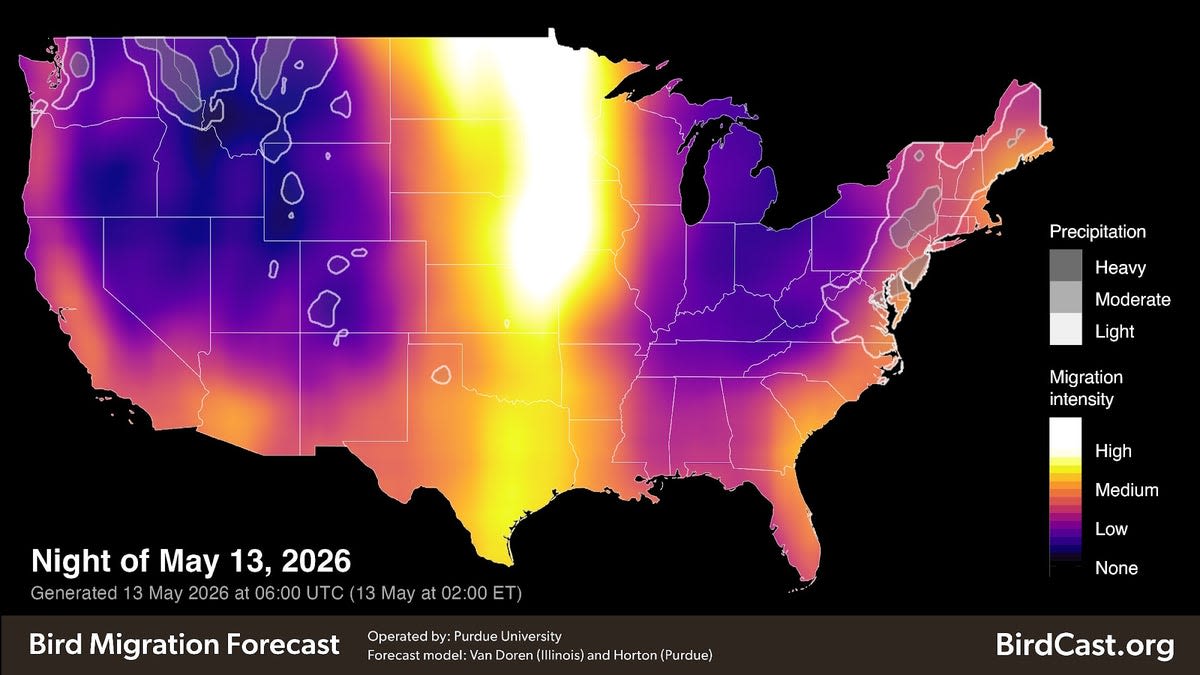
The processed data now powers bird migration forecasts that birding enthusiasts check like weather reports. The maps show how many birds are moving overhead and predict arrivals for the next few days. One thing the forecasts can't reveal is which species are flying or where they'll land during daylight hours.
Why This Inspires
This technology transforms invisible journeys into visible celebrations of nature. Millions of birds have been making these epic nighttime flights for millennia, completely unseen by human eyes. Now anyone with internet access can witness this ancient phenomenon in real time.
The forecasts also support conservation efforts by showing when to turn off unnecessary lights during migration season, helping birds navigate safely. What started as storm tracking has become a window into one of Earth's grandest natural events.
Horton acknowledges the science isn't perfect, and that mystery keeps birdwatching exciting. Some forecast days might signal new arrivals or mass departures of yesterday's visitors. The radar shows the movement but not the full story, inviting people outside to discover the rest for themselves.
More Images



Based on reporting by Scientific American
This story was written by BrightWire based on verified news reports.
Spread the positivity!
Share this good news with someone who needs it