
Scientists Use Light to Slow Down Motion at Nano Scale
In a discovery that flips physics on its head, researchers found that light can act as a brake instead of an accelerator. The breakthrough could one day help steer tiny nanorobots through the human body.
Light usually speeds things up, heating particles and setting them in motion. But scientists in Germany just caught it doing the exact opposite, acting like an invisible brake at scales smaller than you can imagine.
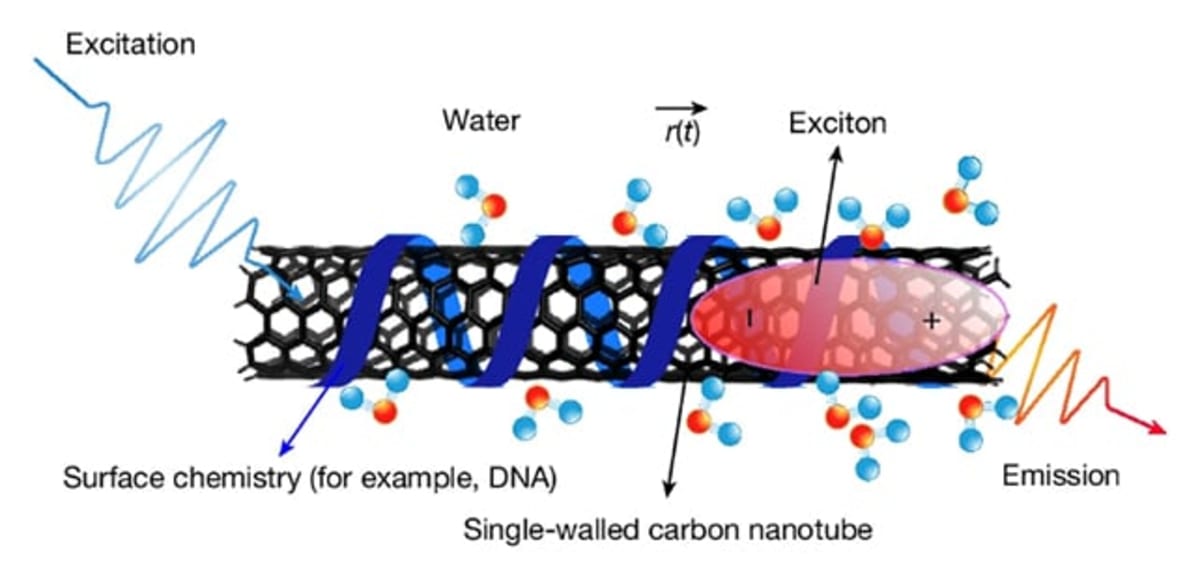
Researchers at Ruhr-University Bochum discovered that carbon nanotube particles move slower when exposed to light in water. The brighter the light, the slower they moved, defying everything we thought we knew about how light behaves.
These nanotubes are incredibly tiny, about 100,000 times thinner than a human hair. When scientists shined light on them in water, the particles acted like they were swimming through honey instead of water.
The secret lies in something called quantum friction, a recently discovered phenomenon that happens at the electron level. When light hits the nanotubes, it creates paired energetic particles called excitons inside them. These excitons interact with surrounding water molecules, transferring momentum and creating resistance that slows everything down.
Physical chemist Sebastian Kruss explains that this discovery fundamentally changes our understanding of how materials interact at tiny scales. Using specialized terahertz spectroscopy to detect molecular activity, his team measured actual momentum transfer between the glowing nanotubes and water molecules.
What makes this even more fascinating is that standard friction requires physical contact between surfaces. Quantum friction operates purely through fluctuating electrical charges, no bumping or grinding needed.
Why This Inspires
This breakthrough opens doors that scientists didn't even know existed. Being able to control friction with light could revolutionize nanotechnology in ways that sound like science fiction.
Imagine guiding microscopic robots through your bloodstream to deliver medicine exactly where it's needed. Or precisely controlling chemical reactions by adjusting light intensity. These applications could transform medicine and materials science.
The research also reveals something beautiful about our universe: at the smallest scales, the boundaries between solid and liquid physics blur into quantum weirdness. Light becomes a steering wheel instead of just energy.
Physical chemist Martina Havenith calls it a door opening in materials science and nanotechnology. Scientists can now control friction at the interface between solids and liquids using electronic excitation, a tool they never had before.
The future of nanotechnology just got a whole lot brighter, even if things are moving a little slower.
More Images


Based on reporting by Google News - Scientists Discover
This story was written by BrightWire based on verified news reports.
Spread the positivity!
Share this good news with someone who needs it