Scientists witness 'first contact' forming complex life
In Australia's ancient Shark Bay, researchers captured the first-ever image of microbes interacting the way our ancestors did billions of years ago. This discovery offers crucial evidence for how simple cells evolved into all complex life on Earth.
Scientists just witnessed something that may explain how we all got here.
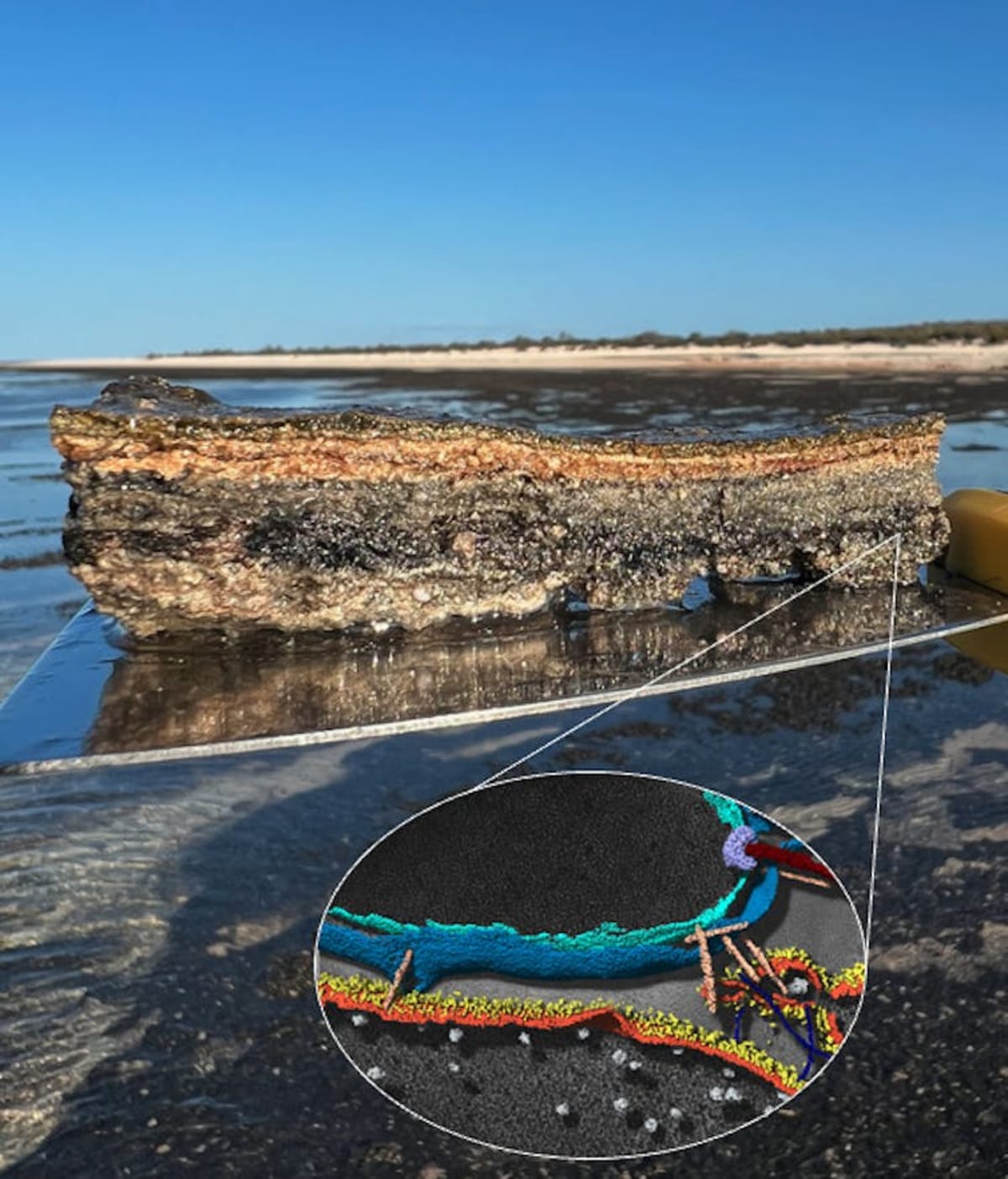
In the ancient microbial mats of Shark Bay, Australia, researchers discovered two microbes caught in the act of cooperating. Tiny nanotubes connected an Asgard archaeon to a bacterium, mirroring what likely happened billions of years ago when simple cells first merged to create complex life.
This marks the first time anyone has observed this interaction. Only four research teams worldwide have successfully grown these elusive Asgard archaea in cultures, and this team spent years nurturing them to make the discovery.
The finding matters because every plant, animal, and human exists thanks to an ancient partnership. Scientists believe that long ago, an Asgard archaeon and a bacterium formed a relationship, sharing resources and physically connecting until they became the first complex cells called eukaryotes.
Using artificial intelligence and electron cryotomography (high-resolution imaging at the nanoscale), the team decoded the microbes' DNA and watched them cooperate in real time. The structures connecting them looked remarkably similar to what researchers theorized must have existed in Earth's distant past.
The discovery happened in Gathaagudu, the Malgana people's name for Shark Bay, where Aboriginal communities lived over 30,000 years ago. Working with language expert Kymberley Oakley and Aboriginal elders, the researchers named their newly discovered microbe Nerearchaeum marumarumayae, meaning "ancient home" in the Malgana language.
The Bright Side: This breakthrough connects cutting-edge science with Indigenous knowledge in a meaningful way. The microbial mats and stromatolites in Shark Bay are living relics from billions of years ago, producing the first oxygen bubbles that filled Earth's atmosphere and made our existence possible.
These seemingly ordinary rocks and slime contain secrets about our origins that we're only beginning to understand. Walking through Shark Bay's waters truly feels like stepping back through time.
The discovery also highlights the urgent need to protect Gathaagudu. Climate change, increased heatwaves, cyclonic events, and human activity threaten this World Heritage Site and its invaluable Aboriginal connections.
By peering into microscopic partnerships in ancient mud, scientists found a mirror reflecting our shared beginning on this fragile branch of life's evolutionary tree.
More Images

Based on reporting by Google News - Science
This story was written by BrightWire based on verified news reports.
Spread the positivity!
Share this good news with someone who needs it