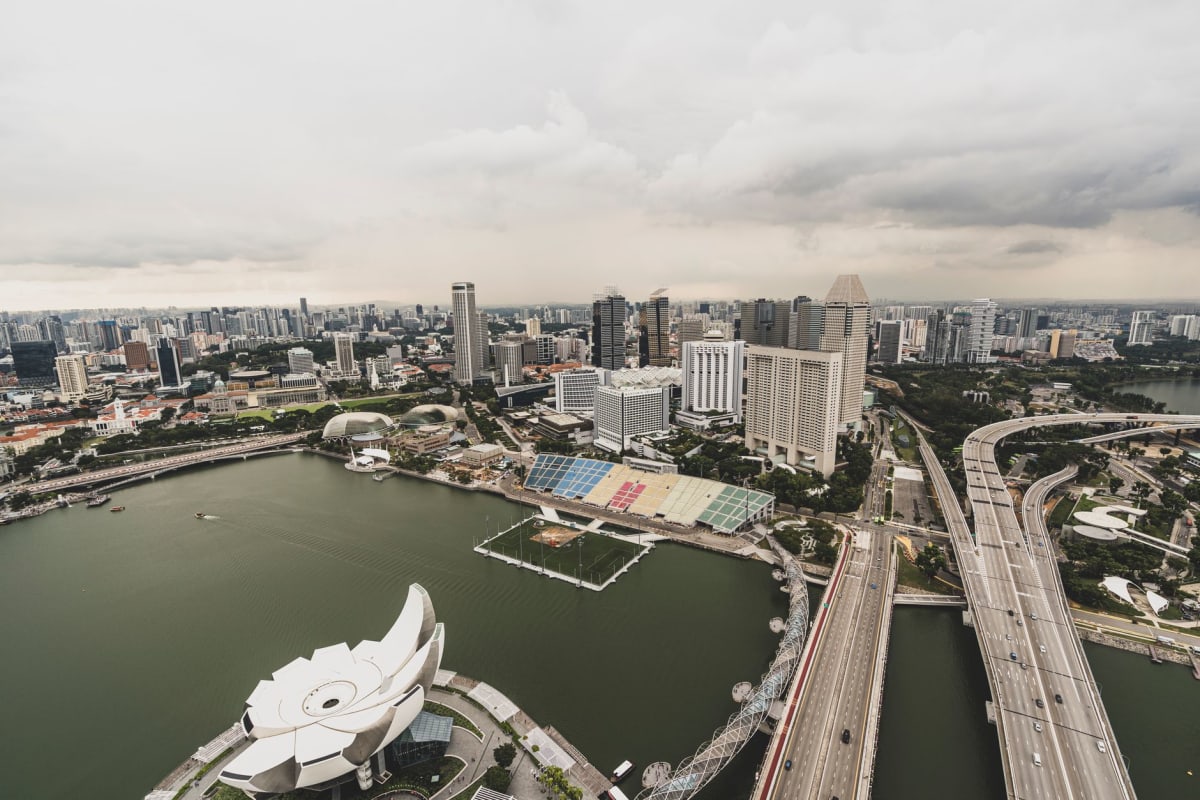
Singapore Tops Global AI Adoption Over San Francisco
A tiny island nation smaller than half of Greater London just beat Silicon Valley at turning artificial intelligence into real-world solutions. Singapore ranked first in a 2025 global AI cities index by excelling at something more important than flashy tech demos.
Singapore proved that building the most powerful AI isn't everything. The city-state just claimed the top spot in Counterpoint Research's 2025 Global AI Cities Index, finishing ahead of Seoul, Beijing, Dubai, and surprisingly, San Francisco.
The ranking wasn't measuring which city creates the smartest chatbots or attracts the most venture capital. Counterpoint studied how well 100 major cities actually deploy AI across hospitals, transportation systems, telecommunications, and government services. Singapore won by turning artificial intelligence into infrastructure that people use every day.
San Francisco remains the heart of the generative AI boom, surrounded by frontier-model companies and research talent. But Singapore's advantage lies in something unexpected: its size. The entire country covers just 744 square kilometers, less than half the area of Greater London.
That compactness creates unusually short distances between decision makers. The national government essentially runs the city, meaning regulators, universities, infrastructure agencies, and corporate leaders operate within one tightly connected system. A pilot program can be tested across a large share of the domestic market without crossing state lines or continental borders.
Singapore hosts 80 of the world's top 100 technology firms, creating an incredibly dense network of partners. When a hospital needs secure cloud infrastructure or a manufacturer needs AI engineers, the right connections exist within the same professional community. Problems get solved through coordination rather than luck.
The country paired ambition with execution machinery. Its AI Singapore initiative runs a program called 100 Experiments, bringing companies with real problems together with AI engineers and apprentices. Teams spend months building working prototypes with co-funding that reduces risk. The method has been refined through more than 300 projects.
Counterpoint's researchers analyzed over 5,000 public and private sector AI initiatives. They considered communications infrastructure, data centers, supercomputing projects, university research, startup strength, and technology vendors active in each city. Singapore excelled across all categories not by dominating any single measure, but by performing consistently well everywhere.
The Ripple Effect
Singapore's approach offers a template for how regions can compete in AI without hosting the companies that make headlines. Success comes from building ecosystems where ideas move quickly from research labs to working applications. It means creating pathways for hospitals, factories, and government agencies to adopt AI safely and effectively.
The ranking challenges the assumption that bigger always wins in technology. Singapore's tightly integrated system allowed it to outpace sprawling metropolitan regions with far more land, people, and capital. Coordination beats scale when the goal is turning innovation into daily infrastructure.
Other cities are watching. If a nation smaller than Greater London can lead in AI adoption, the playbook matters more than the population size or physical footprint.
Small size and smart strategy just proved they can beat Silicon Valley at getting AI into the real world where it actually helps people.
More Images




Based on reporting by Google News - Singapore Technology
This story was written by BrightWire based on verified news reports.
Spread the positivity!
Share this good news with someone who needs it