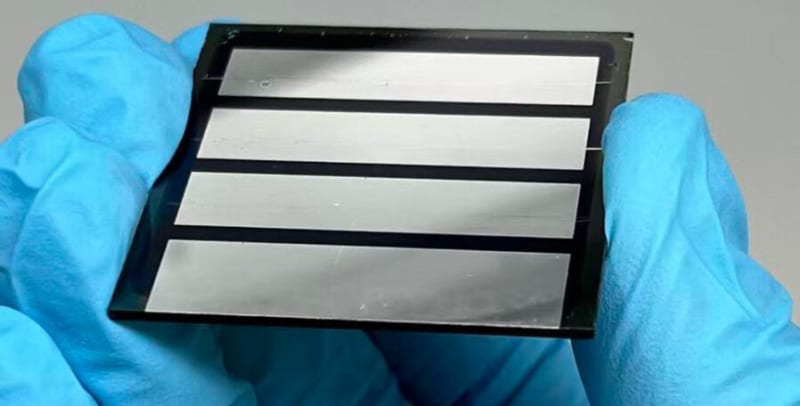
Solar Cells Hit 25.4% Efficiency and Pass Durability Test
Scientists just cracked a major barrier in solar technology, creating panels that are both highly efficient and stable enough to last decades. The breakthrough could finally make perovskite solar cells ready for rooftops worldwide.
Solar power just got a serious upgrade that could change how we capture the sun's energy.
An international team of researchers achieved a certified 25.4% efficiency rate in large-area perovskite solar cells while solving one of the technology's biggest problems: stability. The cells maintained over 95% of their power after running continuously for 1,100 hours at 185 degrees Fahrenheit, meeting the standards needed for real-world use.
The secret lies in how the team rebuilt the solar cell's structure at the molecular level. Instead of using conventional materials that break down quickly, they developed special multivalent ligands that create stronger, more uniform layers within the cell.
"We demonstrated that choosing proper molecular ligand chemistry to form more robust layers is critical for overcoming the fundamental instability issues," said Randi Azmi, one of the lead researchers. The team used accessible solution processes like spin-coating and dip-coating that any manufacturer could replicate.
Perovskite solar cells have tantalized scientists for years because they're cheaper and easier to make than traditional silicon panels. But they've had a fatal flaw: they degraded too quickly to be practical. Some lost efficiency within weeks.
This breakthrough addresses that weakness head-on. The researchers proved their technology works at scale too, with a mini module measuring about 6 inches by 6 inches achieving 24.2% efficiency.
The research brought together scientists from eight institutions across five countries, including the University of Manchester, Chinese University of Hong Kong Shenzhen, and King Abdullah University of Science and Technology. The National Institute of Metrology of China certified the efficiency results.
The Ripple Effect
This advancement touches more than just solar panels. The same principles could improve other perovskite-based technologies, from LED lights to sensors and display screens. The team's focus on controllable, uniform growth of stable structures opens doors across multiple industries.
More immediately, it brings commercial perovskite solar panels closer to reality. Current silicon panels typically achieve 20-22% efficiency, meaning these new cells could generate more power from the same rooftop space while potentially costing less to produce.
"The amidinium ligands we've developed could overcome one of the last major hurdles facing perovskite solar cell technology and ensure it lasts long enough for large-scale deployment," said co-author Thomas Anthopoulos.
The team's work was published in the journal Science, and they're already exploring even more advanced molecular designs. With each improvement, solar power becomes more efficient, more affordable, and more accessible to communities worldwide.
The sun shines on all of us equally, and now we're getting better at capturing its gift.
More Images
Based on reporting by PV Magazine
This story was written by BrightWire based on verified news reports.
Spread the positivity!
Share this good news with someone who needs it