SpaceX Starship: World's Most Powerful Rocket Built to Refly Daily
SpaceX's Starship generates twice the thrust of the Saturn V moon rocket, but its real breakthrough isn't power. It's designed to land, get caught by giant mechanical arms, and launch again the next day.
The world's most powerful rocket just proved that bigger isn't always the point.
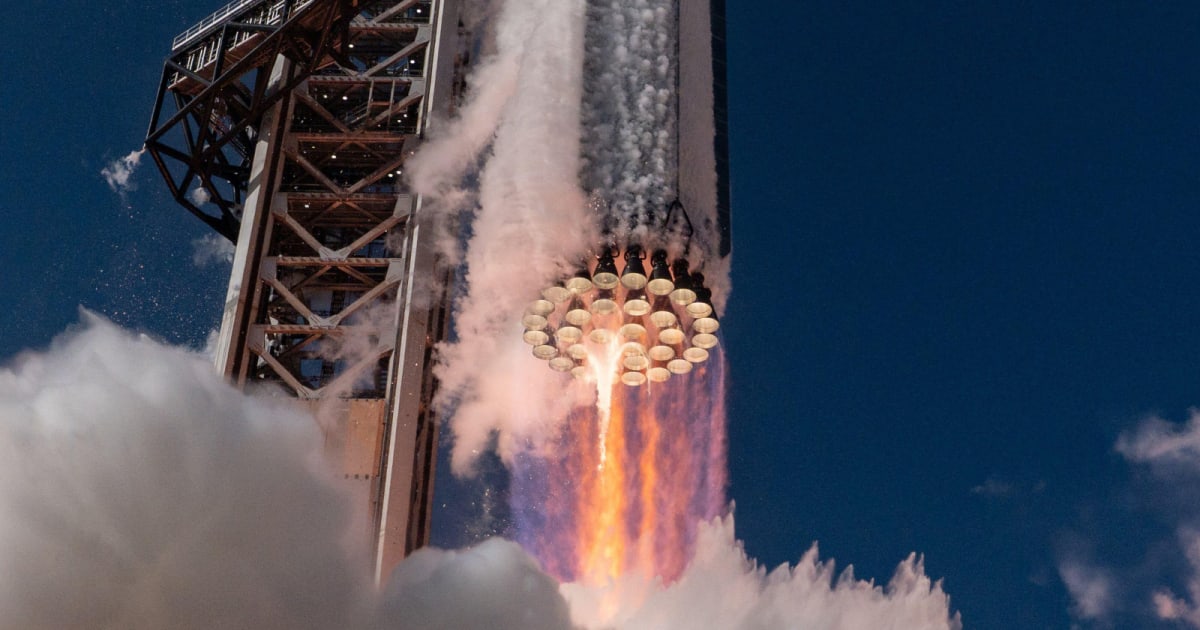
SpaceX's Starship generates 74.4 million newtons of thrust at liftoff, roughly double what the legendary Saturn V produced during the Apollo moon missions. Standing 121 meters tall and weighing over 5,000 tonnes when fully fueled, it's an absolute beast of engineering.
But here's what makes it truly revolutionary: unlike every Saturn V that fell into the ocean after one flight, Starship is built to fly again and again, potentially with just hours between launches.
The rocket's Super Heavy booster burns through 20 tonnes of propellant every second during its 166-second climb. That's powered by 33 Raptor engines gulping liquid methane and oxygen. After pushing the spacecraft toward orbit, the booster doesn't crash into the sea.
Instead, it comes home to be caught mid-air by two enormous mechanical arms everyone calls "the chopsticks."
This might sound ridiculous, but it's brilliant. Landing legs add weight that cuts into payload capacity. A booster caught by its launch tower doesn't need to carry heavy landing gear on every flight. Every kilogram saved is a kilogram more cargo to space.
SpaceX's earlier Falcon 9 rocket pioneered booster reuse starting in 2015, with some first stages flying 20 times. Starship takes this further by making both stages reusable. Both the booster and the spacecraft return to Earth intact.
The entire Apollo program flew 13 Saturn V rockets between 1967 and 1973, then threw away billions of dollars of hardware after each mission. For decades, that's just how spaceflight worked. You built it, flew it once, and watched it burn up or sink.
Reusability changes everything about what's economically possible in space. When launch costs drop from hundreds of millions per flight to potentially just fuel and inspection costs, entirely new missions become feasible.
The Ripple Effect
This isn't just about bragging rights for the biggest rocket. Rapid reusability could transform how we approach space exploration entirely.
Cheaper, more frequent launches mean more satellites for global internet coverage in remote areas. They enable more frequent resupply missions to space stations. They make ambitious projects like moon bases or Mars missions financially realistic instead of budget-breaking fantasies.
The chopstick catch itself represents a bet on precision over brute force. The booster screams back from space at hypersonic speeds, slows itself with engine burns, and slots into those mechanical arms with pinpoint accuracy.
It's the kind of engineering that seemed impossible until someone actually did it.
Saturn V was magnificent for its era, but it was also the end of every journey. Starship is designed to be the beginning of the next one, over and over again.
More Images



Based on reporting by Google News - Science
This story was written by BrightWire based on verified news reports.
Spread the positivity!
Share this good news with someone who needs it