Students 3D Print 350+ Medical Devices for Venezuela
When earthquakes struck Venezuela, UCF engineering students fired up their 3D printers and got to work. They've now sent over 350 custom orthopedic devices to help injured people and pets recover.
When powerful earthquakes hit Venezuela in late June, engineering students at the University of Central Florida didn't wait for instructions. They turned on their 3D printers and started building hope, one splint at a time.
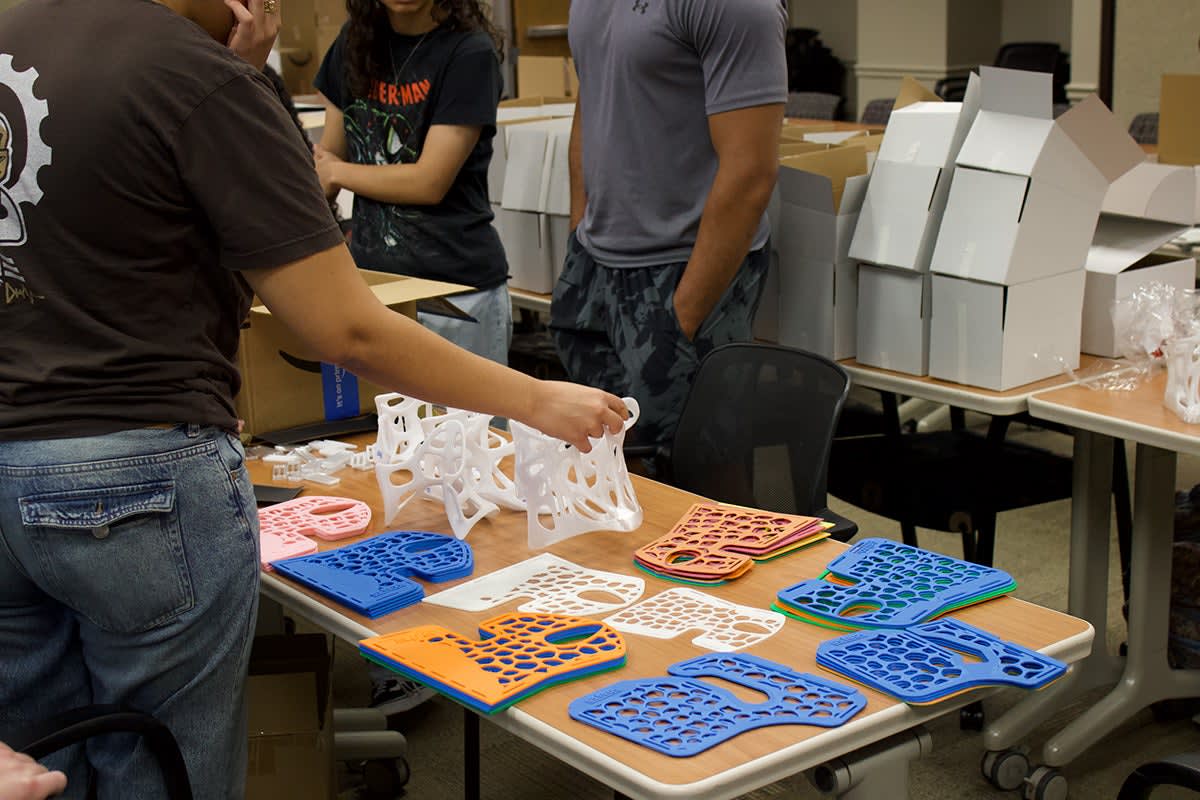
The student-led initiative, called Bracing Venezuela, has already produced more than 350 orthopedic devices for earthquake survivors and their injured pets. Finger splints, wrist braces, neck supports, and even animal leg immobilizers are being shipped directly to physicians treating patients in Caracas.
Jannah Barakat, a mechanical engineering major and president of UCF's Biomedical Engineering Society, spearheaded the effort after connecting with the American Association of Venezuelan Engineers. Within days, students were coordinating with doctors on the ground to identify exactly what was needed most.
"From there, everything snowballed," Barakat says. "Before we knew it, we had a campuswide humanitarian project taking shape."
The design is brilliant in its simplicity. Smaller devices like finger and wrist splints print in just a few hours and lie flat for easy shipping. Once they arrive in Venezuela, clinicians soften them with hot water and mold each device to fit individual patients perfectly.
Larger items, including neck braces and animal leg braces, are printed in multiple sizes and can take up to 10 hours to complete. With volunteers printing simultaneously from across campus and beyond, the operation scaled quickly.
The Ripple Effect
What started as a handful of engineering students has grown into a movement spanning disciplines and communities. Faculty members opened their labs, alumni donated materials, and even local 3D printing hobbyists joined the cause.
Professor Mohsen Rakhshan provided access to his engineering lab's printer, while students organized print trackers, volunteer schedules, and shipping logistics. The group supplies filament to anyone with a printer who wants to help, meaning participation requires only willingness, not expensive equipment.
The impact reaches beyond immediate disaster relief. Each device represents personalized care for someone who might otherwise go without, from a child needing a wrist splint to heal properly to a family pet requiring leg support during recovery.
For Barakat, this project proves what's possible when technical skills meet compassion. She hopes Bracing Venezuela becomes a model for rapid humanitarian response, showing how engineering students can mobilize quickly to serve communities anywhere in the world.
Anyone interested in joining the effort can contribute by printing devices, donating materials, connecting the team with other volunteers, or simply spreading the word. Engineering meets empathy, one print at a time.
More Images
Based on reporting by Google: volunteers help
This story was written by BrightWire based on verified news reports.
Spread the positivity!
Share this good news with someone who needs it