Swiss Scientists Build Camera That Sees Invisible Particles
Researchers created a detector that tracks hard-to-catch particles using camera tech instead of millions of tiny parts. The breakthrough could make future physics experiments cheaper and improve medical scans.
Scientists just solved one of physics' most expensive problems with technology borrowed from photography.
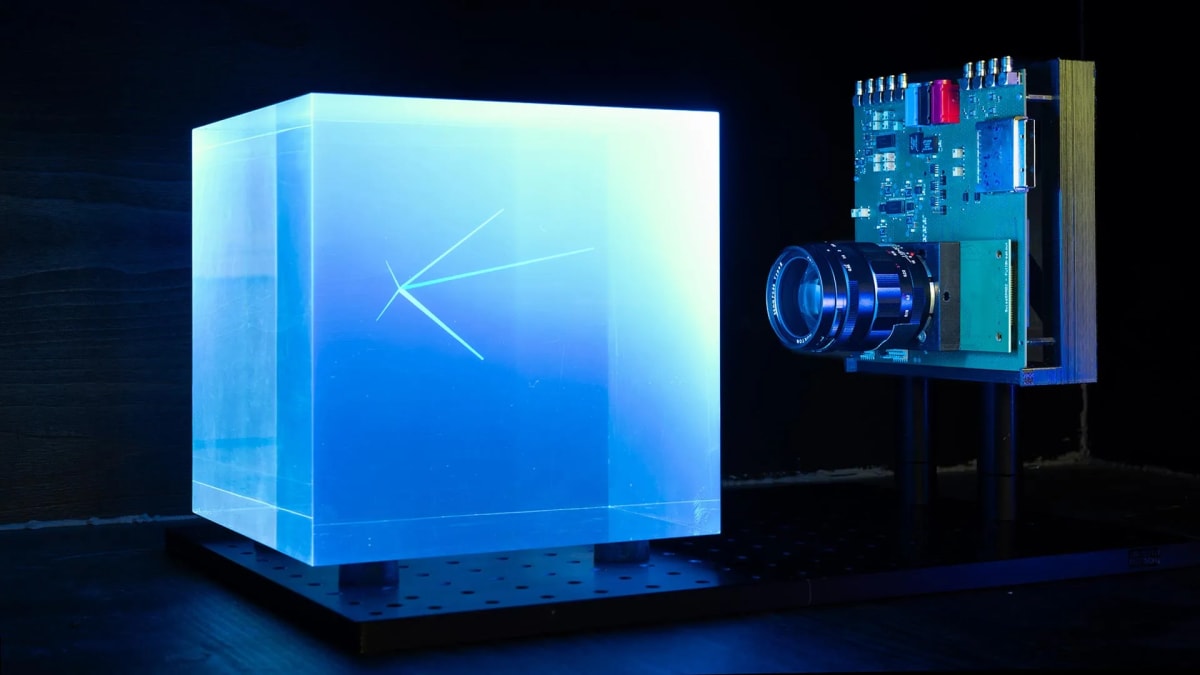
Researchers at ETH Zurich and EPFL in Switzerland built a new particle detector that replaces millions of individual components with a single block of special material and a smart camera. The system, called PLATON, can track invisible particles in 3D just as well as today's best detectors, but it's far simpler to build.
The challenge with detecting particles like neutrinos is that they rarely interact with ordinary matter. Current detectors try to catch these shy particles by dividing sensitive material into millions of tiny sections, each connected to sensors by optical fibers. Japan's T2K experiment, for example, uses about two million cubes and 60,000 fibers just to monitor two tons of material.
Building and maintaining these massive systems has become a major bottleneck. Each new experiment needs more precision, which means even more tiny parts to manufacture and assemble.
The Swiss team took a completely different approach. Instead of splitting their detector into millions of pieces, they used a single block of scintillator material that glows when particles pass through it. The innovation comes from what reads that glow.
They adapted light field camera technology, the same concept behind those cameras that let you refocus pictures after taking them. These cameras capture not just how bright light is, but also which direction it came from. By pairing this with ultra-sensitive sensors that can detect individual photons, the system reconstructs exactly where particles traveled through the detector.
The prototype uses a sensor called SwissSPAD2, developed at EPFL, combined with an array of microscopic lenses. The sensor can also be "gated" to only record light during specific time windows, filtering out background noise and focusing on real particle signals.
The Ripple Effect
Early tests and simulations show PLATON could match or even surpass the resolution of segmented detectors while being much easier to scale up. Building a larger detector would mean adding more camera material, not manufacturing millions more components.
The technology isn't limited to physics labs either. The same principles could lead to sharper PET scans in hospitals. Medical imaging also relies on detecting tiny flashes of light from particles, and better resolution could mean earlier disease detection.
The team published their results in Nature Communications, and other research groups are already taking notice. What started as combining familiar technologies in an unexpected way could open doors that seemed too expensive to unlock.
Sometimes the biggest leaps forward come from looking at old problems through a new lens.
Based on reporting by Science Daily
This story was written by BrightWire based on verified news reports.
Spread the positivity!
Share this good news with someone who needs it