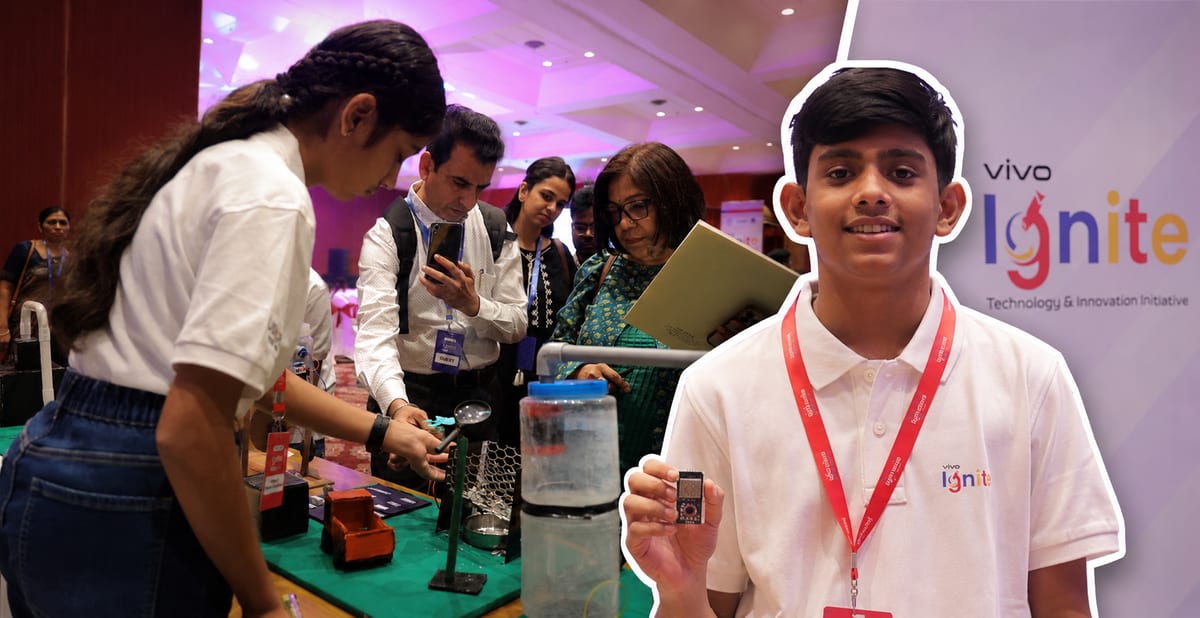
Teen Turns Wi-Fi Into Safety System, Wins $5,000 Prize
A 15-year-old from rural Odisha transformed ordinary Wi-Fi signals into an AI-powered safety system that protects privacy while detecting violence. His innovation won him $5,000, and now the same competition is open to students across India until July 10.
When Prateek Sethi was 14, he realized that the places where people need safety most are exactly where cameras shouldn't be: washrooms, hostel corridors, private rooms.
His solution didn't involve lenses or recording. Instead, he looked at something already moving through every wall: Wi-Fi signals.
Most people see Wi-Fi as a way to stream videos or browse the internet. Prateek saw something different: a signal that bends and scatters in unique patterns every time someone moves through a room.
He wondered if artificial intelligence could learn to read those patterns and tell the difference between normal movement and dangerous behavior. No cameras, no footage, no privacy violations.
That idea won him Rs 4 lakh (about $5,000) at vivo Ignite, a national innovation competition for students. He's from a remote part of Odisha and attends a public school there.
His interest in technology started during the pandemic when his professor father suggested he spend free time exploring AI instead of just studying textbooks. Years of self-directed learning followed.
When news reports highlighted crimes against women in India, Prateek found his purpose. "That's what sparked the journey of this innovation," he says.
He built the system using ESP32 transceivers to capture Wi-Fi signals and trained an AI model to recognize patterns. The project competed against thousands of entries before reaching the national finale in Delhi.
A mentor's advice guided him through the process: "Stick to the problem and keep solving the small details. We may never solve the problem completely, but if we try, we'll get somewhere."
A year after winning, Prateek's system now runs across his father's college campus, including classrooms and hostel areas. "I was able to catch up with one or two cases where some sort of violence was happening," he says. "I successfully identified it in real-time data."
His long-term vision is bringing WiFi sensors into ordinary homes. "You can't put a CCTV camera in a washroom," he points out. "But with WiFi sensors, only when there's activity, you can identify it without violating anyone's privacy."
The Ripple Effect
The vivo Ignite program that launched Prateek's innovation is now accepting applications for its fourth edition. Students in grades 8 through 12 across India can submit their ideas at vivoignite.com until July 10.
Last year alone, the competition drew over 37,000 registrations from more than 9,000 schools spanning 660 districts. That's double the previous year's participation.
This year brings a new focus: students from India's 112 government-designated "aspirational districts" and those attending government schools will receive special consideration in the selection process.
Geetaj Channana, Chief Corporate Communications Officer at vivo India, explains the motivation: "India has nearly 250 million children, and one of the youngest populations in the world. We saw enormous, untapped potential, especially with students from Classes 8 to 12."
The competition narrows to 200 finalists who receive online mentoring before a two-day national finale. Winners receive scholarships ranging from Rs 50,000 to Rs 4 lakh, along with guidance to develop their projects further.
If you're a student with an idea worth exploring, you have until July 10 to find out.
More Images
%2Fenglish-betterindia%2Fmedia%2Fmedia_files%2F2026%2F07%2F06%2F1-2026-07-06-16-59-40.png)

%2Ffilters%3Aformat(webp)%2Fenglish-betterindia%2Fmedia%2Fmedia_files%2F2026%2F07%2F06%2F2-2026-07-06-17-03-35.png)
%2Ffilters%3Aformat(webp)%2Fenglish-betterindia%2Fmedia%2Fmedia_files%2F2026%2F07%2F06%2F5-2026-07-06-17-06-49.png)
Based on reporting by The Better India
This story was written by BrightWire based on verified news reports.
Spread the positivity!
Share this good news with someone who needs it