Telescope Finds Stellar Explosions at Milky Way's Heart
Scientists just discovered powerful flares from dying stars near our galaxy's center using a telescope at the South Pole. It's the first time anyone has spotted these rare stellar outbursts in millimeter wavelengths, opening a new window into the Milky Way's most crowded neighborhood.
Scientists scanning the heart of our galaxy just caught something spectacular: two massive stellar flares erupting from white dwarf stars locked in a cosmic dance with companion stars.
The discovery came from the South Pole Telescope, which repeatedly photographed a 100-square-degree patch of sky toward the Milky Way's center. Over two years, researchers at the University of Illinois Urbana-Champaign spotted two distinct flares, each lasting about a day, shining brightly in millimeter wavelengths where such events have never been detected before.
What makes this breakthrough exciting is how the team found these flares. Instead of looking at specific stars they already knew about, they scanned a massive region and let the universe surprise them. The discovery proves that patient, systematic sky watching can reveal cosmic fireworks we didn't even know to look for.
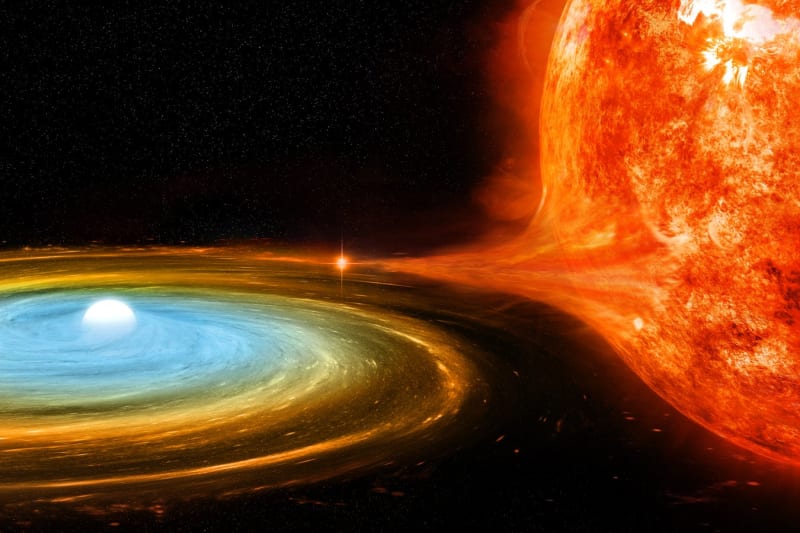
The flares came from accreting white dwarfs, the dense remnants of dead stars that are slowly pulling gas off nearby companion stars. As this stolen material swirls around the white dwarf in a superhot disk, magnetic forces can trigger sudden explosions similar to solar flares but far more powerful. These stellar tantrums release enormous amounts of energy that radiate across space.
Lead researcher Yujie Wan, a graduate student in astronomy, sees this as just the beginning. "There is so much happening at the center of our galaxy that we've never been able to observe at these wavelengths," she said. The Galactic Center is incredibly crowded with stars, dust, and overlapping light sources, making it one of the hardest regions to study.
The South Pole location gives the telescope a unique advantage. From Antarctica, it can stare at the same patch of sky for months without interruption from daylight, building up hundreds of observations that reveal changes over time.
Why This Inspires
This discovery shows how new ways of looking at familiar places can reveal hidden wonders. For decades, astronomers have studied the Milky Way's center in visible light and X-rays, but millimeter wavelengths offer a fresh perspective on the extreme physics happening there.
The findings also demonstrate the power of patience in science. By repeatedly scanning the same region and carefully sifting through the data, the team could distinguish genuine stellar events from background noise and weather effects. It's detective work on a cosmic scale.
Professor Joaquin Vieira, who directs the Center for AstroPhysical Surveys, notes that finding transients in millimeter wavelengths gives scientists a new tool for understanding how binary star systems behave. These observations could help explain how compact stars evolve, how they generate powerful outflows, and how magnetic forces shape their environments.
The discovery points to a richer, more dynamic Milky Way than we've previously imagined, where stellar explosions constantly reshape the neighborhood around our galaxy's heart.
More Images

Based on reporting by Google News - Researchers Find
This story was written by BrightWire based on verified news reports.
Spread the positivity!
Share this good news with someone who needs it