Planet 700 Light-Years Away Has Clouds Made of Rock
Scientists just discovered a planet where clouds made of rocky minerals appear every morning and vanish by nightfall. The James Webb Space Telescope gave astronomers their clearest view yet into this bizarre alien world.
Imagine a world where clouds form from actual rocks every morning, then disappear completely by evening. Scientists just found exactly that on a giant planet 700 light-years away.
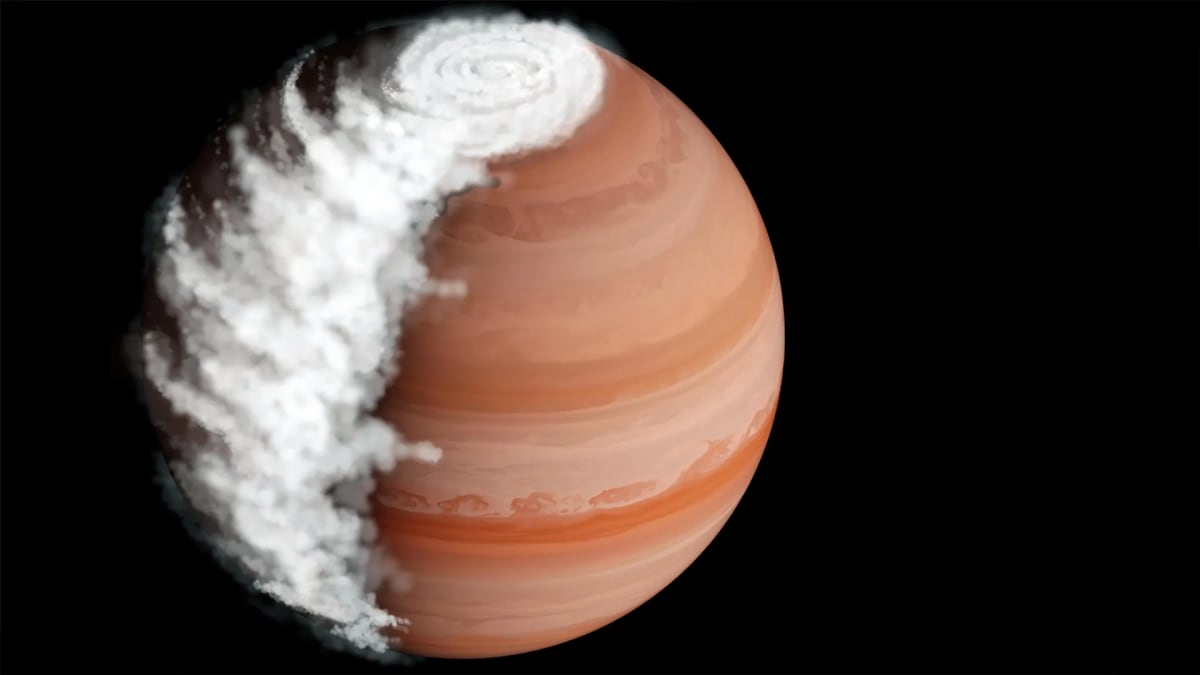
Using the James Webb Space Telescope, astronomers discovered that WASP-94A b experiences a wild daily weather cycle unlike anything in our solar system. Every morning, clouds made of magnesium silicate (a mineral found in Earth's rocks) gather across the sky. By evening, those clouds completely vanish, leaving clear skies.
The discovery happened when scientists observed the planet crossing in front of its star. By examining the leading and trailing edges separately, they could see the morning and evening sides independently. The difference was dramatic.
The morning side appeared packed with mineral clouds as cooler air from the night side moved toward the scorching day side. The evening side looked almost cloud-free as air traveled back into darkness.
Scientists think the clouds either get dragged deep into the planet's atmosphere by powerful winds or evaporate in temperatures exceeding 1,000 degrees. It's similar to morning fog burning off on Earth, just under far more extreme conditions.
"I've been looking at exoplanets for 20 years, and general cloudiness has been a thorn in our side," said David Sing, a professor at Johns Hopkins University. "Not only have we been able to clear the view, but we can finally pin down what the clouds are made out of."
Why This Inspires
This breakthrough does more than reveal bizarre alien weather. The clearer evening skies gave scientists something previously impossible: a direct look at the planet's atmosphere without clouds blocking the view.
That clearer view solved a mystery that had puzzled researchers for years. Earlier measurements suggested WASP-94A b contained hundreds of times more oxygen and carbon than Jupiter, which didn't match theories about how planets form. The new observations show it actually contains only about five times more, making it far more similar to Jupiter than anyone thought.
The team has already found similar cloud cycling on two other planets: WASP-39 b and WASP-17 b. They're planning a larger program to study cloud cycles across many different worlds.
After two decades of looking at exoplanets through foggy windows, scientists can finally see clearly into alien skies.
Based on reporting by Google: James Webb telescope
This story was written by BrightWire based on verified news reports.
Spread the positivity!
Share this good news with someone who needs it