Telescope Maps Clouds on Planet 700 Light-Years Away
Scientists just delivered the first weather report from a planet nearly 700 light-years from Earth, and it's partly cloudy with a chance of vaporized rock. The James Webb Space Telescope spotted dramatically different skies on opposite sides of a distant giant planet, proving we can now track weather patterns across the galaxy.
Scientists just delivered a weather forecast for a world nearly 700 light-years away, and it's a game changer for understanding planets beyond our solar system.
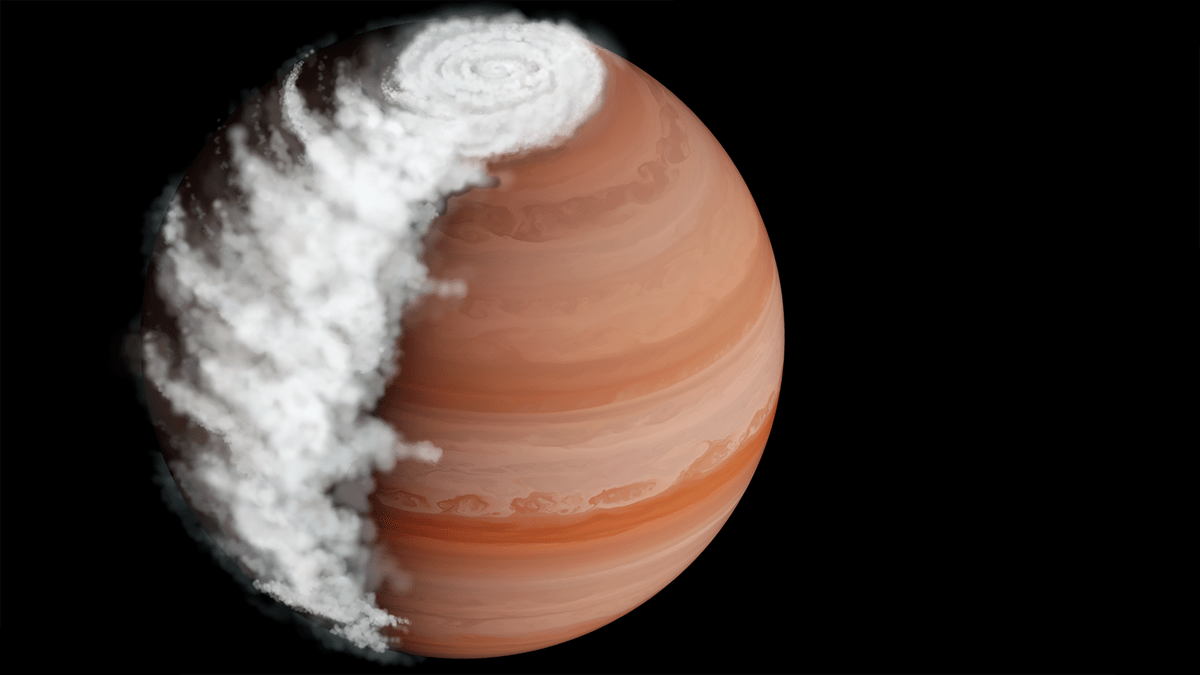
The James Webb Space Telescope tracked clouds moving across WASP-94A b, a giant planet orbiting its star so closely that one side stays locked in eternal day while the other freezes in permanent night. What researchers found stunned them: the morning side is covered in thick clouds while the evening side enjoys clear skies.
These aren't your typical fluffy white clouds. They're made of vaporized rock, magnesium silicate, iron, and magnesium sulfide, baked into the atmosphere by extreme temperatures from the nearby star.
"It was really surprising how different the two halves of the same planet are," says Sagnick Mukherjee, lead author of the study at Arizona State University. The planet completes a full orbit every four days, and scientists watched it transit across its star to peek at different sides separately.
The weather pattern works like Earth's overnight fog burning off in morning sun. Powerful winds push cooler air around the planet's nightside, building clouds that tower by daybreak before dissipating in the scorching daylight.
Why This Inspires
This breakthrough does more than satisfy our cosmic curiosity. Understanding cloud patterns on distant worlds is essential for reading their chemical compositions correctly, which tells us how planets form and evolve throughout the universe.
Scientists previously struggled because clouds block their view when they try to analyze exoplanet atmospheres. Now they know they need to check multiple sides of a planet before drawing conclusions about what it's made of.
The research team has already studied similar weather dynamics on two other hot Jupiter planets using the same technique. As telescopes grow more powerful, scientists hope to eventually track weather on smaller, Earth-like planets across the galaxy.
"You can, at a glance, see the difference" in the hemispheres' weather, says Heather Knutson, an exoplanetary scientist at Caltech not involved in the study. She notes that clouds on exoplanets rarely form uniformly, so scientists need to account for atmospheric variety when studying distant worlds.
The ability to forecast weather on planets hundreds of light-years away shows how far our cosmic vision has reached in just a few years of Webb telescope observations.
More Images


Based on reporting by Scientific American
This story was written by BrightWire based on verified news reports.
Spread the positivity!
Share this good news with someone who needs it