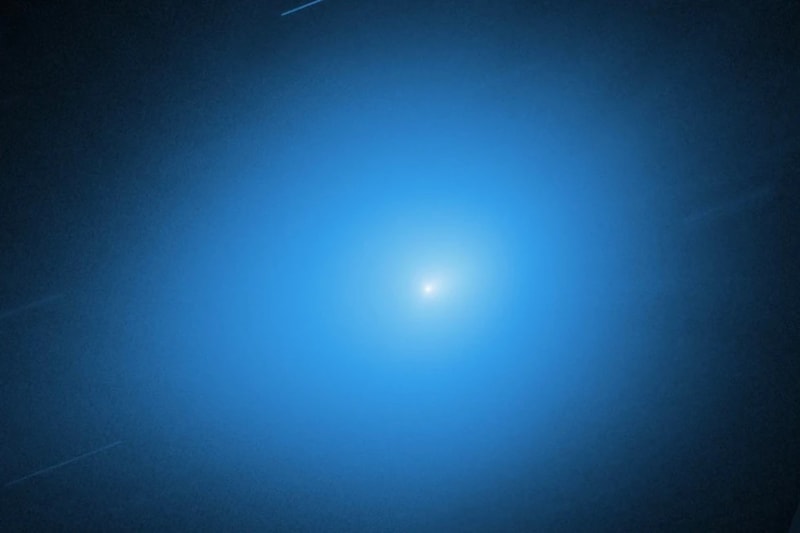
Third Interstellar Comet Ever Spotted Visits Our Solar System
Astronomers tracked a rare visitor from beyond our solar system as comet 3I/ATLAS passed through on a one-way journey. The James Webb Space Telescope revealed its unique composition, offering scientists an exciting glimpse into how other star systems form planets.
A cosmic traveler from another star system just passed through our neighborhood, and scientists are thrilled about what it revealed.
Astronomers discovered 3I/ATLAS on July 1, 2025, when a NASA-funded telescope in Chile spotted the faint object streaking through space. It became only the third confirmed interstellar visitor ever observed, joining 1I/'Oumuamua in 2017 and 2I/Borisov in 2019.
Unlike comets born in our solar system, this visitor formed around a distant star before drifting into our cosmic backyard. Its hyperbolic trajectory means it won't stick around. Instead of settling into orbit around our sun, 3I/ATLAS is headed back out into deep space forever.
Dr. Benjamin Rose, an assistant professor of physics and astronomy at Baylor University, explains why these rare visitors matter so much. "Interstellar objects are formed from different gas clouds," he said. "With enough observations, we can learn if the material composition of our solar system is typical for stellar systems in our neighborhood."
The comet posed no threat to Earth, passing about 170 million miles away at its closest approach. Still, scientists scrambled to learn everything they could during its brief visit.
In August 2025, the James Webb Space Telescope turned its powerful infrared eye toward the comet and discovered something fascinating. The comet's atmosphere contained unusually high amounts of carbon dioxide compared to water, along with traces of carbon monoxide. This unique chemical signature offers clues about the planetary system where it formed billions of years ago.
Why This Inspires
These fleeting visitors are teaching us something profound about our place in the universe. Each interstellar object carries a message from another star system, like a cosmic postcard revealing how planets form across the galaxy.
"Objects like 3I/ATLAS are able to contribute to our understanding of planet formation since it is a 'rejected' object from the planet formation processes," Rose noted. In other words, this comet is debris left over when planets formed around another star, perhaps not unlike Earth.
The comet made its closest pass to the sun on October 30, 2025, swooping near the orbit of Mars. European spacecraft orbiting Mars captured images of the visitor during this window, adding to the treasure trove of data.
Scientists even explored whether they could launch a quick mission to intercept 3I/ATLAS for a closer look. While no spacecraft was ready, the study showed that future rapid response missions could be possible if we're prepared when the next visitor arrives.
Space is vast, making these encounters incredibly rare and difficult to spot. The objects are small, fast, and usually only visible for a short window as they zip through the inner solar system. But each discovery improves our ability to detect the next one.
As 3I/ATLAS continues its lonely journey back into interstellar space, it leaves behind something valuable: proof that our solar system isn't as isolated as it seems, and every cosmic visitor brings new understanding of the universe we call home.
Based on reporting by Google: NASA discovery
This story was written by BrightWire based on verified news reports.
Spread the positivity!
Share this good news with someone who needs it
%2Fhttps%3A%2F%2Ftf-cmsv2-smithsonianmag-media.s3.amazonaws.com%2Ffiler_public%2F58%2F0a%2F580a77b9-7590-43c5-b70d-e3a590810348%2Fsmithmag-rockwell-edit.jpg)