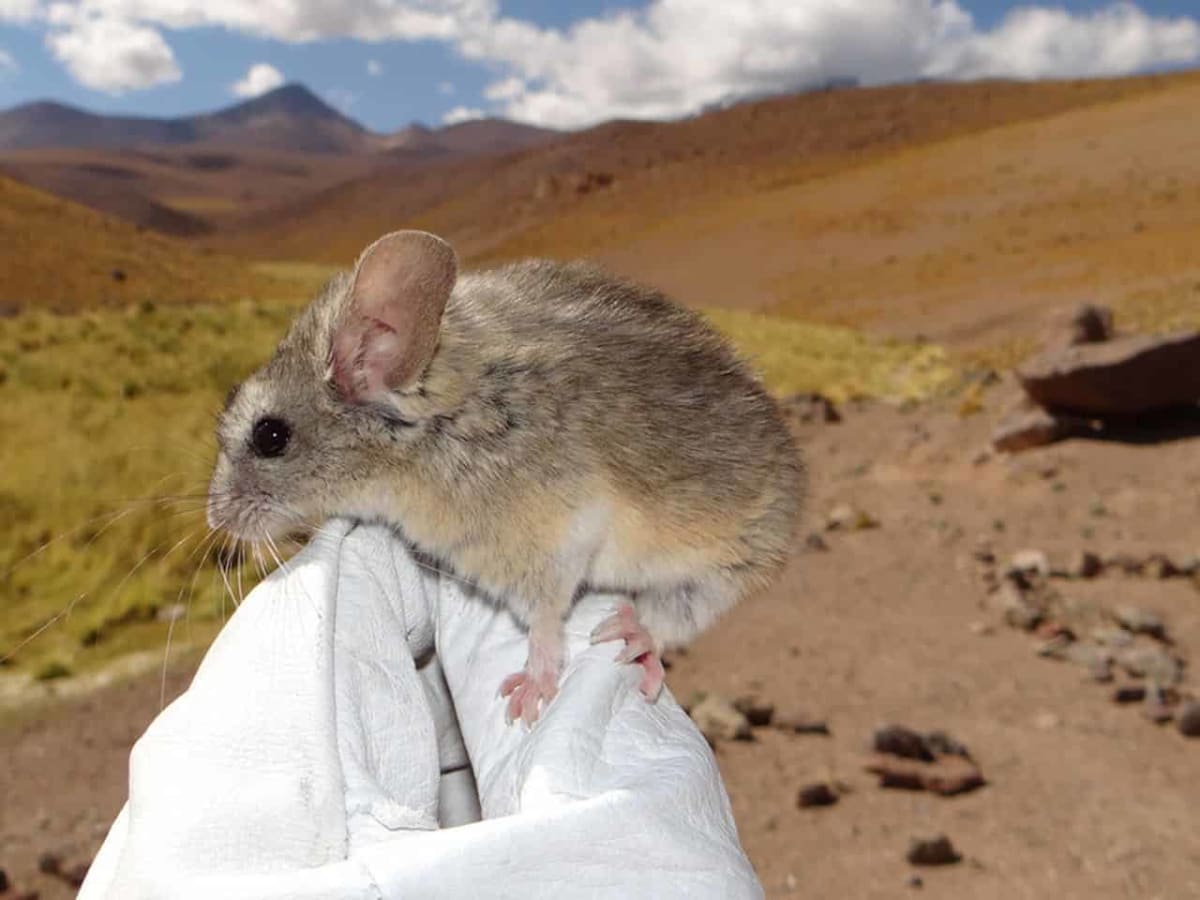
Tiny Mouse Survives 22,000 Feet in Andes Death Zone
Scientists finally cracked the mystery of how a tiny mouse thrives year-round at altitudes so extreme that even experienced climbers struggle to survive. The adorable Andean leaf-eared mouse has evolved remarkable biological superpowers to live where mammals shouldn't exist.
A small rodent just rewrote the rules of what scientists thought was possible for mammal survival.
The Andean leaf-eared mouse lives permanently above 22,000 feet on volcanic summits in the Andes, more than 3,000 feet higher than experts believed any mammal could survive. At these heights, oxygen levels drop to just 44 percent of sea level, temperatures stay below freezing most of the year, and food is almost nonexistent.
When British zoologist Oldfield Thomas first discovered these mice in 1912, scientists were baffled. For over a century, researchers wondered how such a tiny creature could thrive where humans barely survive even briefly.
Now a groundbreaking study has revealed the answer. Researchers spent years on mountaineering expeditions across the Andes, collecting more than 160 mice from sea level to nearly 7,000 meters. What they found amazed them.
The mice transformed themselves into efficient biological furnaces. Their muscles are packed with mitochondria, the tiny powerhouses that produce energy in cells. Graham Scott, an animal physiology expert at McMaster University, explains they're built like marathon runners rather than sprinters.
Instead of burning carbohydrates like most mammals, these mice switched to burning fats, providing steady fuel for both shivering muscles and specialized brown fat that generates heat without movement. This keeps them warm in constantly freezing conditions.
The adaptations go deeper than just staying warm. The mice developed enhanced systems for energy production, blood vessel regulation, and long-term tolerance of oxygen-starved air. Surprisingly, they didn't evolve special hemoglobin like some high-altitude species. Instead, multiple body systems improved together.
Why This Inspires
The biggest surprise wasn't about oxygen at all. The barren volcanic landscape offers almost no food except sparse alpine vegetation and lichens. Many of these plants contain toxic compounds that would sicken other animals.
The mice evolved the ability to detoxify these poisonous plant chemicals, turning a deadly food source into fuel. Grant McClelland, a biology professor at McMaster University, notes that evolution addressed multiple extreme challenges simultaneously, not just the obvious ones.
Even more remarkable, high-altitude and low-altitude mice still interbreed and exchange genes. Yet despite this genetic mixing, the survival adaptations persist, showing that natural selection continuously favors these extraordinary traits.
These tiny survivors remind us that life finds pathways through seemingly impossible challenges. When faced with multiple extreme obstacles at once, nature doesn't just solve one problem. It orchestrates an entire symphony of adaptations working in harmony.
The Andean leaf-eared mouse proves that the boundaries of what's possible keep expanding when we look closely enough at the natural world's ingenious solutions.
More Images
Based on reporting by Google News - Science
This story was written by BrightWire based on verified news reports.
Spread the positivity!
Share this good news with someone who needs it

%2Fhttps%3A%2F%2Ftf-cmsv2-smithsonianmag-media.s3.amazonaws.com%2Ffiler_public%2F46%2Ff1%2F46f18bd2-beb5-4922-9fa0-6f5d63e35951%2Fwilliston-lake.jpg)