
Tropical Forests Regrow in Decades, Study Finds
A clearing in the Amazon can look like forest again in just 30 years, and the speed at which nature bounces back is giving scientists new hope for conservation. Birds, bats, and bees are leading the recovery, bringing life back to logged land faster than anyone expected.
Stand in a tropical forest that was farmland three decades ago, and you might not realize anything ever changed. New research from Ecuador shows that abandoned pastures and plantations can regain most of their biodiversity within a generation, offering a practical path forward for restoration efforts worldwide.
Scientists studied 62 plots across active farms, regenerating forests, and untouched rainforest in lowland Ecuador. They tracked everything from trees to soil bacteria, watching how life returns after land is cleared.
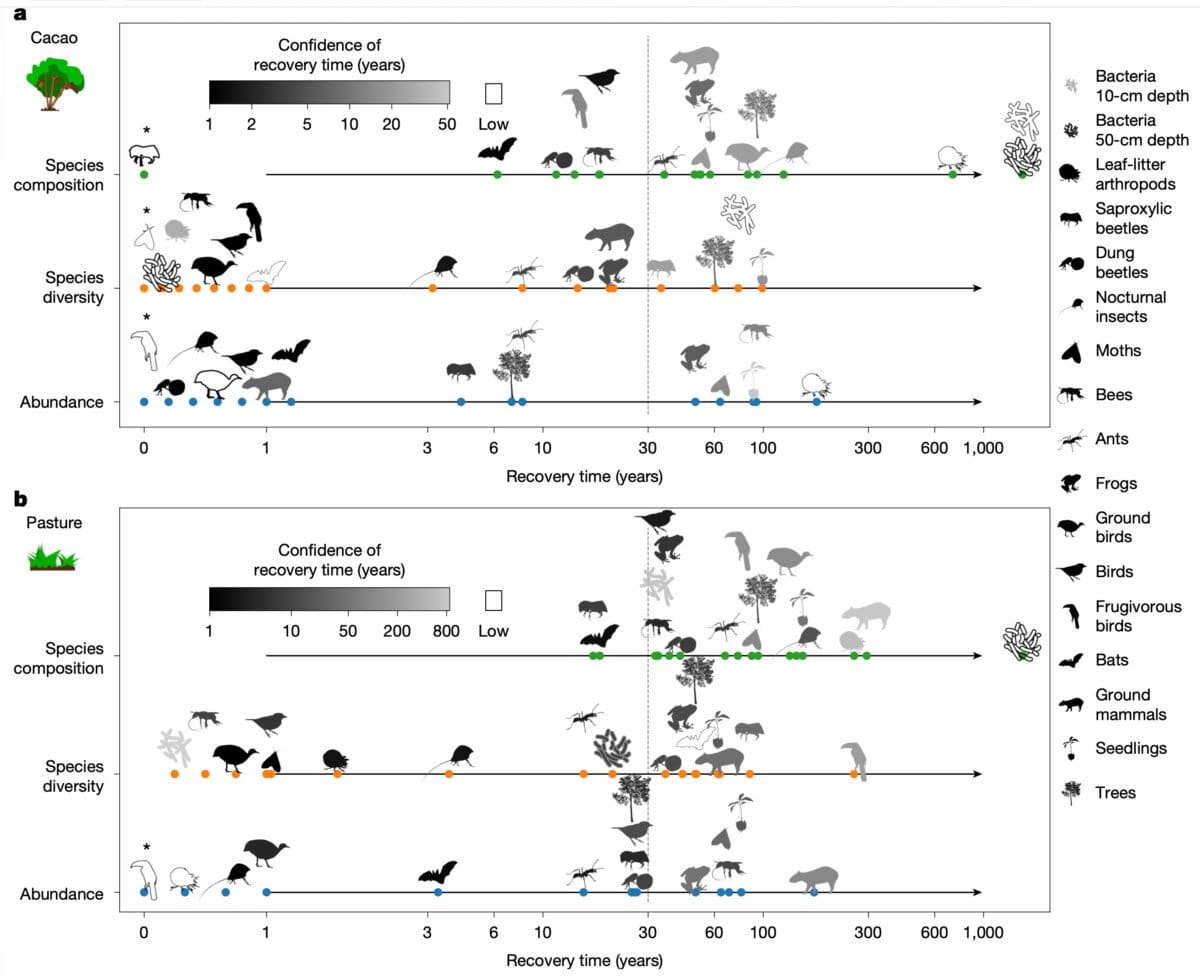
The good news came quickly. Within 30 years, many groups of animals and plants reached abundance levels close to old-growth forest. Some recovered even faster.
Birds, bats, and bees led the comeback. These mobile creatures can move easily across cleared landscapes, returning to regenerating areas almost as soon as vegetation appears. Once there, they become ecosystem architects, pollinating flowers and spreading seeds that accelerate recovery.
Their presence creates a virtuous cycle. As plants grow back, they provide food and shelter that attracts more animals. Those animals, in turn, help more plants establish themselves.
Trees take longer to return, constrained by slow growth and limited seed dispersal. Many old-growth species are rare to begin with, so even when species numbers rebound, the forest's original character takes decades or centuries to fully restore.
This matters because ecosystems depend on which species are present, not just how many. A forest might look recovered while still missing key interactions that define healthy, mature ecosystems.
The Bright Side
Secondary forests now cover roughly 70 percent of all tropical forest area, and this study shows they're far more valuable than previously thought. Forests regrowing from former cacao plantations recovered faster than those from pasture, suggesting that even degraded land with some tree cover provides a better foundation for nature's return.
The surrounding landscape matters too. Forests near intact habitat receive a steady stream of colonizing species, speeding recovery significantly. This finding supports protecting existing forest fragments, even small ones, as sources of biodiversity for regenerating areas.
Recovery happens at different speeds below ground. Soil bacteria communities remained altered long after visible recovery, while less mobile creatures like leaf litter arthropods returned slowly, limited by their inability to cross open ground.
The research offers conservation planners a cost-effective strategy: protect secondary forests and let time do the heavy lifting. While nothing replaces old-growth forest, allowing cleared land to regenerate could restore vast amounts of biodiversity within our lifetimes.
More Images


Based on reporting by Mongabay
This story was written by BrightWire based on verified news reports.
Spread the positivity!
Share this good news with someone who needs it

%2Ffile%2Fattachments%2F2998%2F14147038_376896.jpg)