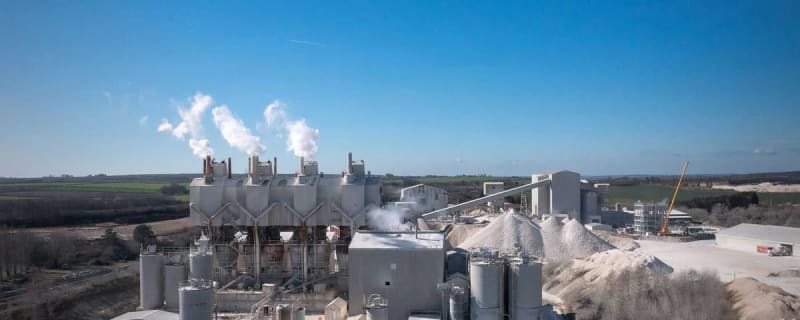
UK Lime Plant Tests New Tech to Slash Carbon Emissions
A British lime factory is installing cutting-edge carbon capture technology that could transform one of the hardest industries to clean up. The breakthrough system uses less energy and takes up less space than traditional carbon capture methods.
One of Britain's oldest lime production plants just became a testing ground for technology that could help solve one of climate action's toughest puzzles.
Nuada, a UK carbon capture company, is installing its demonstration system at the Singleton Birch facility in a partnership with US chemical lime business MLC. The goal is proving that carbon capture can work in lime production, an industry where most emissions are basically unavoidable.
Here's the challenge: making lime requires heating limestone to extreme temperatures in a process called calcination. When calcium carbonate transforms into quicklime, it releases carbon dioxide no matter what. It's chemistry, not fuel choice.
That's what makes this test so important. Unlike sectors that can switch to renewable energy, lime production needs a different solution entirely.
Nuada's system tackles the problem from a new angle. The technology requires less energy than conventional carbon capture systems and fits into a smaller footprint. That matters enormously for existing industrial sites where space and power are limited.
Singleton Birch has been producing high-purity lime for construction, metals, water treatment and agriculture for generations. Now it's helping write the playbook for how centuries-old industries can meet modern climate goals.
The Ripple Effect
If the demonstration succeeds, the technology could roll out across MLC's entire operation. But the impact could stretch far beyond one company.
Lime production represents a massive source of industrial emissions with few alternatives on the horizon. Carbon capture might be the only realistic path to cleaning up the sector.
MLC has committed to carbon neutrality by 2050. Fiona Woody, the company's director of sustainability, called carbon sequestration technology "the strongest potential to meaningfully reduce lime's climate impact."
The partnership shows how innovation happens in the real world. Cutting-edge materials science meets practical engineering at an operating plant, generating performance data that can inform projects across an entire industry.
Dr. Jose Casaban, co-CEO of Nuada, emphasized that the collaboration demonstrates how advanced engineering can support deep emissions cuts in sectors with "the most untapped carbon capture potential."
This isn't about perfect solutions arriving fully formed. It's about testing, learning and building the infrastructure needed for industrial decarbonization.
Progress on climate requires breakthroughs in exactly these kinds of hard-to-abate sectors, where the path forward isn't obvious and the stakes are enormous.
More Images
Based on reporting by Google News - Emissions Reduction
This story was written by BrightWire based on verified news reports.
Spread the positivity!
Share this good news with someone who needs it
%20-%202.png)