Webb Telescope Captures 16.5 Million Stars in Cigar Galaxy
NASA's James Webb Space Telescope has revealed 16.5 million individual stars hidden within the dust-covered Cigar Galaxy, offering scientists an unprecedented look at one of the universe's most intense star-forming regions. The discovery gives astronomers new clues about how galaxies evolve and what triggers bursts of stellar birth.
Scientists just got the clearest view ever of a galaxy churning out stars at 10 times the speed of our own Milky Way.
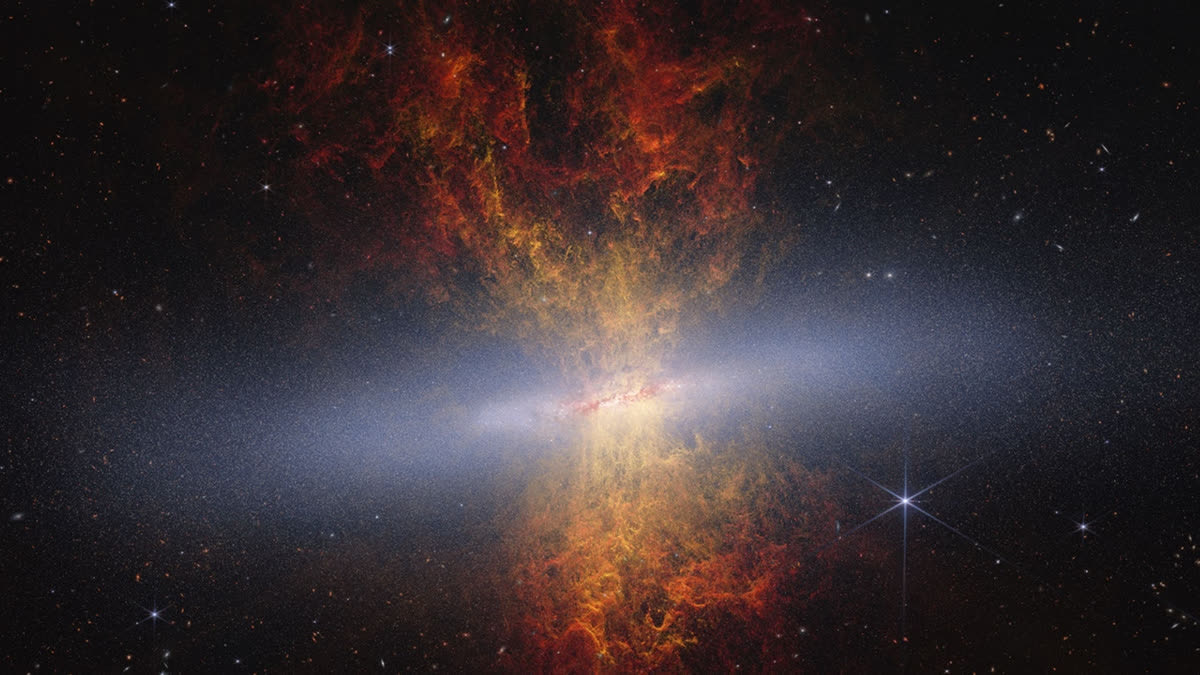
NASA's James Webb Space Telescope spent 65 hours photographing Messier 82, nicknamed the Cigar Galaxy for its elongated shape. The result is a stunning portrait showing 16.5 million individual stars sparkling through clouds of dust that had previously blocked our view.
Located 12 million light-years from Earth, M82 is experiencing what astronomers call a starburst phase. Something in its past, likely a collision or close encounter with another galaxy, kicked its star formation into overdrive.
This intense period will only last a few hundred million years in cosmic time, making it a rare opportunity to study galactic evolution in action. Previous telescopes like Hubble and Spitzer couldn't pierce through the galaxy's thick dust blanket, but Webb's infrared vision saw right through it.
Principal investigator Adam Smercina of the Space Telescope Science Institute calls M82 "a beautiful mess" whose history scientists are still working to understand. The galaxy offers a window into multiple cosmic mysteries that no other nearby galaxy can provide.
The new image reveals more than just stars. Webb captured the galaxy's distorted disk structure, showing evidence of that ancient gravitational encounter. The pattern of brightness and asymmetrical shape near the center tells a story of dramatic past events.
Benjamin Williams from the University of Washington said the number of visible stars represents a completely different perspective compared to what previous telescopes could show. Even more remarkably, these 16.5 million stars are only a fraction of the total population believed to exist in M82.
The galaxy's extreme star formation is creating powerful outflows of material that shoot above and below the disk in an hourglass shape. These plumes contain ionized gas, dust grains, and complex molecules called polycyclic aromatic hydrocarbons that help scientists trace how material moves through space.
Why This Inspires
This discovery shows how far our cosmic vision has expanded in just a few years. Webb's ability to see through cosmic dust means scientists can now study processes that were completely hidden before, from star birth to galaxy evolution.
The research team combined Webb's new data with images from Hubble to create a complete picture of M82's complex ecosystem. Kristen McQuinn of the Space Telescope Science Institute emphasized that this multi-mission approach is essential for understanding how galaxies like this one work.
Each of those 16.5 million visible stars represents a sun that might have its own family of planets. The discovery reminds us that even in a "nearby" galaxy 12 million light-years away, we're still uncovering cosmic neighborhoods we never knew existed.
Scientists expect this detailed view of M82 to help them understand not just this galaxy's history, but how star formation has shifted in galaxies across billions of years. The findings could reshape theories about what triggers these dramatic bursts of stellar birth.
The universe just got a little less mysterious, one star at a time.
More Images




Based on reporting by Google: James Webb telescope
This story was written by BrightWire based on verified news reports.
Spread the positivity!
Share this good news with someone who needs it