Webb Telescope Captures Baby Stars Being Born in FS Tau
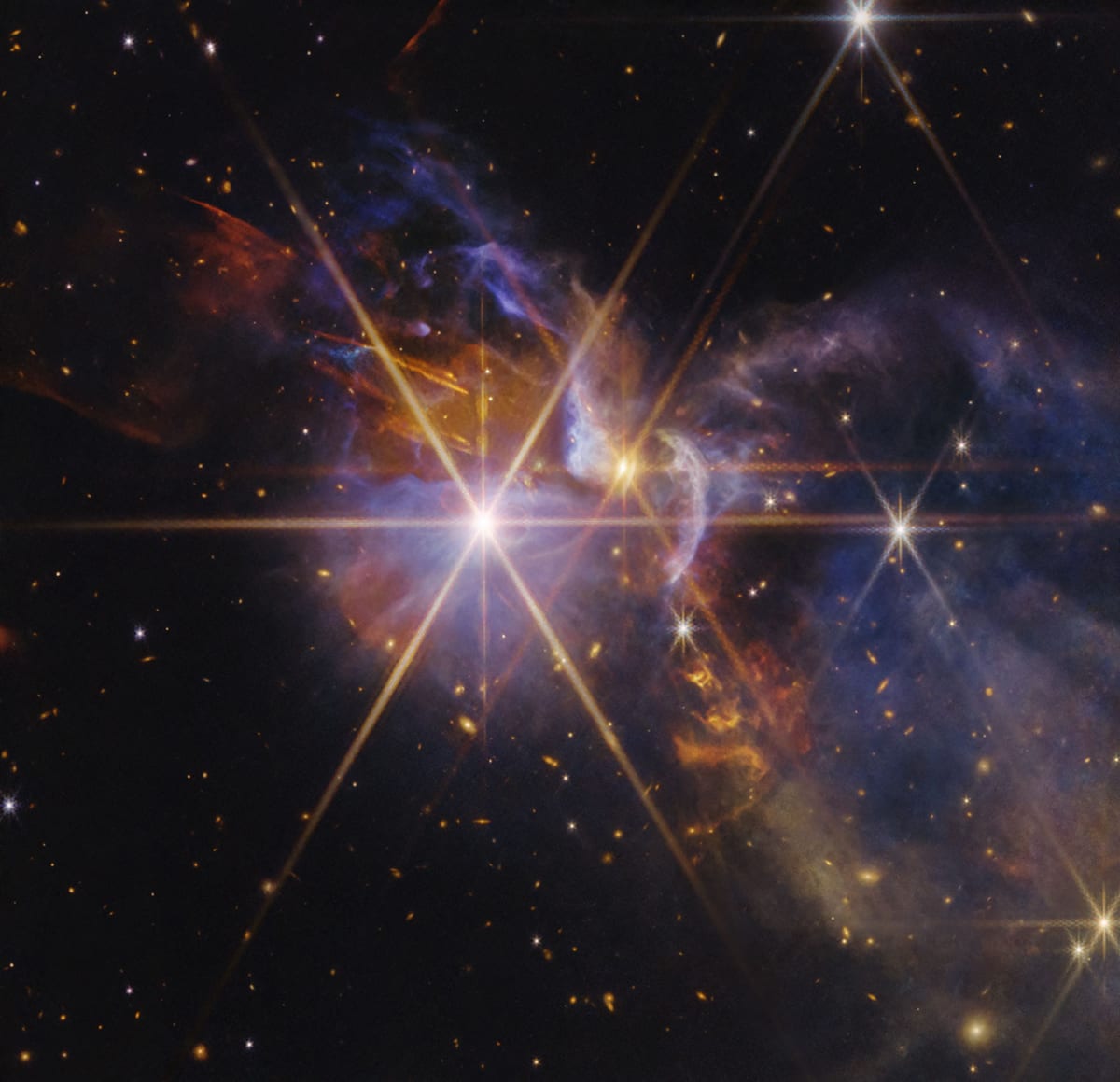
NASA's James Webb Space Telescope has revealed stunning new details of protostars just 1 to 3 million years old forming in the FS Tau system. The infrared images show baby stars shooting colorful jets of matter while shaping their cosmic nursery.
NASA's most powerful space telescope just showed us something incredible: stars being born in real time, wrapped in glowing clouds of gas and dust like cosmic fireworks.
The James Webb Space Telescope captured never-before-seen details of the FS Tau star system, revealing protostars that are mere toddlers in space terms. These baby stars, between 1 and 3 million years old, are still forming from dense pockets of gas and dust in their stellar nursery.
For comparison, our Sun is 4.6 billion years old. These protostars are so young they can't even burn hydrogen yet, which is what makes a full-fledged star like ours shine.
The images show something fascinating happening in real time. As these infant stars feed on surrounding dust and gas to grow bigger, they simultaneously eject superheated matter outward in brilliant orange and red streams. These dramatic outflows stretch across space like ribbons, shaping the entire region around them.
Scientists discovered something new in these Webb observations: gaps between the outflows. This reveals that baby stars don't grow smoothly. Instead, they have growth spurts, alternating between active feeding episodes where they blast out jets of matter, and quiet periods where they rest.
One protostar called FS Tau B, visible as an orange glow slightly right of center, appears responsible for the spectacular orange outflows painting the dusty region. These jets form when the protostar's magnetic field interacts with superheated matter in its accretion disk, the band of material swirling around it.
Why This Inspires
What makes this discovery particularly valuable is that FS Tau contains low-mass stars. These gentler stars disturb their environment much less than massive stars do, giving scientists a clearer window into how star formation actually works.
Webb's infrared vision can peer through thick dust that completely obscured this region in previous Hubble images. The telescope revealed not just the protostars themselves, but also light-blue ridges of compressed dust and gas shaped by stellar winds, plus a spectacular backdrop of distant galaxies bursting into view like celestial fireworks.
Scientists can even map the dust distribution by analyzing colors. Bluer light gets absorbed by dust, so redder galaxies have more dust blocking them, while yellow galaxies shine through clearer regions.
Understanding how these baby stars grow helps us understand our own origins, since our Sun formed through this exact same process billions of years ago.
More Images



Based on reporting by Google: James Webb telescope
This story was written by BrightWire based on verified news reports.
Spread the positivity!
Share this good news with someone who needs it