Webb Telescope Finds Disguised Baby Black Holes
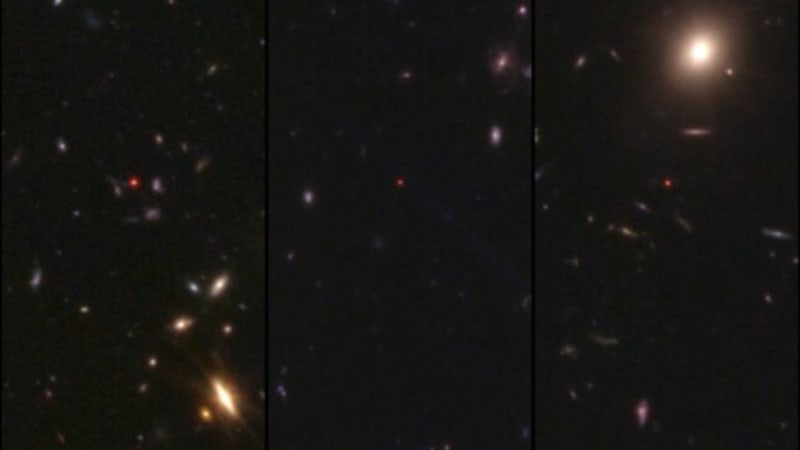
Scientists just solved a cosmic mystery that's been puzzling astronomers for three years. Those strange "little red dots" spotted by the James Webb Space Telescope are actually supermassive black holes in their youth, wearing a nearly perfect disguise.
Astronomers have cracked the case of one of the universe's newest mysteries, revealing that tiny red specks of light spotted in 2022 are actually baby black holes cleverly hiding their true nature.
The James Webb Space Telescope first detected these "little red dots" three years ago, and scientists have been debating what they could be ever since. These ancient cosmic objects appeared less than 1 billion years after the Big Bang and mysteriously vanished after 2 billion years.
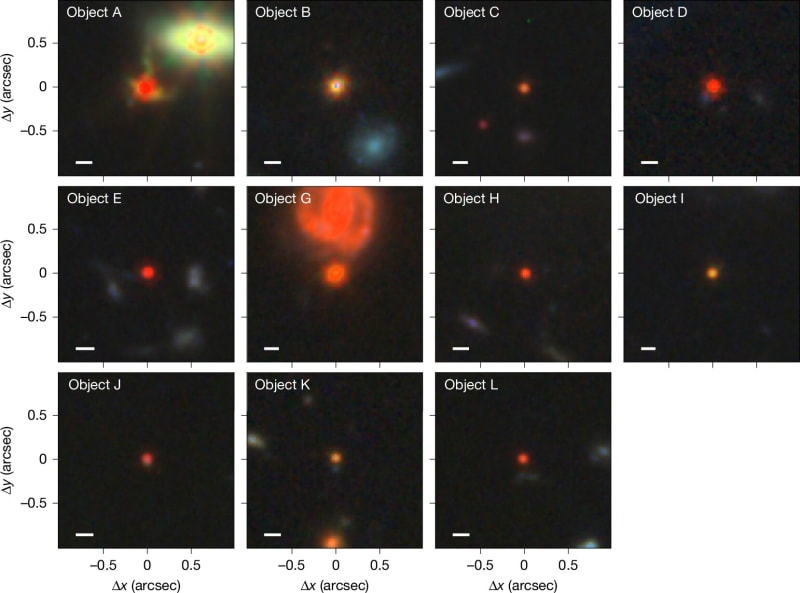
Researchers at the University of Manchester analyzed 12 of these ancient galaxies, with the oldest dating back to when the universe was just 840 million years old. What they found shocked them: each dot contained a light source as bright as 250 billion suns packed into an incredibly tiny space, less than a third of a light-year across.
That's far too bright and compact to be a galaxy filled with stars. To put it in perspective, the distance from our sun to its nearest neighbor star is about 4.25 light-years, making these objects impossibly dense if they were just regular galaxies.
The real breakthrough came when scientists realized why nobody had identified these as black holes before. Typically, supermassive black holes emit telltale X-rays and radio waves, but these young black holes are wrapped in dense cocoons of ionized gas that trap nearly all that radiation.
Lead researcher Vadim Rusakov calls it "an almost perfect disguise." The gas clouds scatter the light in a way that hides the black holes' usual signatures, making them look like something entirely different through our telescopes.
By measuring the speed of gas swirling around these hidden giants (about 670,000 miles per hour), the team calculated that each black hole weighs between 100,000 and 10 million times the mass of our sun. That's 100 times smaller than previous estimates and fits perfectly with what scientists would expect from young supermassive black holes.
Why This Inspires
This discovery represents something incredibly rare in astronomy: catching cosmic giants in their infancy. For the first time, scientists can study supermassive black holes early enough in their lives to understand how they were actually born.
The finding could finally answer one of astrophysics' biggest questions. Did these massive objects grow slowly over time from smaller black holes, or did they start out big from the beginning when collapsing streams of gas created intermediate-mass black holes?
Rusakov believes we're closer than ever to solving this puzzle. The little red dots might still preserve clues from the moment they formed, whether in their gas chemistry or physical properties that could differentiate between competing theories.
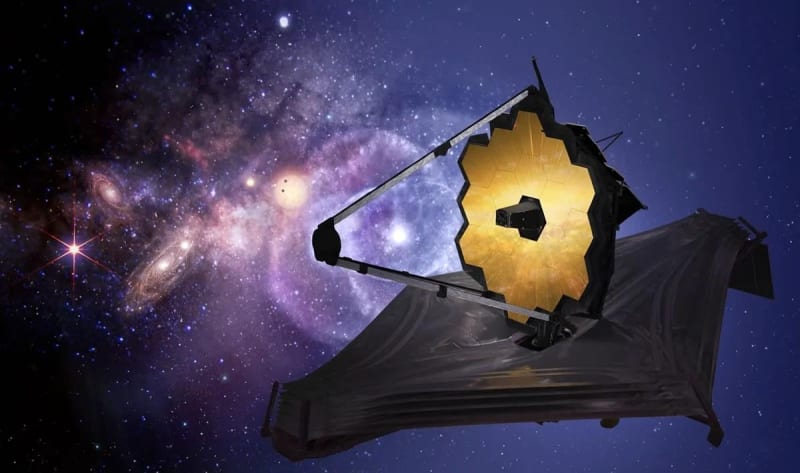
The James Webb Space Telescope continues proving its worth, revealing secrets from the universe's earliest days that were completely invisible to previous instruments.
More Images

Based on reporting by Google News - Science
This story was written by BrightWire based on verified news reports.
Spread the positivity! 🌟
Share this good news with someone who needs it