Webb Telescope Finds Water Near Milky Way's Black Hole
Scientists discovered water molecules and dust thriving near the supermassive black hole at our galaxy's center, proving delicate materials can survive in extreme cosmic environments. The James Webb Space Telescope spotted these fragile molecules around a dying star just half a light-year from one of the universe's most violent neighborhoods.
The James Webb Space Telescope just found something scientists didn't expect: water molecules floating in one of the harshest environments in our galaxy.
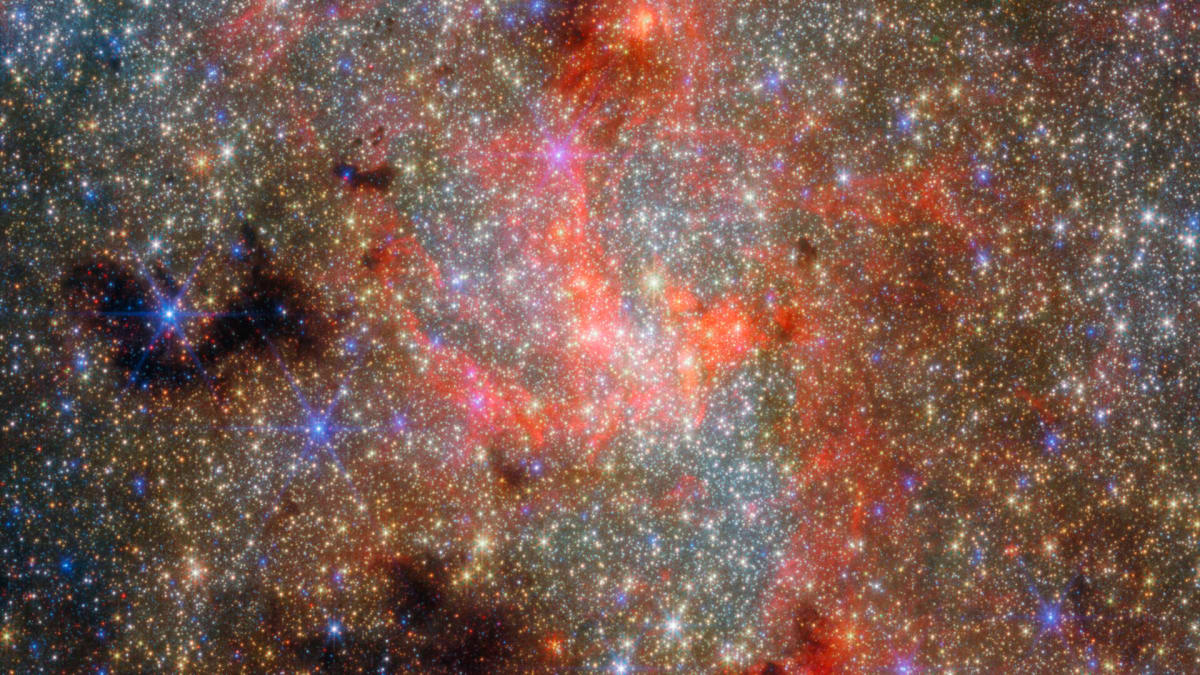
The telescope detected water vapor and freshly formed dust around a dying star called IRS 3, located just over half a light-year from Sagittarius A*, the supermassive black hole at the Milky Way's center. That might sound like a safe distance, but in cosmic terms, it's like standing next to a roaring furnace.
This isn't liquid water or even ice. It's molecular water vapor mixed with silicate dust, the same material that makes up rocky planets like Earth. The discovery appeared in the peer-reviewed journal Astronomy & Astrophysics in 2025.
Webb didn't take a photograph. Instead, it split the star's infrared light into a spectrum, revealing the unique fingerprints of water molecules between 6.0 and 6.25 micrometers. Scientists also found two telltale silicate features that confirmed the star has an oxygen-rich envelope filled with dust grains.
The discovery settles a long debate about what kind of star IRS 3 really is. Previous observations couldn't determine if it was oxygen-rich or carbon-rich because the crowded galactic center made it hard to separate one source from another. Now scientists know for certain: this dying giant is producing oxygen-rich silicate dust.
What makes this remarkable is where it's happening. The galactic center blazes with intense ultraviolet radiation, hot gas, and fast-moving material. Most scientists assumed such fragile molecules couldn't form or survive there.
The star's secret lies in its protective cocoon. IRS 3 has built a dusty envelope stretching about 10,000 astronomical units, roughly one-sixth of a light-year across. This shell has multiple layers, with temperatures dropping from about 1,200 degrees Fahrenheit in the inner regions to around negative 315 degrees in the outer zones.
As the star pulses and sheds material, gas expands and cools, allowing molecules to persist and dust grains to condense. The inner layers likely contain aluminum oxide mixed with silicates, while pure silicates dominate the outer regions.
The Ripple Effect
This discovery changes how scientists think about star death in extreme environments. If water molecules and delicate dust can form this close to a supermassive black hole, similar processes might happen in other harsh cosmic neighborhoods across the universe.
The finding also shows that even in the galaxy's most radiation-soaked regions, dying stars can still create the building blocks of planets. These silicate grains and molecules represent the raw materials that eventually become rocky worlds.
Every discovery like this expands the map of where complex chemistry can happen in space, bringing us closer to understanding how planetary systems and potentially life-supporting worlds form throughout the cosmos.
More Images

Based on reporting by Google: James Webb telescope
This story was written by BrightWire based on verified news reports.
Spread the positivity!
Share this good news with someone who needs it