Webb Telescope Maps Glowing Auroras on Uranus
The James Webb Space Telescope just created the first detailed 3D map of Uranus' mysterious upper atmosphere, revealing giant aurora bands that stretch far beyond the planet's poles. Scientists say understanding this ice giant's unique energy system is a crucial step toward studying planets beyond our solar system.
Scientists just got their best look ever at one of the solar system's strangest worlds, and the view is stunning.
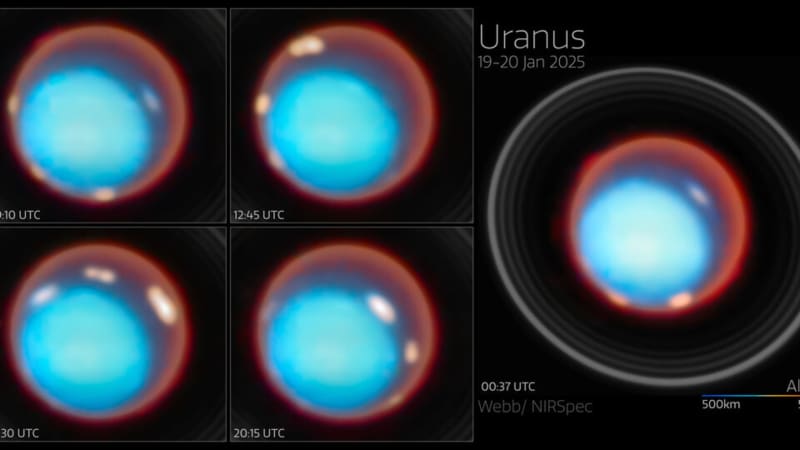
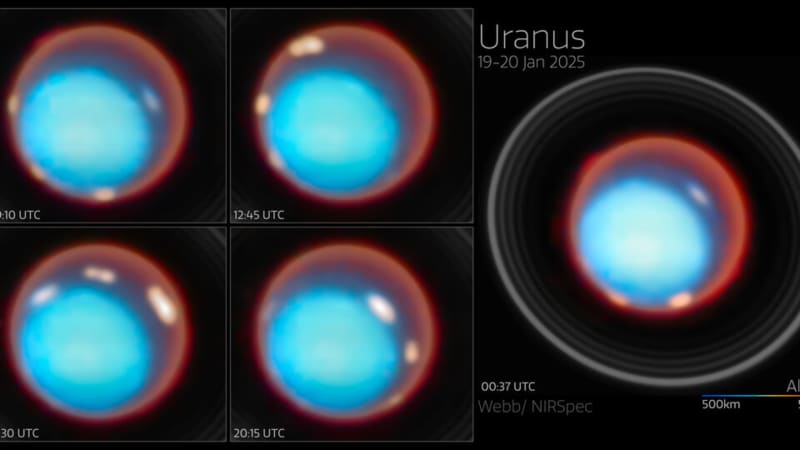
The James Webb Space Telescope watched Uranus rotate for 15 hours straight in January 2025, creating the most detailed portrait yet of the ice giant's upper atmosphere. The observations revealed two bright bands of auroras glowing near the planet's magnetic poles, unlike anything we see on Earth.
Uranus is truly weird. Its magnetic pole tilts 60 degrees away from its geographic pole, making it the most lopsided magnetic field among all the big planets in our solar system. That extreme tilt pushes auroras far beyond the poles, creating light shows that extend thousands of miles into space.
Webb's observations captured something scientists had never seen before: a dark gap between the two aurora belts where both ion density and light emissions drop dramatically. The team believes this mysterious gap happens where different magnetic field lines transition, similar to patterns spotted around Jupiter.
The telescope measured temperature and ion density up to 3,100 miles above Uranus' cloud tops. The data revealed a puzzle: the warmest ions sit between 2,500 and 3,100 miles high, but the densest ions cluster much lower, around 600 miles up. That unusual split comes from the complex geometry of the planet's tilted magnetic field.
Lead researcher Paola Tiranti, a doctoral student at Northumbria University, said Webb showed just how deeply the magnetic effects reach into the atmosphere. The team also confirmed that Uranus has been steadily cooling since the early 1990s. The current average temperature sits at about 307 degrees Fahrenheit, lower than previous measurements.
Why This Inspires
Uranus rolls sideways around the sun, a literal oddball that we've barely studied up close. The only spacecraft to visit was Voyager 2 back in 1986, leaving scientists hungry for detailed observations.
Now Webb is filling those gaps without leaving Earth's orbit. By mapping how ice giants distribute energy in their upper atmospheres, scientists are building a blueprint for understanding giant planets orbiting distant stars. Every discovery at Uranus teaches us something about the thousands of exoplanets waiting to be explored.
The telescope's ability to chart Uranus in three dimensions represents a major leap forward in planetary science. Understanding the energy balance of ice giants brings us closer to answering bigger questions about how planets form, evolve, and maintain their atmospheres over billions of years.
This breakthrough shows how studying our cosmic neighbors can unlock secrets about worlds we'll never visit in person but desperately want to understand.
More Images



Based on reporting by Live Science
This story was written by BrightWire based on verified news reports.
Spread the positivity!
Share this good news with someone who needs it