Webb Telescope Finds Black Hole That Formed Before Galaxy
NASA's James Webb Space Telescope discovered a supermassive black hole that existed just 700 million years after the Big Bang, challenging everything scientists thought they knew about how these cosmic giants form. The black hole makes up two-thirds of its entire system's mass, suggesting it formed first and the galaxy came later.
Scientists just flipped the cosmic script on one of astronomy's biggest questions: Which came first, the galaxy or the black hole?
For decades, researchers believed galaxies formed first, then black holes grew from collapsed stars within them. But NASA's James Webb Space Telescope just spotted a supermassive black hole that appears to have beaten its galaxy to the punch.
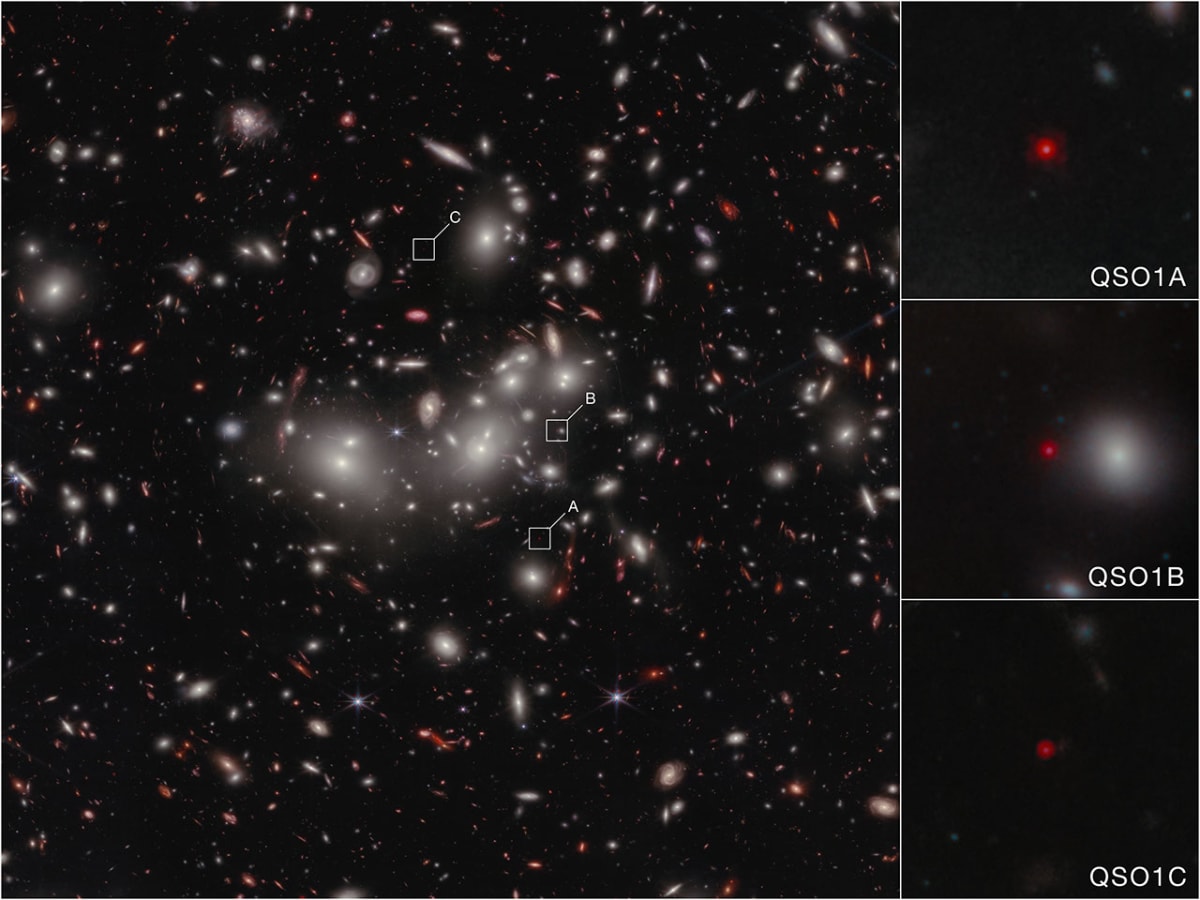
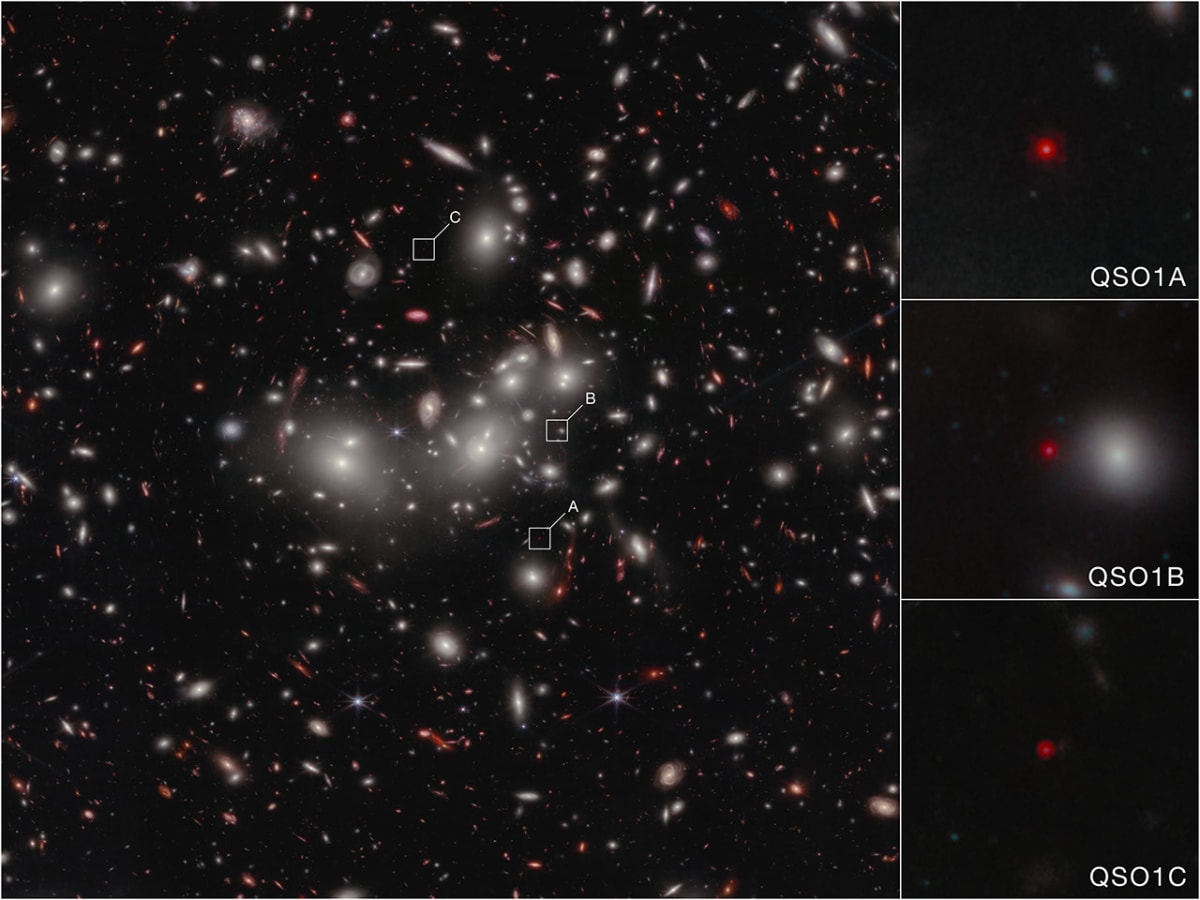
The black hole, called Abell2744-QSO1, existed when our universe was only 700 million years old. That's incredibly young in cosmic terms, leaving scientists scratching their heads about how it grew so massive so quickly.
Here's what makes this discovery remarkable: The black hole weighs about 50 million times more than our Sun and makes up at least two-thirds of its entire system's mass. In our nearby galaxies today, supermassive black holes are tiny fractions of their galaxy's total weight.
"This is a paradigm shift, a total revisiting of the classical scenarios of how black holes form and grow," said Roberto Maiolino of Cambridge University, who co-authored the studies published in Nature and the Monthly Notices of the Royal Astronomical Society.
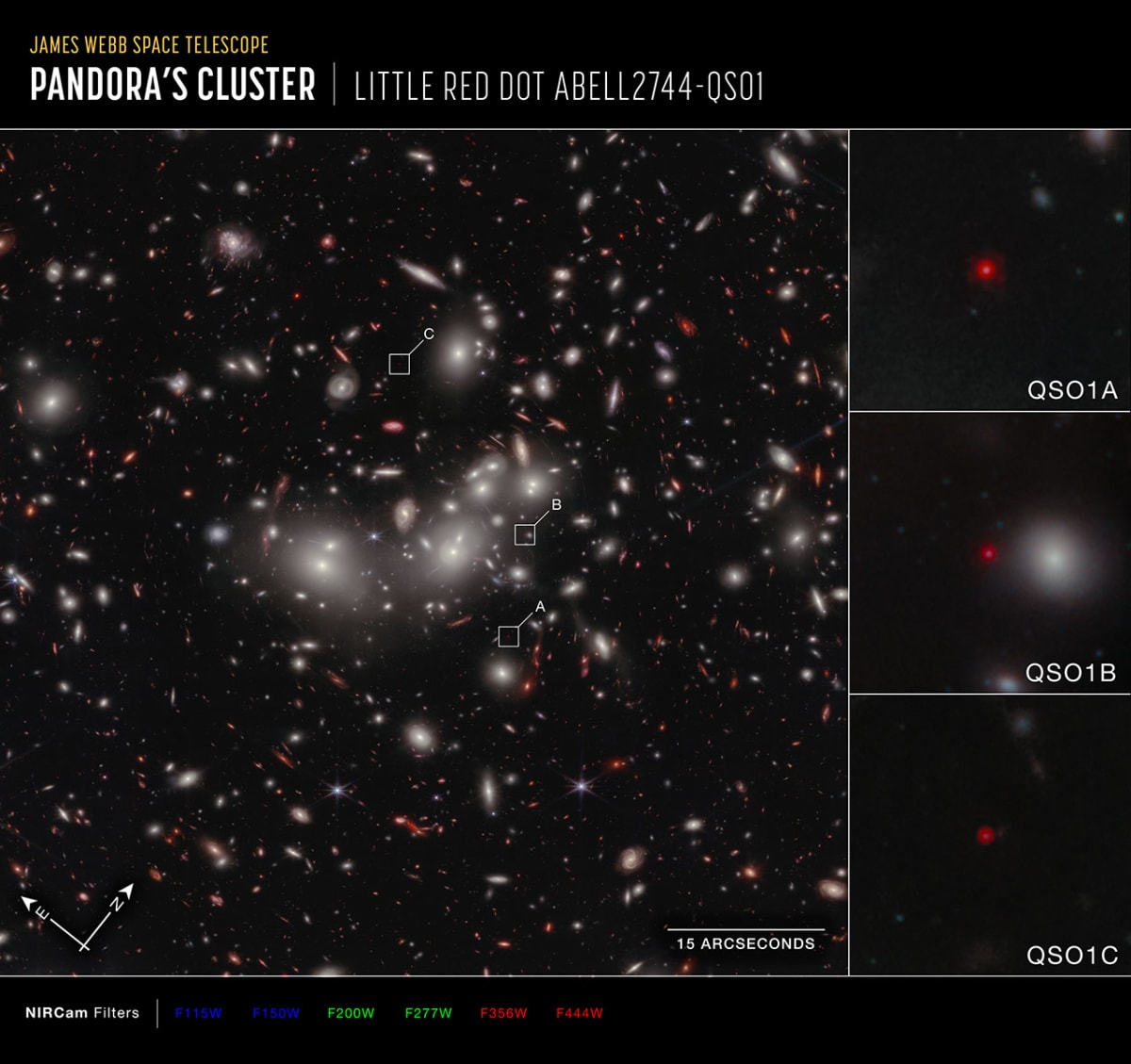
The team got lucky with this discovery. A massive galaxy cluster called Pandora's Cluster acted like a cosmic magnifying glass, bending light and creating three separate images of the same black hole. This gravitational lensing made detailed observations possible.
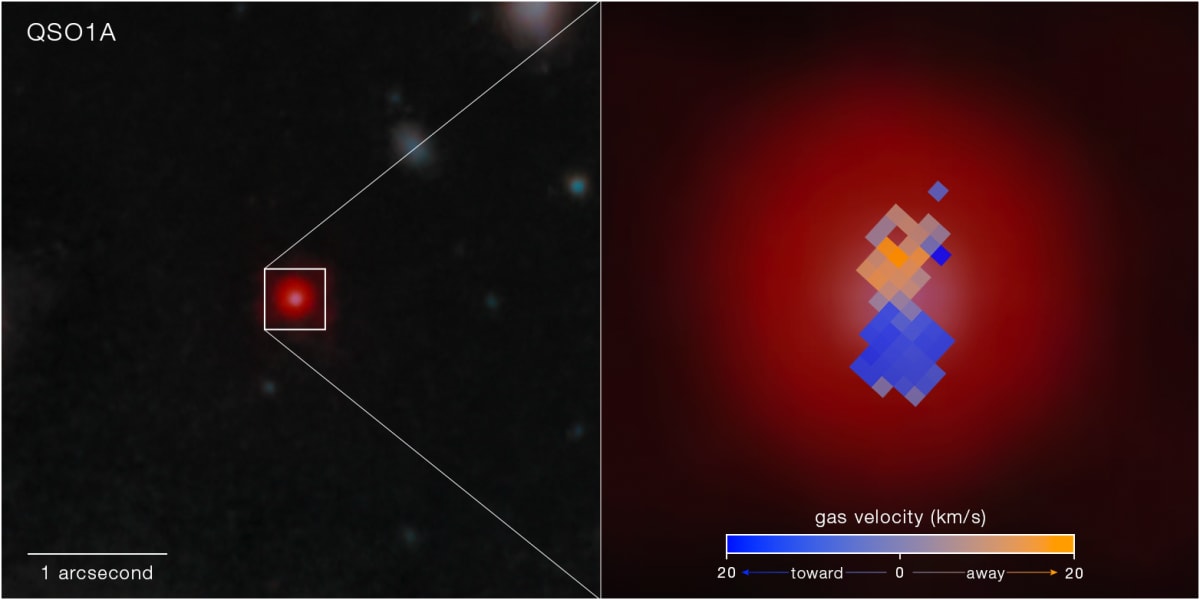
Cambridge graduate student Ignas Juodžbalis and his team used Webb's Near Infrared Spectrograph to map hydrogen gas swirling around the black hole. They discovered the gas moves in Keplerian motion, the same way planets orbit our Sun, which only happens when mass is concentrated at a single central point.
This movement pattern allowed scientists to directly calculate the black hole's mass for the first time ever in the early universe. Previous measurements were all educated guesses based on assumptions from nearby black holes.
The gas composition revealed another surprise: almost pure hydrogen and helium, with barely any heavier elements like oxygen. If stars filled this system, their debris would have left chemical fingerprints. Instead, the pristine environment suggests this black hole formed without the usual stellar collapse process.
Why This Inspires
This discovery opens a new chapter in understanding our cosmic origins. Scientists have detected thousands of supermassive black holes in the early universe, but could never explain how they grew so big so fast from stellar seeds.
Now we know some black holes might have been born enormous, skipping the slow growth phase entirely. This finding validates earlier indirect measurements of early black holes, giving scientists confidence that their previous work wasn't overestimating these cosmic giants.
The James Webb Space Telescope continues proving its worth, peering deeper into space and time than ever before. Each discovery rewrites textbooks and reminds us how much we still have to learn about our universe's incredible story.
This black hole that came before its galaxy shows us the cosmos still holds beautiful mysteries waiting to be solved.
More Images
Based on reporting by NASA
This story was written by BrightWire based on verified news reports.
Spread the positivity!
Share this good news with someone who needs it