Webb Telescope Maps Weather on Planet 700 Light-Years Away
NASA's James Webb Space Telescope just delivered the first weather forecast for a distant exoplanet, revealing clouds made of vaporized rock that form overnight and disappear by morning. The breakthrough shows scientists can now track atmospheric patterns on worlds hundreds of light-years from Earth.
Scientists just figured out the weather forecast for a planet nearly 700 light-years away, and it's unlike anything you've seen on Earth.
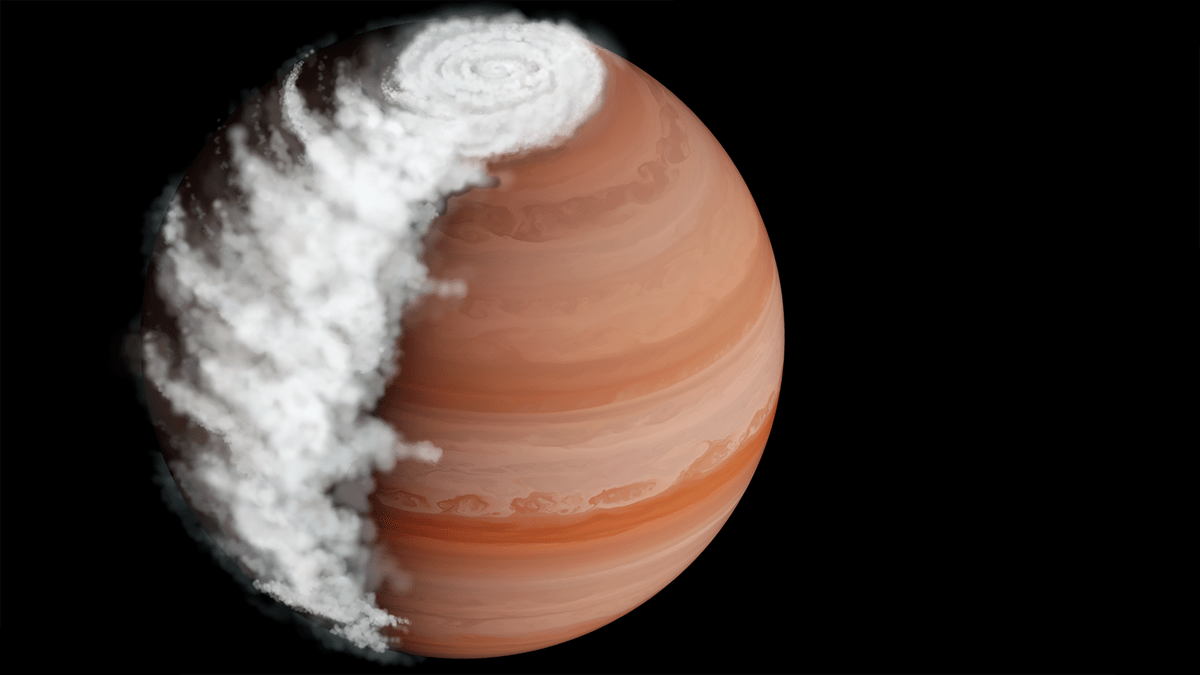
NASA's James Webb Space Telescope captured the first detailed weather report for WASP-94A b, a giant gas planet orbiting its star every four days. The forecast reveals puffy clouds made of vaporized rock, including magnesium silicate and iron, that form on one side of the planet and vanish on the other.
The planet is tidally locked to its star, meaning one side always faces the sunlight while the other remains in eternal darkness. This creates dramatically different conditions on each hemisphere that scientists can now observe as the planet moves around its star.
Researchers discovered something remarkable when they looked at the planet's morning and evening edges separately. The morning side shows thick cloud cover, while the evening side is almost completely clear.
"It was really surprising how different the two halves of the same planet are," says Sagnick Mukherjee, lead author of the study from Arizona State University. The research appears in the journal Science.
The weather pattern works like an overnight fog on Earth, but on a cosmic scale. Cooler air throughout the night generates clouds that burn off in the bright morning light as powerful winds push the atmosphere around the planet.
This discovery solves a puzzle that has frustrated astronomers for years. Dense clouds often block scientists from studying the chemical makeup of distant planets, but understanding these weather patterns helps them work around the problem.
Why This Inspires
This breakthrough represents more than just a fancy weather report. For the first time, scientists can track how clouds move and change on a world hundreds of light-years away, proving that tools exist today to understand alien atmospheres in real time.
"You can, at a glance, see the difference" in the hemispheres' weather, says Heather Knutson, an exoplanetary scientist at Caltech who wasn't involved in the study. The clarity of the data exceeded expectations.
The findings also carry an important lesson about making assumptions. Scientists now know they need to observe multiple regions of a planet before drawing conclusions about its composition and history, because atmospheric conditions can vary dramatically across a single world.
The research team has already used Webb to study similar weather dynamics on two other hot Jupiter planets. Future telescopes could eventually track weather patterns on smaller, more Earth-like planets, bringing scientists one step closer to finding worlds that might support life.
A decade ago, scientists discovered WASP-94A b by detecting the wobble it creates in its star and watching it cast shadows during transits. Today, they're mapping its clouds and understanding its storms, turning a distant point of light into a world with its own unique climate system.
More Images

Based on reporting by Google: James Webb telescope
This story was written by BrightWire based on verified news reports.
Spread the positivity!
Share this good news with someone who needs it