Webb Telescope Reveals Stunning Star Nursery 25M Light-Years Away
The James Webb Space Telescope captured breathtaking new details of Arp 263, one of the universe's strangest galaxies, revealing thousands of baby stars forming in brilliant cosmic nurseries. Scientists are unlocking secrets about how stars are born across different types of galaxies.
The James Webb Space Telescope just gave us front-row seats to one of the cosmos's most beautiful mysteries: a chaotic galaxy bursting with newborn stars.
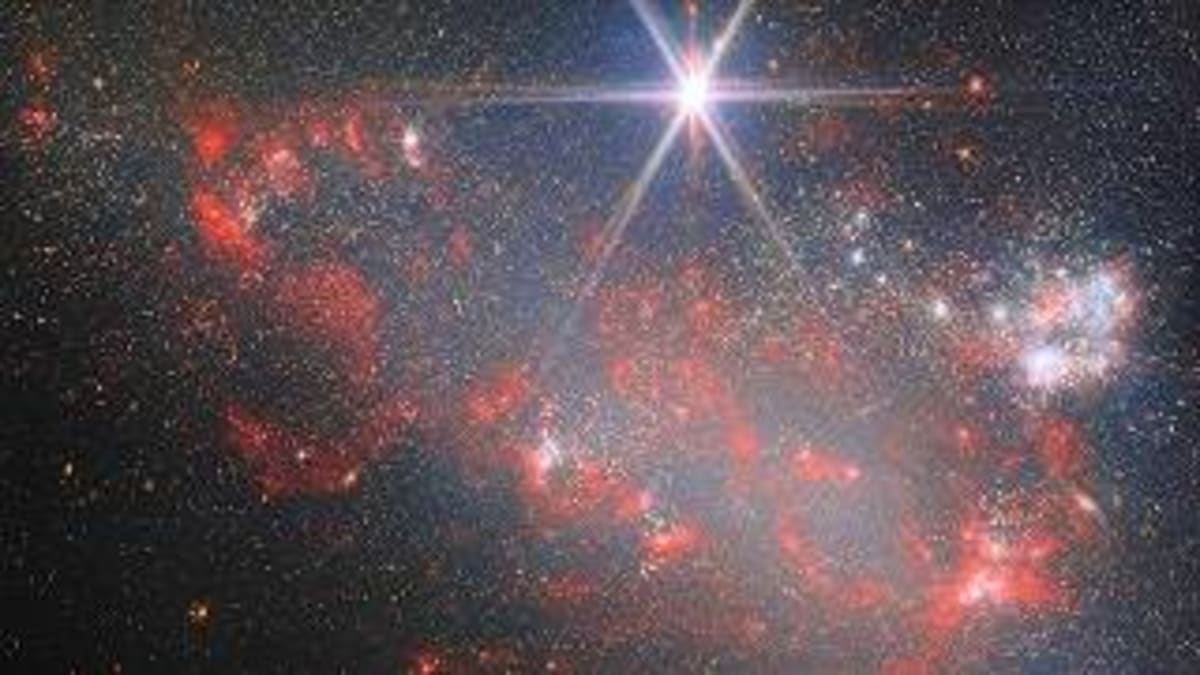
Arp 263, located 25 million light-years from Earth, earned its spot in the Atlas of Peculiar Galaxies for good reason. Its wildly irregular shape and curved tails tell the dramatic story of an ancient collision with another galaxy.
What makes this discovery truly special is what Webb can now see that other telescopes couldn't. The $10 billion observatory's powerful infrared camera peers through thick cosmic dust to reveal stunning detail: glowing hydrogen gas lit up by starlight appears in brilliant blue, while complex molecules shine in deep red across the galaxy.
The most exciting view is a curved chain of compact star clusters leading to the galaxy's brightest star-forming region. Webb lets astronomers peek directly into this stellar nursery and watch stars being born in real time.
Scientists believe Arp 263's companion galaxy from that long-ago collision has completely vanished. The smaller galaxy may have been absorbed entirely into Arp 263, or it could have been so dim that even Webb's exceptional vision can't spot what remains.
Either way, that cosmic crash shook up Arp 263's gas so thoroughly that new stars are now forming at an incredible rate. This kind of galactic upheaval actually creates the perfect conditions for star birth.
Why This Inspires
When the Hubble Space Telescope photographed this same galaxy just a few years ago, the view was dramatically different. Webb's advanced technology reveals details Hubble simply couldn't capture, showing how far our ability to explore the universe has come.
Researchers are studying Arp 263 because it offers valuable clues about how stars form differently across various galaxy types. Each observation adds pieces to the puzzle of how our universe creates new solar systems and potentially new worlds.
The image also captures dozens of other distant galaxies, including some appearing as tiny orange dots that are hundreds of millions of light-years away. Every bright object in the frame represents countless stars and untold cosmic stories waiting to be discovered.
Even the brightest star in the image, BD+17 2217, reminds us of connection: it's actually part of our own Milky Way Galaxy, a nearby neighbor watching over this distant stellar nursery.
New telescopes like Webb prove that our capacity to understand the universe keeps growing, one stunning image at a time.
More Images

Based on reporting by Google: James Webb telescope
This story was written by BrightWire based on verified news reports.
Spread the positivity!
Share this good news with someone who needs it