Webb Telescope Spots Supermassive Black Hole Being Born
Scientists may have captured the birth of a supermassive black hole for the first time, revealing how the universe creates these cosmic giants far faster than previously thought. The discovery could solve a puzzle that has stumped astronomers for decades.
Scientists using the James Webb Space Telescope may have witnessed something extraordinary: a supermassive black hole being born right before our eyes.
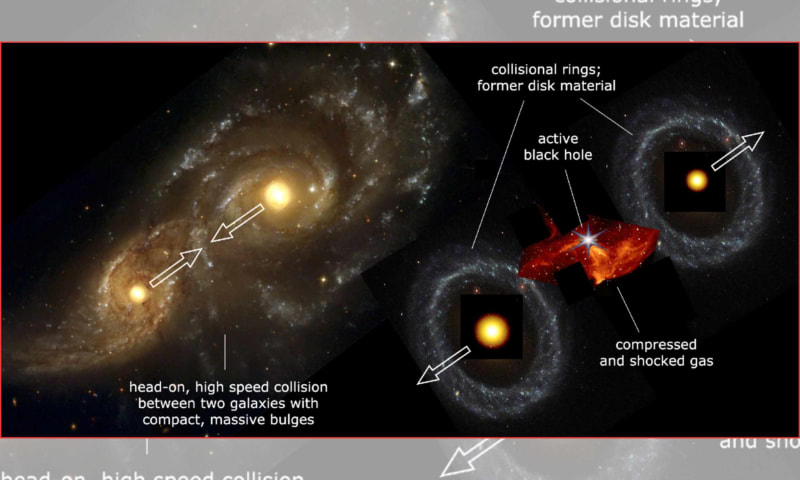
The discovery happened in a distant galaxy nicknamed "Infinity" because of its figure-eight shape. Two galaxies crashed together in a cosmic collision so powerful it may have squeezed gas into a brand new black hole between them.
Yale University Professor Pieter van Dokkum led the team that spotted the unusual system. When they looked closer with Hawaii's Keck Observatory, they found something puzzling: the brightest light source wasn't coming from either galaxy's center, but from the space between them.
That's not where black holes normally live. Supermassive black holes usually anchor themselves in the heart of galaxies, so finding one in the middle of nowhere raised serious questions.
Follow-up observations from radio and X-ray telescopes all pointed to the same spot. A cloud of glowing, superheated gas surrounded the mysterious object, exactly what you'd expect from a hungry young black hole feeding for the first time.
"How can we make sense of this?" van Dokkum wondered after seeing where the black hole appeared. The team realized they might be watching a long-theorized process actually happening.
When the two galaxies slammed together, the impact compressed massive gas clouds with incredible force. That compression created conditions extreme enough for the gas to collapse into a single dense object instead of spreading out into stars.
Why This Inspires
This discovery matters because it solves a cosmic mystery. Scientists have long struggled to explain how supermassive black holes grew so large so quickly in the early universe.
The traditional theory says small black holes from dying stars slowly grow by feeding and merging over billions of years. But that process takes too long to explain the monsters we see in young galaxies.
The Infinity galaxy shows another path: colliding galaxies can birth already-massive black holes that skip the slow growth phase entirely. While galaxy crashes like this are rare today, they were common when the universe was young.
The team will use sharper telescopes with adaptive optics to study the gas movements near the black hole's center. Those observations could confirm whether this black hole truly formed on the spot or wandered there from somewhere else.
Computer simulations will replay the collision to see if the physics match what telescopes observe. If the models work, astronomers will have a new guide for finding more black holes caught in the act of being born.
The research appears in The Astrophysical Journal Letters, opening a window into cosmic creation that scientists have chased for generations.
Based on reporting by Google: James Webb telescope
This story was written by BrightWire based on verified news reports.
Spread the positivity!
Share this good news with someone who needs it