Webb Telescope Unlocks Mysteries of the Early Universe
The James Webb Space Telescope is revealing cosmic wonders never seen before, from mysterious "little red dots" to impossibly large ancient black holes. Scientists worldwide are racing to understand what these discoveries mean for our universe's earliest days.
Scientists around the world are sketching, calculating, and marveling at cosmic mysteries that didn't exist before 2022.
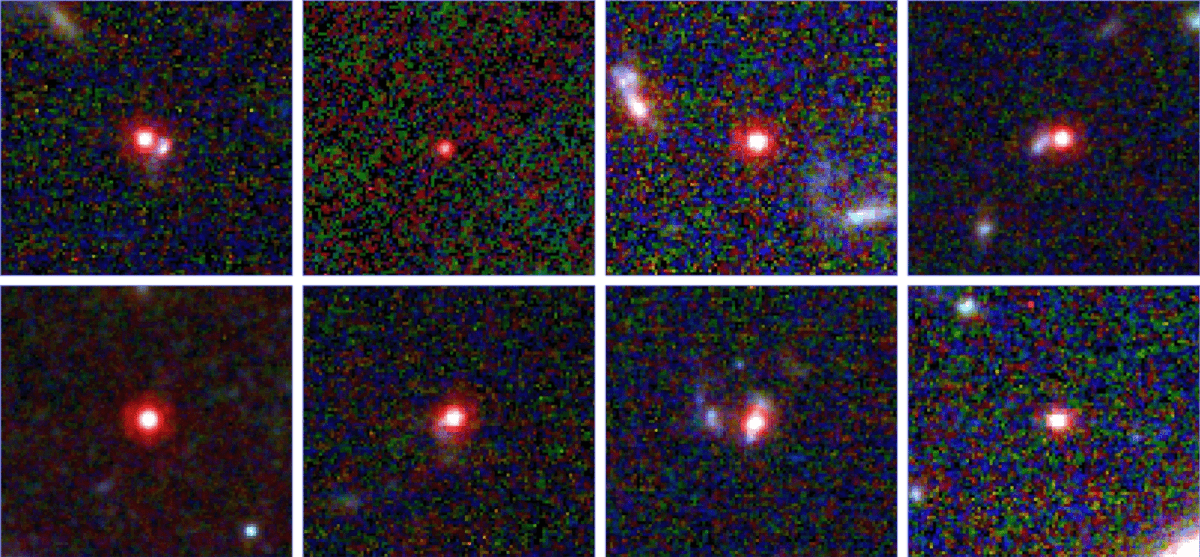
That's when the James Webb Space Telescope came online and started sending back images that have turned our understanding of the early universe upside down. The telescope has spotted hundreds of strange objects called "little red dots" that appeared just 650 million years after the Big Bang, and nobody had seen them before.
Charlotte Mason, an astrophysicist in Copenhagen, is one of many researchers trying to crack the code. She fills notebooks with sketches of these tiny cosmic enigmas, drawing circles within circles to visualize what might be happening billions of light-years away.
The leading theory? These little red dots could be black holes wrapped in thick clouds of gas. Some scientists think they might even be an entirely new type of object called a black hole star, where the gas shroud glows like a stellar atmosphere.
But Mason's team recently found something puzzling. When they analyzed the light from one little red dot, it didn't match what dense clouds should produce. Now she's drawing new diagrams with holes in the gas clouds, trying different configurations until the picture makes sense.
The telescope has also spotted black holes that seem impossibly large for their age. Some reached a billion times the mass of our sun within the first billion years after the Big Bang, and scientists can't fully explain how they grew so big so fast.
Why This Inspires
What makes this moment special isn't just the discoveries themselves. It's watching the scientific process unfold in real time as researchers worldwide collaborate to solve cosmic puzzles.
Jenny Greene, an astrophysicist at Princeton University, describes the challenge with excitement. Getting black holes that massive so quickly requires "some gymnastics," she says, and teams are proposing creative new theories to explain what they're seeing.
Some researchers think ancient star clusters created black hole seeds that rapidly merged. Others believe massive gas clouds collapsed directly into black holes, skipping the star stage entirely. Computer simulations now suggest black holes might grow faster than previously thought possible through "super-Eddington" accretion, where gas overwhelms the usual limits.
Every day brings new data, and every image from the telescope adds another piece to the puzzle. Like the photons that travel billions of light-years to reach us, fragments of understanding are constantly falling into place as scientists sketch, theorize, and test their ideas against the evidence.
The universe's earliest chapters are being rewritten before our eyes, one discovery at a time.
More Images

Based on reporting by Wired
This story was written by BrightWire based on verified news reports.
Spread the positivity!
Share this good news with someone who needs it