Wobbling Black Hole Jet Reshapes How We See Galaxies
Astronomers discovered a massive 20,000-light-year jet erupting from a black hole in galaxy VV340a, twisting like a cosmic corkscrew. The finding challenges everything scientists thought they knew about how galaxies grow and evolve.
Scientists just witnessed something they thought was impossible: a young galaxy shooting twisted jets of superheated plasma across thousands of light-years, fundamentally rewriting our understanding of how galaxies like our own Milky Way came to be.
Researchers from UC Irvine and Caltech spotted the phenomenon in galaxy VV340a using three of the world's most powerful telescopes working together. The W. M. Keck Observatory in Hawaii, the James Webb Space Telescope, and the Karl G. Jansky Very Large Array each captured different pieces of this cosmic puzzle.
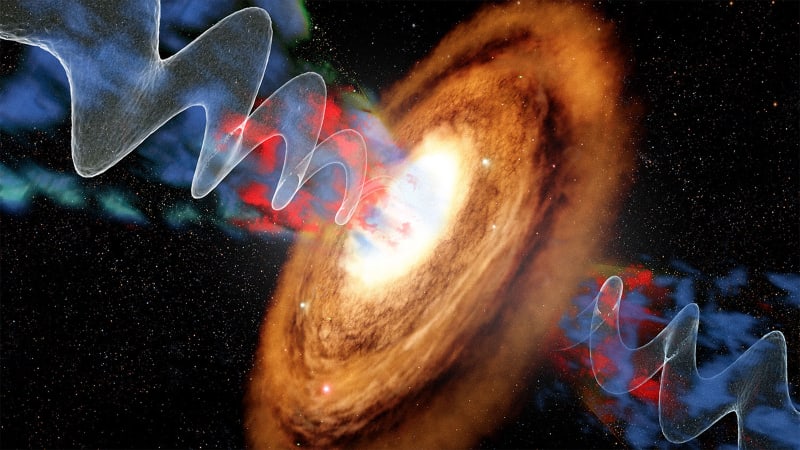
What they found was breathtaking. A supermassive black hole at VV340a's center is launching jets of plasma that wobble like a spinning top as they streak outward at nearly the speed of light. These jets stretch 20,000 light-years from the galaxy's core, making them the largest ever observed in a nearby galaxy.
The wobbling motion, called jet precession, creates a helical pattern rarely seen in nature. Think of it like water spiraling from a garden hose that's slowly rotating.
Even more surprising was what the Webb telescope revealed: a corona of superheated gas measuring several thousand parsecs across. Most coronae measure in the hundreds of parsecs, making this discovery record-breaking on multiple fronts.
Lead researcher Justin Kader explained that the Keck Observatory data showed the true scale of how powerfully and persistently this black hole is reshaping its galaxy. The jets are stripping away about 20 Solar masses worth of gas every year, effectively shutting down new star formation in their path.
Here's what has scientists buzzing: this kind of massive jet activity was only supposed to happen in old, settled elliptical galaxies. VV340a is young and still merging with another galaxy, turning conventional wisdom on its head.
Why This Inspires
This discovery opens an exciting new chapter in understanding our cosmic home. For decades, scientists wondered if something similar could have happened in the Milky Way's past, but there was no evidence.
Now we know it's possible. The findings suggest our own galaxy may have experienced dramatic reshaping events we never imagined, hidden in its ancient history.
Vivian U, the study's senior author, emphasized that we're only beginning to understand how common this powerful galaxy-changing activity might be. When the world's most advanced observatories work together, they reveal wonders that rewrite the textbooks.
The research team plans to conduct higher-resolution observations to determine if a second black hole might be causing the wobble. If confirmed, it would add another layer to this already remarkable story.
This discovery proves that even after centuries of studying the night sky, the universe still has surprises that can fundamentally change how we see our place in the cosmos.
More Images

Based on reporting by Live Science
This story was written by BrightWire based on verified news reports.
Spread the positivity!
Share this good news with someone who needs it