World's Most Sensitive Radio Telescope to Debut in Nevada
A groundbreaking telescope array in Nevada's desert will double humanity's known radio sources in just 24 hours. The 1,650-dish Deep Synoptic Array promises to revolutionize our understanding of black holes, pulsars, and mysterious cosmic signals.
The Nevada desert is about to become home to the most powerful radio telescope ever built, capable of discovering more cosmic objects in one day than humanity has found in a century.
The California Institute of Technology announced it's moving forward with the Deep Synoptic Array after securing full funding. The ambitious project will place 1,650 individual radio dishes across 123 square miles of Nevada's White Pine County, creating an unprecedented tool for exploring the universe.
The numbers are staggering. Every telescope built in the past 100 years has collectively found about 20 million radio sources in space. This new array will double that number in its first 24 hours of operation.
"Radio astronomy is about to go from sketch to photograph," said Vikram Ravi, a Caltech professor and co-principal investigator. The telescope will survey the sky 100 times faster than existing instruments while producing the highest quality radio images ever captured.
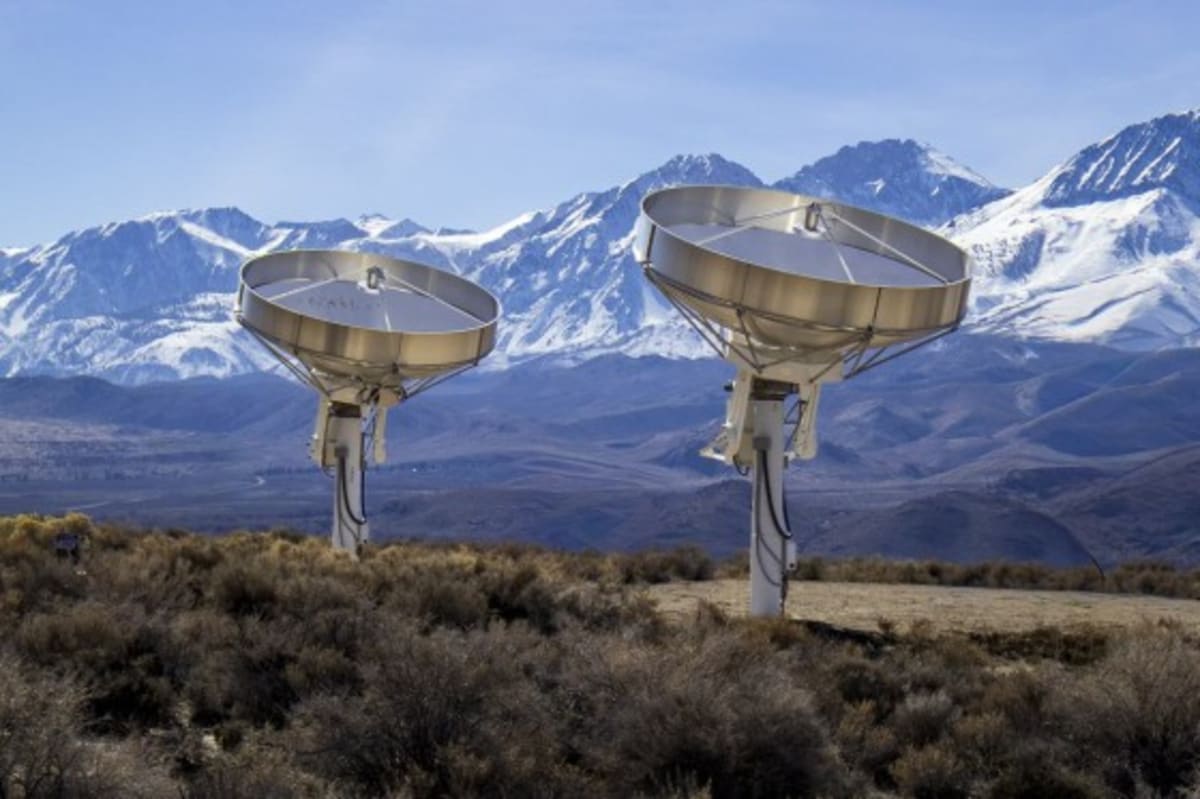
Each dish measures roughly 20 feet across, and together they'll hunt for supermassive black holes, spinning dead stars called pulsars, and fast radio bursts. These brief, intense explosions of radio waves from deep space remain one of astronomy's most tantalizing mysteries.
What makes this telescope special is its dual superpower. Previous radio telescopes had to choose between sensitivity or image quality. Single giant dishes could detect faint signals but produced fuzzy images, while arrays of smaller dishes created sharp pictures but missed weaker signals. The Deep Synoptic Array delivers both.
The location wasn't chosen by chance. Gregg Hallinan and his team surveyed sites across California, Nevada, New Mexico, and Utah, searching for the quietest spot they could find. Radio telescopes need protection from interference created by cellphones, Wi-Fi, and other electronics.
"This telescope is sensitive enough to detect a cellphone as far away as the sun," Hallinan explained. The Great Basin's quiet valleys and low population density provide a natural shield, making White Pine County ideal for the project.
The Ripple Effect
The telescope's discoveries won't stay secret. Researchers plan to conduct at least five major sky surveys, pinpointing cosmic events with unprecedented precision. When the array detects something interesting, optical, infrared, and X-ray observatories worldwide can immediately focus on the same spot for deeper investigation.
This collaboration could unlock answers to questions about how galaxies form, what causes mysterious cosmic explosions, and how the universe evolved. Schmidt Sciences, the philanthropic organization founded by former Google CEO Eric Schmidt and his wife Wendy, provided funding to make the vision reality.
Construction could begin next year following the permitting process, with completion targeted for 2029. Two prototype dishes near Bishop, California, have already proven the technology works.
In just a few years, humanity's view of the radio universe will transform from a rough sketch into a high-definition photograph, revealing cosmic wonders we've never imagined.
More Images


Based on reporting by Google News - Science
This story was written by BrightWire based on verified news reports.
Spread the positivity!
Share this good news with someone who needs it