Ocean AI Nodes Could Power Data Centers Using Waves
Investors just bet $210 million on floating AI data centers that generate their own power from ocean waves. The bold solution tackles energy and cooling challenges facing traditional data centers on land.
📺 Watch the full story above
When Silicon Valley investors put $210 million into giant floating spheres that power AI with ocean waves, they weren't just betting on cool technology. They were betting on solving one of the biggest challenges facing artificial intelligence today.
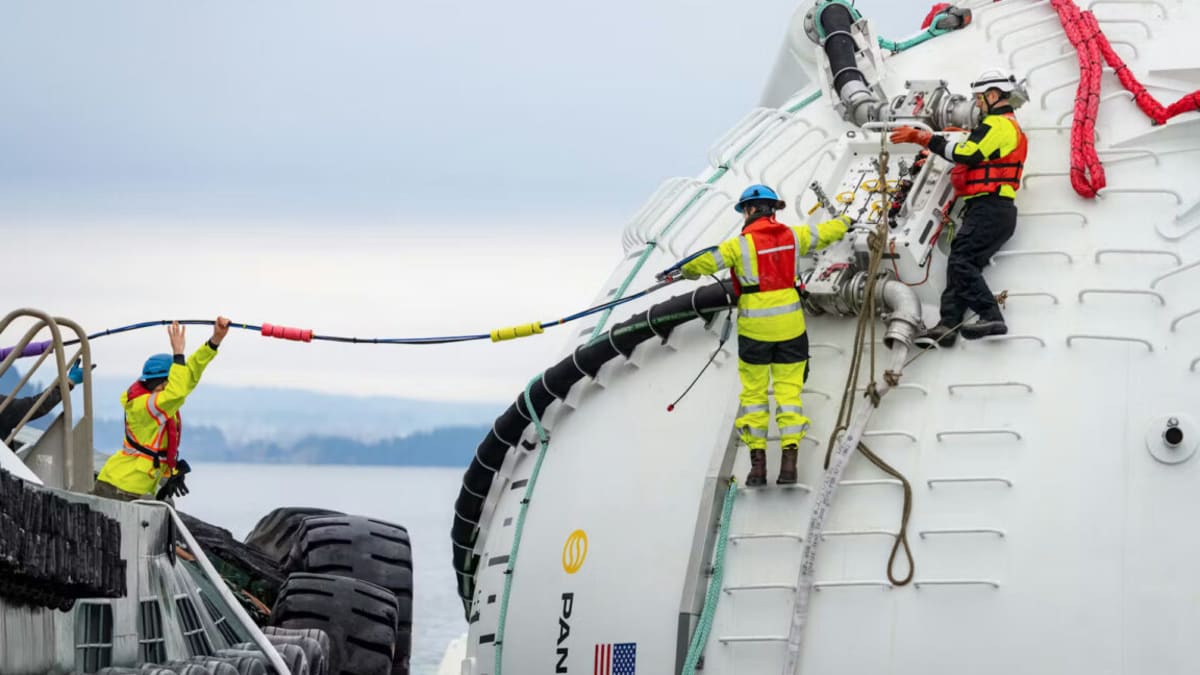
The company Panthalassa just secured $140 million to build ocean-based AI data centers that skip the traditional power grid entirely. Instead, massive steel spheres bobbing on the water use wave motion to generate renewable energy that powers AI chips right on board.
Here's how it works: Each sphere stands nearly as tall as Big Ben, with a tube extending deep below the surface. Waves push water up through the tube into a pressurized tank, which then spins a turbine to create electricity for onboard AI processors.
The timing couldn't be better. Tech companies plan to spend $765 billion building AI data centers in 2026, but they're hitting roadblocks everywhere. Power shortages, water scarcity for cooling systems, and local community pushback are slowing construction across the country.
Panthalassa's floating nodes solve multiple problems at once. The ocean provides free cooling through surrounding water, eliminating the massive fresh water needs of land-based facilities. The wave energy means no strain on electrical grids already struggling to keep up with AI's appetite for power.
The company has already tested earlier prototypes, including a three-week trial off Washington state in February 2024. Their next version, Ocean-3, hits the northern Pacific for testing in late 2026.
The Ripple Effect
This approach could open up AI computing capacity without the environmental and infrastructure costs plaguing current expansion. Computer engineer Benjamin Lee from the University of Pennsylvania notes that ocean-based computing offers massive cooling advantages since ambient ocean temperatures stay consistently low.
Sure, there are hurdles. Satellite connections mean slower data transfers than fiber-optic cables, and maintaining equipment in harsh ocean conditions won't be simple. The nodes need to survive a decade without human intervention, according to company job listings.
But Panthalassa isn't alone in seeing ocean potential. Chinese companies already deployed underwater data centers near Hainan Island and Shanghai, while Singapore is building floating facilities. Microsoft's Project Natick showed that sealed, seawater-cooled systems actually achieved lower failure rates than land-based ones.
CEO Garth Sheldon-Coulson envisions thousands of these nodes eventually dotting the world's oceans, each one turning waves into the computing power that drives tomorrow's AI breakthroughs.
The world's oceans might just become the unexpected solution to keeping AI innovation flowing without overwhelming our power grids and water supplies.
More Images



Based on reporting by Ars Technica
This story was written by BrightWire based on verified news reports.
Spread the positivity!
Share this good news with someone who needs it