245-Million-Year-Old Reptile Found With Organs Intact
Scientists discovered a marine reptile fossil in China with its stomach, liver, and intestines still preserved after 245 million years. The ancient creature reveals how land animals first mastered life in the sea.
A fossil tucked away in China just rewrote what we know about ancient life, preserving a complete digestive system that survived for 245 million years.
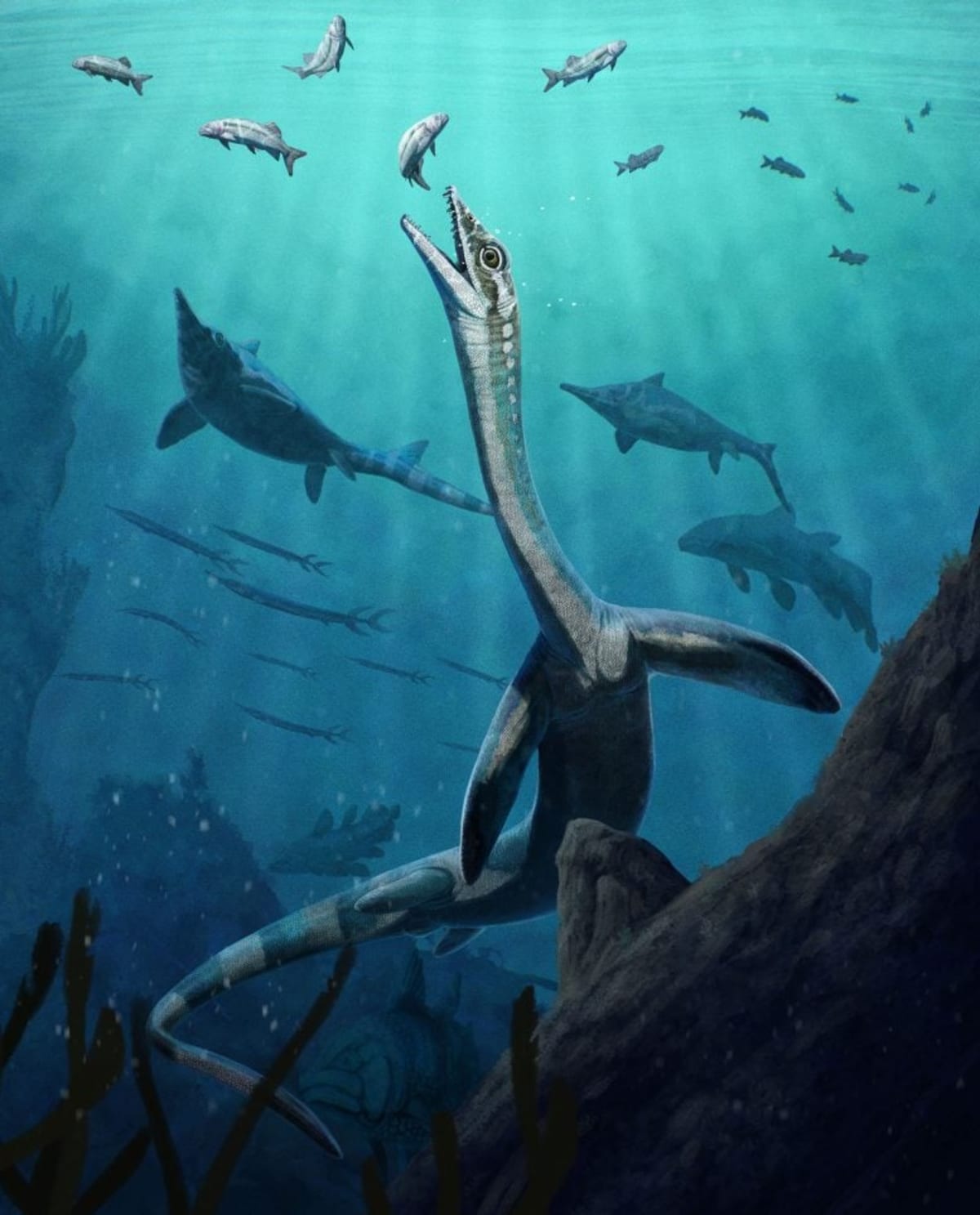
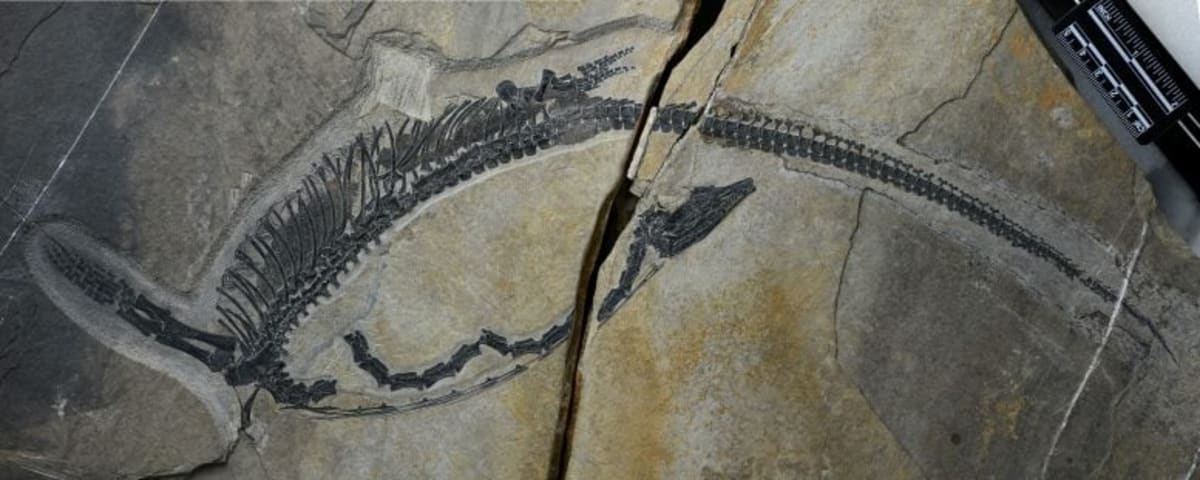
An international research team examined the remains of Austronaga minuta, a small marine reptile with an impossibly long neck that once glided through prehistoric oceans. Inside the nearly complete fossil, they found something extraordinary: the animal's stomach, liver, and intestines had been preserved in stunning detail.
The 60-centimeter reptile looked unlike anything swimming in today's oceans. Its exceptionally long neck and tail gave it a serpentine appearance, while elongated front limbs worked like fins to help it steer through the water. Its tiny hind limbs had already become nearly useless for swimming.
What makes this discovery truly special is what it tells us about evolution's creativity. Austronaga wasn't closely related to famous marine reptiles like ichthyosaurs or mosasaurs. Instead, it descended from the same land-dwelling lineage that would eventually produce dinosaurs and crocodiles.
Dr. Stephan Spiekman from the State Museum of Natural History Stuttgart helped analyze the fossil using ultraviolet light photography and mass spectrometry. These modern techniques revealed individual organs that had somehow survived intact for hundreds of millions of years.
The digestive system told its own story about ancient life. A large, sac-like stomach sat at the front, followed by a bright red liver where researchers could still detect traces of hemoglobin. Behind that stretched a simple tube forming the intestines.
Why This Inspires
This fossil represents the oldest known example of a largely complete digestive system in any reptile. It shows us that 245 million years ago, land animals were already experimenting with ocean life in ways scientists never imagined possible.
The simple stomach structure also solved an evolutionary puzzle. While today's birds and crocodiles have complex two-part stomachs, Austronaga had just one chamber. This proves that archosaurs started with basic digestive systems that only became more sophisticated over millions of years.
Dr. Wei Wang, the study's lead author at the Institute of Vertebrate Paleontology and Paleoanthropology in Beijing, notes that the short, uncomplicated digestive tract closely resembles what we see in modern fish-eating reptiles. Some solutions to survival challenges remain remarkably consistent across vast stretches of time.
The discovery opens new questions about how diverse life in Triassic seas really was and what other surprises might be waiting in fossil beds around the world.
More Images
Based on reporting by Google News - Scientists Discover
This story was written by BrightWire based on verified news reports.
Spread the positivity!
Share this good news with someone who needs it