236-Million-Year-Old Fossil Reveals Early Mammal Live Birth
Scientists discovered evidence that ancient mammal ancestors were giving birth to live young 95 million years earlier than we thought possible. The find suggests many traits we consider "modern" evolved far earlier in history than anyone imagined.
A fossilized creature from 236 million years ago just flipped our understanding of when mammals started giving birth to live babies instead of laying eggs.
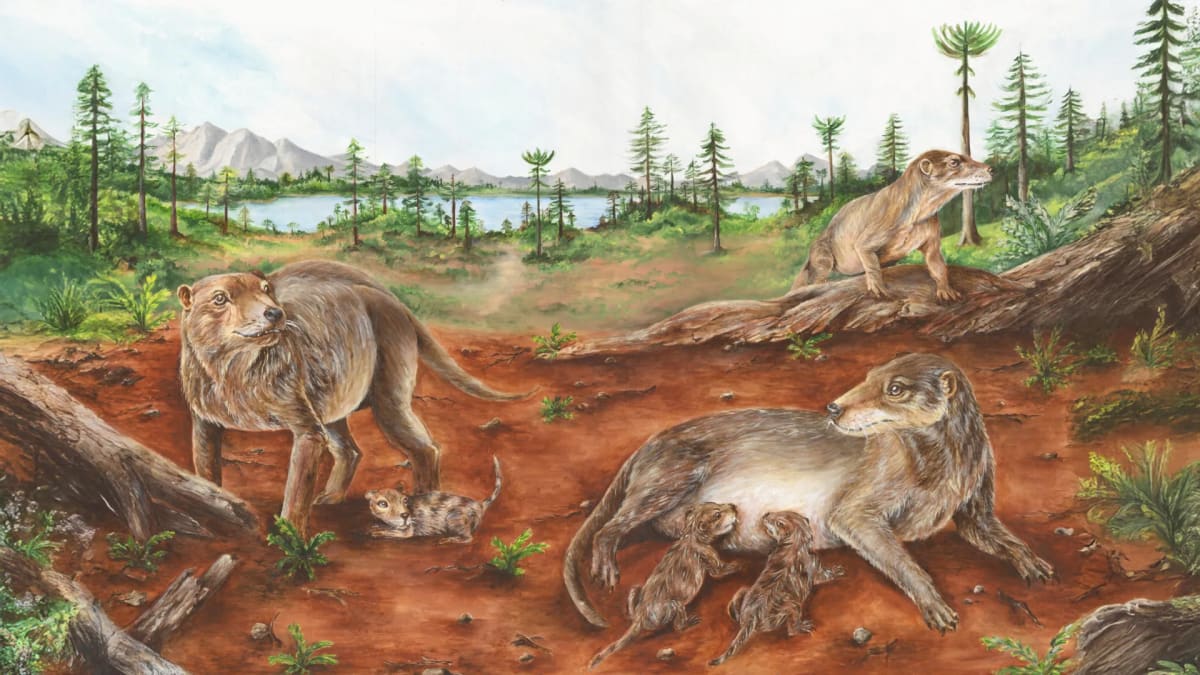
Scientists examining a cynodont fossil named Chiniquodon theotonicus found something remarkable: a tiny growth ring that only appears when animals are born live. The creature, discovered in northwestern Argentina, lived during the Triassic period when life was rebuilding after one of Earth's worst mass extinctions.
Dr. Leandro Gaetano and his team at Argentina's National Scientific and Technical Research Council spotted the unusual mark during a graduate course. The neonatal line, as it's called, forms when growth suddenly accelerates right after birth.
But finding the mark was just the beginning. The researchers needed proof that this wasn't a fluke.
They calculated the animal's birth weight at about 1.7 kilograms and its adult weight at roughly 12 kilograms. That meant babies were born at about 14% of their eventual adult size, a ratio strikingly similar to modern mammals like the bay duiker antelope.
Compare that to reptiles and birds of similar size. Turtle and crocodile hatchlings weigh only 0.1% to 0.6% of their adult mass. Bird chicks fare slightly better at 1.3% to 4.5%, but they're still nowhere near mammal ratios, which can reach nearly 19%.
The team ruled out egg-laying explanations and compared their fossil against data from thousands of living animals. The ancient cynodont grouped clearly with modern placental mammals, not reptiles or birds.
Why This Inspires
This discovery pushes back the timeline for live birth by up to 95 million years. What scientists thought was a relatively recent evolutionary development might have been protecting baby animals since the age of dinosaurs.
The Triassic world was harsh, with intense competition for resources, dangerous predators, and extreme seasonal changes. Carrying babies internally until they were larger and stronger gave them a fighting chance their egg-bound cousins didn't have.
Graduate student María Miceli Baro captured the excitement perfectly: a trait linked to evolutionary success existed long before true mammals even appeared. Other abilities we consider uniquely mammalian might have similarly ancient origins waiting to be discovered.
Dr. Gaetano believes this might not be an isolated case. More cynodonts could have given live birth, suggesting an early and widespread shift in reproductive strategy across the mammalian family tree.
The mystery of when our ancestors stopped laying eggs seemed unsolvable until this team developed creative methods to read stories written in ancient bones. Now every cynodont fossil holds new possibilities for rewriting what we know about our deep evolutionary past.
Based on reporting by Google: fossil discovery
This story was written by BrightWire based on verified news reports.
Spread the positivity!
Share this good news with someone who needs it