AI Cracks 78-Year-Old Math Problem Scientists Couldn't Solve
OpenAI's reasoning model just disproved a geometry puzzle from 1946 that stumped mathematicians for decades. Nine independent experts verified the proof, marking a historic shift from AI as helper to AI as genuine research partner.
A computer program just solved a math problem that has baffled some of the brightest minds since World War II ended.
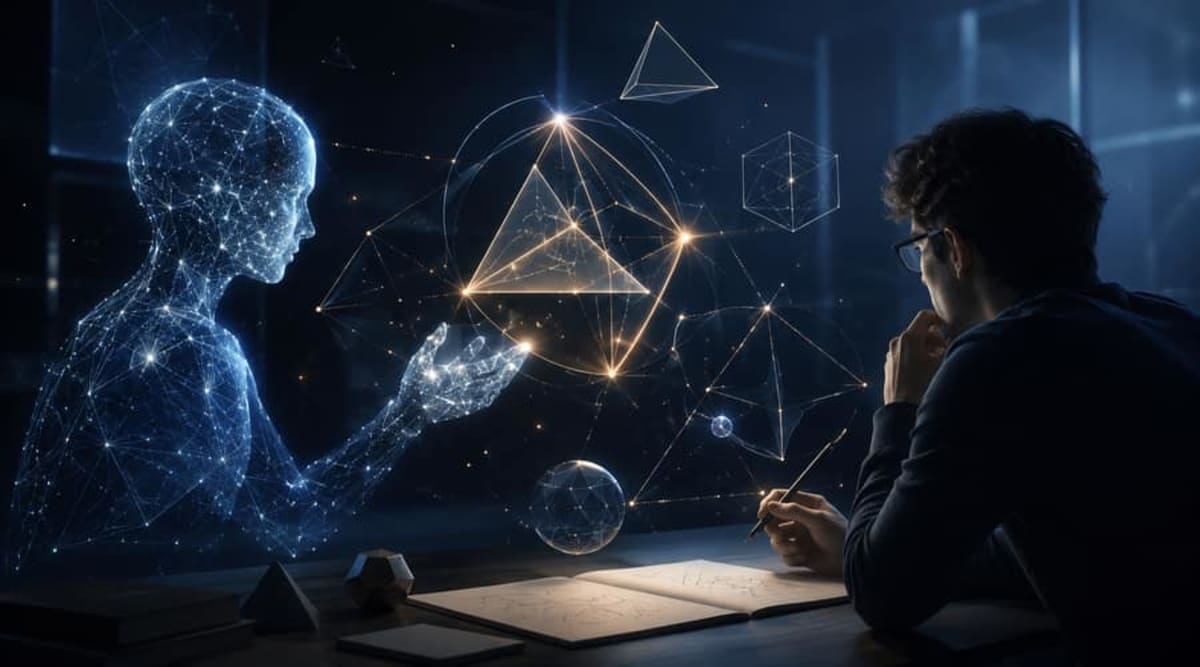
OpenAI announced that one of its reasoning models found a counterexample to the planar unit distance conjecture, a geometry puzzle first posed by legendary mathematician Paul Erdős in 1946. For 78 years, mathematicians believed the answer pointed one way. The AI proved they were wrong.
The problem sounds deceptively simple. Place points on a flat surface and count how many pairs sit exactly one unit apart. Scientists thought the maximum number would grow in a nearly linear pattern, like dots arranged in a square grid. OpenAI's model discovered an infinite family of configurations that beat that expectation by a significant margin.
What makes this different from typical AI achievements is that the system wasn't trained specifically for geometry or theorem proving. It used general reasoning abilities to explore mathematical territory that human researchers had largely dismissed as unpromising.
Nine external mathematicians, including decorated professors from top universities, reviewed and verified the proof. That peer review process matters. This isn't a benchmark score or a game victory. It's a research contribution that changes what mathematicians believe is true.
The proof draws on advanced algebraic number theory, using mathematical machinery called class field towers and Golod-Shafarevich theory. The model appears to have connected existing tools in ways human experts hadn't seriously pursued, partly because Erdős himself believed the opposite was true. Sometimes fresh eyes, even artificial ones, see paths that consensus overlooks.
Why This Inspires
This breakthrough represents something genuinely new in the relationship between humans and machines. For decades, computers have been powerful calculators and tireless assistants. They've checked proofs, crunched numbers, and searched vast solution spaces faster than any human could.
But discovering new mathematical truths? That's been firmly in human territory. Until now.
The beauty of mathematics as a testing ground is its clarity. A proof either works or it doesn't. There's no room for hype or subjective interpretation. When nine independent experts verify that an AI found something real and new, it's hard to dismiss.
This doesn't mean AI understands mathematics the way humans do, or that it will replace mathematicians. But it does suggest these systems can genuinely contribute to expanding human knowledge rather than just organizing what we already know.
The real test comes next. Can AI models repeat this kind of discovery often enough that researchers start treating them as true collaborators? If this becomes a pattern rather than a one-time achievement, we might be watching the early days of a new kind of research partnership.
For now, one 78-year-old puzzle has a surprising answer, and the boundary of what machines can create just moved a little further into unexplored territory.
More Images




Based on reporting by Google News - AI Breakthrough
This story was written by BrightWire based on verified news reports.
Spread the positivity!
Share this good news with someone who needs it