AI Maps Entire Forests Tree by Tree in 3D
Scientists at Purdue and Kiel University created TreeStructor, an AI that can identify and map individual trees in complete forests. The breakthrough helps scientists understand forests better and could improve conservation efforts worldwide.
Imagine trying to count and map every single tree in a forest when their branches tangle together like nature's jigsaw puzzle. Scientists just figured out how to do exactly that using artificial intelligence.
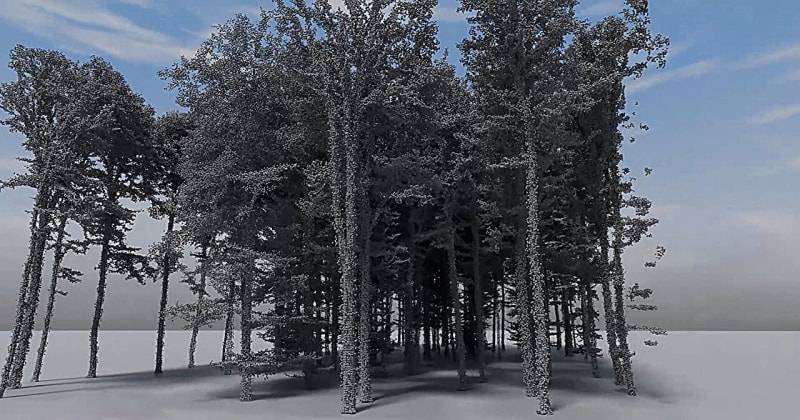
Researchers at Purdue University and Kiel University developed TreeStructor, an AI system that can pick out individual trees from dense forest scans and rebuild them in 3D. While existing technology could only reconstruct single trees from clean data, TreeStructor tackles entire messy forests at once.
The challenge was bigger than it sounds. Trees don't follow neat patterns like buildings or cars do. Every branch grows differently, twisting and overlapping with neighbors in ways that confuse most computer programs.
Professor Bedrich Benes and his team cracked the code by teaching AI to recognize something humans naturally understand. Small twigs look like tiny versions of big branches. TreeStructor learned to spot these repeating patterns at different scales, like recognizing that all maple leaves share similar shapes despite their variations.
The system works like a smart matching game. Scientists fed it a dictionary of tree parts, from trunks to branching points. When TreeStructor scans forest data collected by laser technology, it sorts through its dictionary and finds the best matches for what it sees.
Previous methods often failed when branches connected at complicated angles. TreeStructor handles these tricky spots by understanding the natural randomness of how trees actually grow. It can even tell two trees apart when their canopies intertwine so closely that human eyes struggle.
The Ripple Effect
This breakthrough opens doors scientists have been knocking on for years. Foresters can now count trees more accurately, measure forest health in detail, and track how ecosystems change over time without trudging through difficult terrain.
Conservation groups gain a powerful new tool for monitoring endangered forests. Scientists can study how trees grow in different climates and conditions. Land managers can make better decisions about protecting habitats and planning sustainable harvests.
The technology also works with data collected from drones flying overhead, making it possible to map forests that would be dangerous or impossible for humans to survey on foot. Remote wilderness areas that were once mysteries can now be studied in remarkable detail.
Xiaochen Zhou, who earned his PhD working on this project, created a visual demonstration showing TreeStructor in action. Watching the AI work feels almost magical as it untangles confused clusters of branches and reveals the hidden structure of complete forests.
What took two years to develop could save decades of painstaking fieldwork while giving us unprecedented insight into the forests that help our planet breathe.
More Images

Based on reporting by Phys.org
This story was written by BrightWire based on verified news reports.
Spread the positivity!
Share this good news with someone who needs it