Ancient Microbes Used Rare Metal 3.7 Billion Years Ago
Scientists discovered that early life used molybdenum 3.7 billion years ago, even when the metal was extremely rare on Earth. This finding rewrites our understanding of how life evolved and opens new possibilities for finding life on other worlds.
Life found a way to use one of Earth's rarest metals billions of years before scientists thought possible, and the discovery is changing how we search for life in the universe.
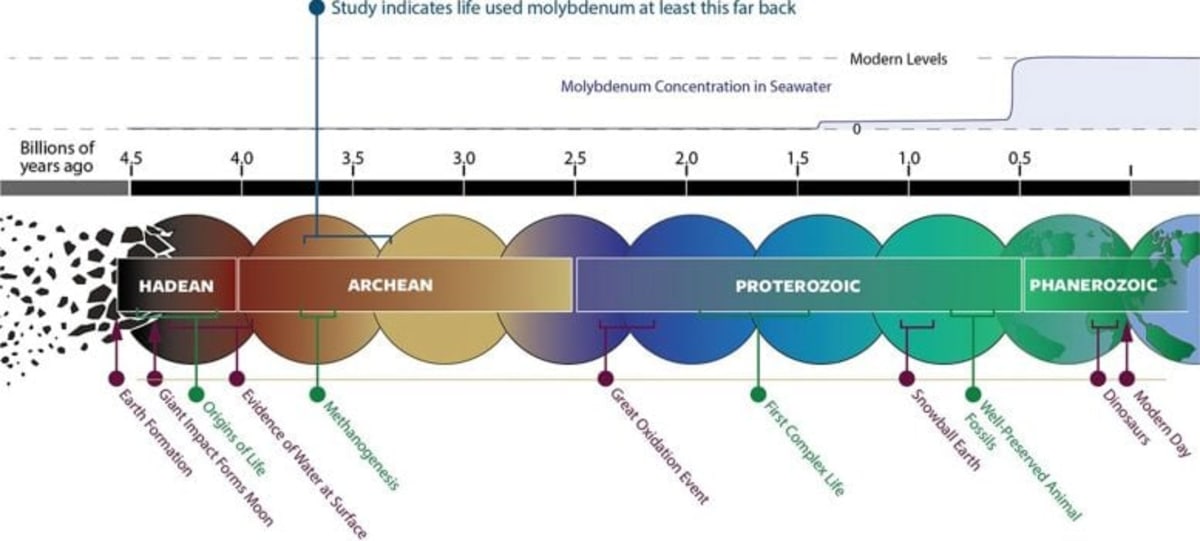
NASA-funded researchers discovered that microbes living 3.7 billion years ago were already using molybdenum, despite the metal being incredibly scarce in Earth's early oceans. The finding surprised scientists who assumed ancient life would have relied on more abundant alternatives first.
Molybdenum powers some of the most important reactions inside cells today. It sits at the center of enzymes that drive major carbon, nitrogen, and sulfur cycles that make life possible on our planet.
Scientists previously believed early organisms used tungsten instead, then switched to molybdenum about 2.45 billion years ago when oxygen transformed Earth's atmosphere. That event, called the Great Oxidation Event, made molybdenum more available in the oceans.
The new research in Nature Communications tells a different story. Betül Kaçar and her team at the University of Wisconsin Madison reconstructed the history of metal use across the tree of life and found both metals were in play from the beginning.
"Early life likely worked with both metals rather than following a simple 'tungsten first, molybdenum later' story," said Kaçar, who leads a NASA astrobiology research group.
So how did ancient microbes access such a rare resource? Earlier research from the same team points to hydrothermal vents deep on the seafloor. These underwater hot springs release trace amounts of molybdenum and other useful metals into their immediate surroundings.
Even when scarce, molybdenum offered unique advantages. The metal enables catalysis across a broad range of conditions, making it worth the evolutionary effort to acquire and use.
Why This Inspires
This discovery shows that life is remarkably resourceful. Ancient organisms didn't just work with what was abundant. They evolved ways to capture and use rare elements that offered the best chemical advantages for survival.
The finding also expands the playbook for searching for life beyond Earth. Scientists no longer need to assume alien life would only use elements that are common in their environments.
"Different abiotic inventories could lead to different biological element choices," said Kaçar. Her team suggests that hunting for extraterrestrial life should be "metal-aware, redox-aware, and evolution-aware."
By studying Earth's own deep past, when our planet looked nothing like it does today, scientists can imagine a wider range of worlds that might support life. That means more possibilities, more hope, and more places to look as humanity reaches outward into the cosmos.
Life's ability to thrive against the odds started billions of years ago, and it continues to inspire our search for cosmic neighbors today.
More Images
Based on reporting by Google News - Scientists Discover
This story was written by BrightWire based on verified news reports.
Spread the positivity!
Share this good news with someone who needs it

%2Ffile%2Fattachments%2Forphans%2FIMG_46372_797479.jpg)