Baboons Feel Sibling Jealousy Just Like Humans Do
Scientists watching wild baboons in Namibia discovered young monkeys throw tantrums, wedge between siblings, and even trick their sisters to steal mom's attention. The behavior offers powerful evidence that primates experience complex emotions like jealousy.
Ever watched a toddler melt down when their younger sibling gets a hug from mom? Scientists just discovered baboons do exactly the same thing.
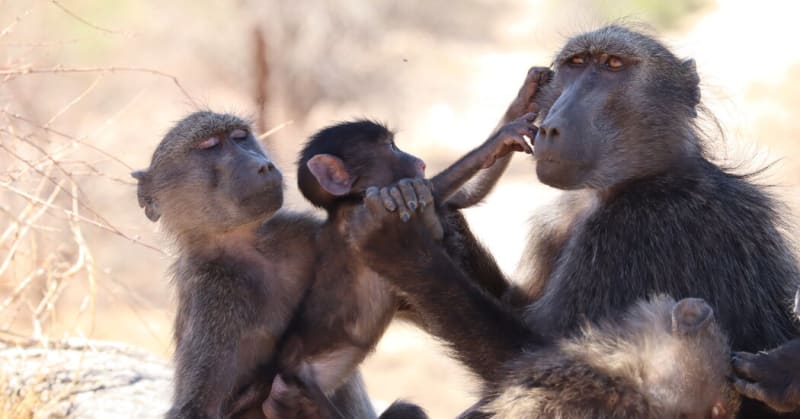
Researchers from the University of Turku in Finland spent most of 2021 following chacma baboon families on foot through Namibia's Tsaobis Nature Park from sunrise to sunset. What they witnessed looked remarkably familiar to anyone with siblings.
The young baboons threw full tantrums when their mothers groomed their brothers or sisters. They physically wedged themselves between mom and sibling. One particularly clever female even lured her sister away with the promise of play, then immediately stole her spot in their mother's arms.
"She played with her for about 10 seconds, just long enough to drive her away from mom," said behavioral ecologist Axelle Delaunay. "It felt really strategic."
The team observed hundreds of these interruptions and published their findings Wednesday in Proceedings of the Royal Society B. After analyzing the patterns, jealousy was the only explanation that made sense.
The baboons bothered their mothers twice as often when she was grooming a younger sibling compared to an older one. They also interrupted more when the sibling getting attention was the same sex. As the baboons grew older, these jealous outbursts became less frequent.
Why This Inspires
This research represents some of the strongest evidence yet that primates can feel complex emotions like humans do. Previous studies only looked at captive animals in small numbers, but this team watched natural behavior unfold in the wild.
The findings also reveal something puzzling about evolution. Less than 10 percent of these jealous interruptions actually worked. Most of the time, mom ignored the tantrum and kept grooming the other sibling.
"Most of the time, interference doesn't really work," Delaunay said. "So what are the benefits?" She hopes future research will answer why this behavior persists if it rarely pays off.
The study opens new doors for understanding primate emotions and relationships. While scientists can't ask baboons how they feel, they can measure the behavioral and physiological changes that emotions trigger.
For anyone who's ever felt overlooked when a sibling got extra attention, there's something oddly comforting about knowing we're not alone in the animal kingdom.
Based on reporting by Google News - Science
This story was written by BrightWire based on verified news reports.
Spread the positivity!
Share this good news with someone who needs it