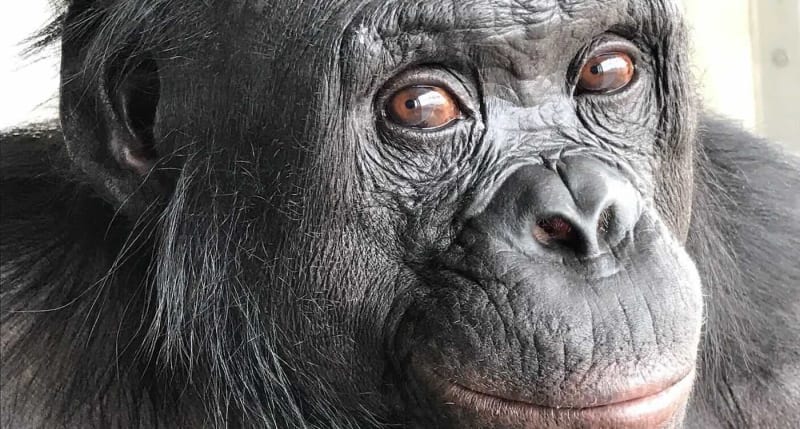
Bonobo Named Kanzi Proves Apes Can Imagine and Pretend
A 43-year-old bonobo in Iowa just passed "tea party" tests proving apes can imagine things that aren't really there. Scientists say this discovery challenges what we thought made humans special.
Scientists just discovered that apes share our ability to imagine and pretend, something researchers believed was uniquely human until now.
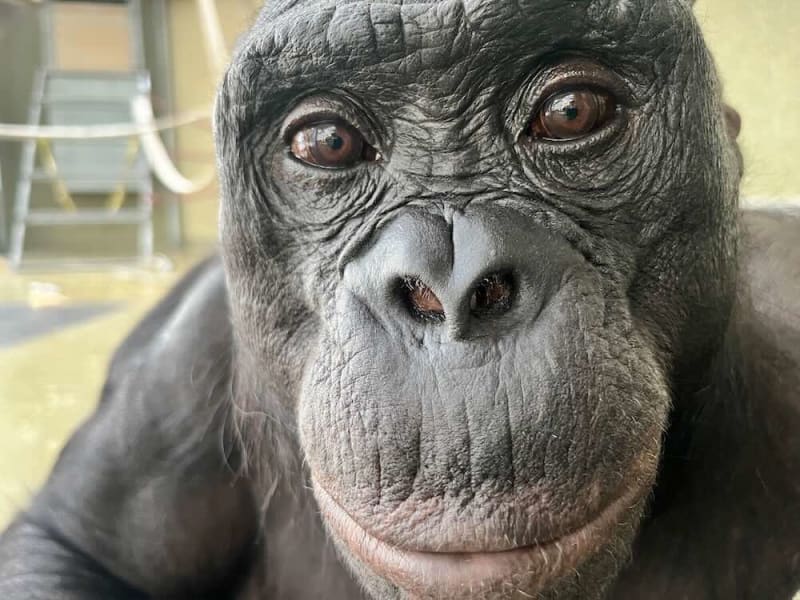
Kanzi, a 43-year-old bonobo living at Iowa's Ape Initiative, amazed researchers at Johns Hopkins University by consistently tracking imaginary juice and pretend grapes across multiple experiments. The bonobo correctly pointed to cups that contained "pretend juice" even after watching researchers pour and dump invisible liquids.
In one experiment, a researcher sat across from Kanzi at a table with two empty transparent cups and an empty pitcher. The researcher pretended to pour juice into both cups, then dumped out one cup while shaking it to really empty it. When asked "Where's the juice?" Kanzi pointed to the correct cup every time, even when researchers moved the cups around.
To make sure Kanzi understood the difference between real and pretend, scientists placed a cup of actual juice next to the pretend cup. Kanzi almost always chose the real juice when asked what he wanted, proving he knew the difference.
Dr. Christopher Krupenye, a study co-author, called the findings game-changing. "It really is transformative that their mental lives go beyond the here and now," he said. The research, published this week in Science, suggests this ability dates back six to nine million years to our common ancestors.
The discovery echoes Jane Goodall's groundbreaking finding that chimpanzees make tools, which forced scientists to reconsider what makes humans unique. By age two, human children engage in pretend tea parties, but until now, no controlled studies had tested whether other animals could do the same.
Why This Inspires
This research invites us to see animals in a completely new light. If apes can imagine things that don't exist, their inner worlds may be far richer than we ever understood. They're not just reacting to their surroundings like robots but creating mental pictures and scenarios.
Dr. Amalia Bastos, who co-authored the study, said it's "extremely striking" that apes can conceive of things that aren't there while simultaneously knowing they're not real. That level of mental complexity suggests a depth of consciousness we've only just begun to appreciate.
The team now wants to test other apes and explore whether they can imagine the future or guess what others are thinking. These creatures with "rich and beautiful minds" deserve our care and protection, especially as their habitats face threats.
One bonobo's performance in pretend tea parties just expanded our understanding of consciousness across species.
More Images



Based on reporting by Good News Network
This story was written by BrightWire based on verified news reports.
Spread the positivity!
Share this good news with someone who needs it
%2Fhttps%3A%2F%2Ftf-cmsv2-smithsonianmag-media.s3.amazonaws.com%2Ffiler_public%2F4e%2F9f%2F4e9f0fe8-aa48-438a-b88f-3a29cd71107e%2Fhttps___wwwfrontiersinorg_files_articles_1758862_xml-images_fmats-13-1758862-g001.jpeg)