Bumblebees Solve Problems Like Chimps, Study Finds
Bumblebees rolled a ball under an out-of-reach flower and climbed on it to reach a reward, demonstrating spontaneous problem-solving previously seen only in apes and elephants. The breakthrough suggests tiny insect brains are far more flexible than scientists thought.
Bumblebees just proved their tiny brains can tackle problems in ways we thought only the smartest animals could.
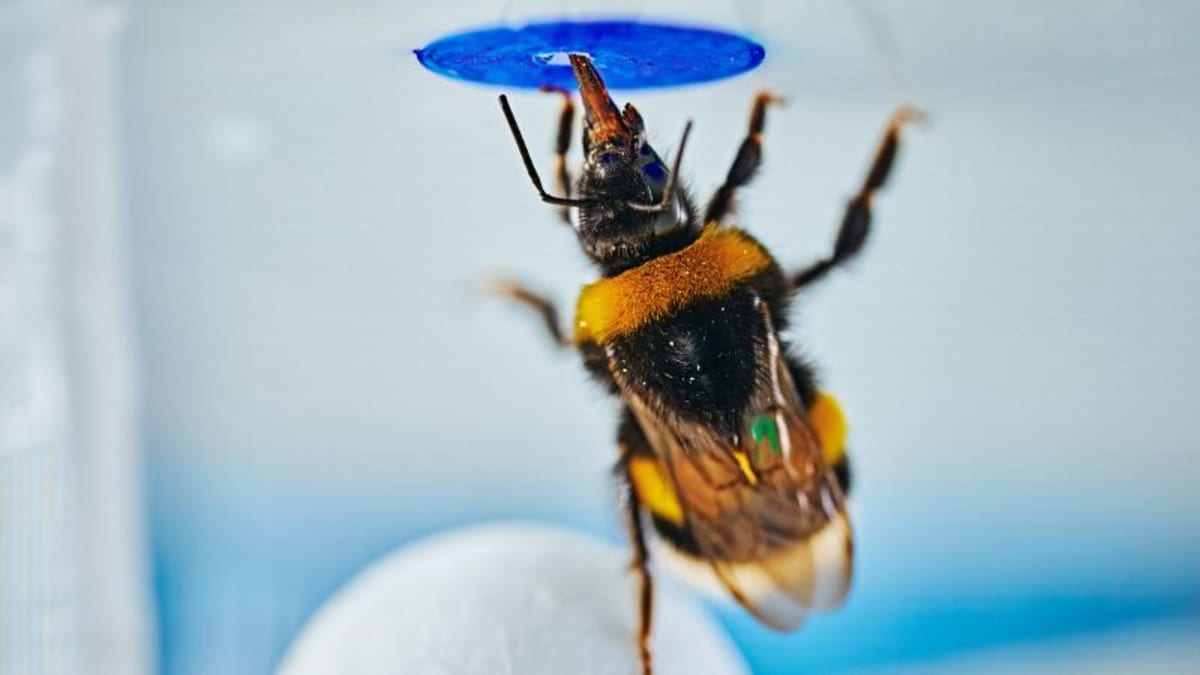
Scientists at the University of Oulu in Finland watched as bumblebees figured out how to roll a foam ball underneath an artificial flower hanging from the ceiling, then climbed on top to reach a sugary reward. The insects solved this completely novel challenge without any training or trial and error.
This matters because it demonstrates what researchers call insight, the ability to understand cause and effect spontaneously. Until now, scientists had only observed this advanced cognitive skill in great apes, elephants, and some birds.
The experiment echoes a famous 1920s study where psychologist Wolfgang Köhler watched chimpanzees stack boxes to reach a hanging banana. The chimps figured out the solution through insight, not random attempts. Now bumblebees have joined that exclusive club.
Lead researcher Akshaye Bhambore and his team designed a clever test. They first let bees explore the flower and ball separately, then showed them how pushing the ball away revealed the flower. But they never taught the complete solution.
When researchers moved the flower to the ceiling above a small pit, 75% of the bees who'd seen those earlier scenarios figured it out. They rolled the ball to the right spot, climbed aboard, and claimed their prize.
The scientists made sure this wasn't luck. They tested bees that had never seen the ball or flower before. Those bees couldn't solve it, proving the successful ones were actually thinking through the problem.
To eliminate any possibility the bees were just reacting to visual cues, researchers hid the flower from the ball's starting position. The bees still found the solution.
Why This Inspires
This discovery changes how we think about intelligence across the animal kingdom. Professor James Nieh from UC San Diego points out that bees don't naturally move objects to create platforms, making this achievement even more remarkable.
The findings could help us understand how pollinators adapt to changing environments. As landscapes shift and flowers become harder to access, this mental flexibility might help bees and other insects survive new challenges.
Associate professor Natalie Hempel de Ibarra from the University of Exeter notes that scientists are only beginning to understand how insects learn and change their behavior. Each discovery reveals creatures far more capable than we imagined.
These fuzzy little pollinators just reminded us that brilliance comes in all sizes.
More Images

Based on reporting by Google News - Science
This story was written by BrightWire based on verified news reports.
Spread the positivity!
Share this good news with someone who needs it