Four-Winged Dinosaur Discovered in China's Fossil Bird Graveyard
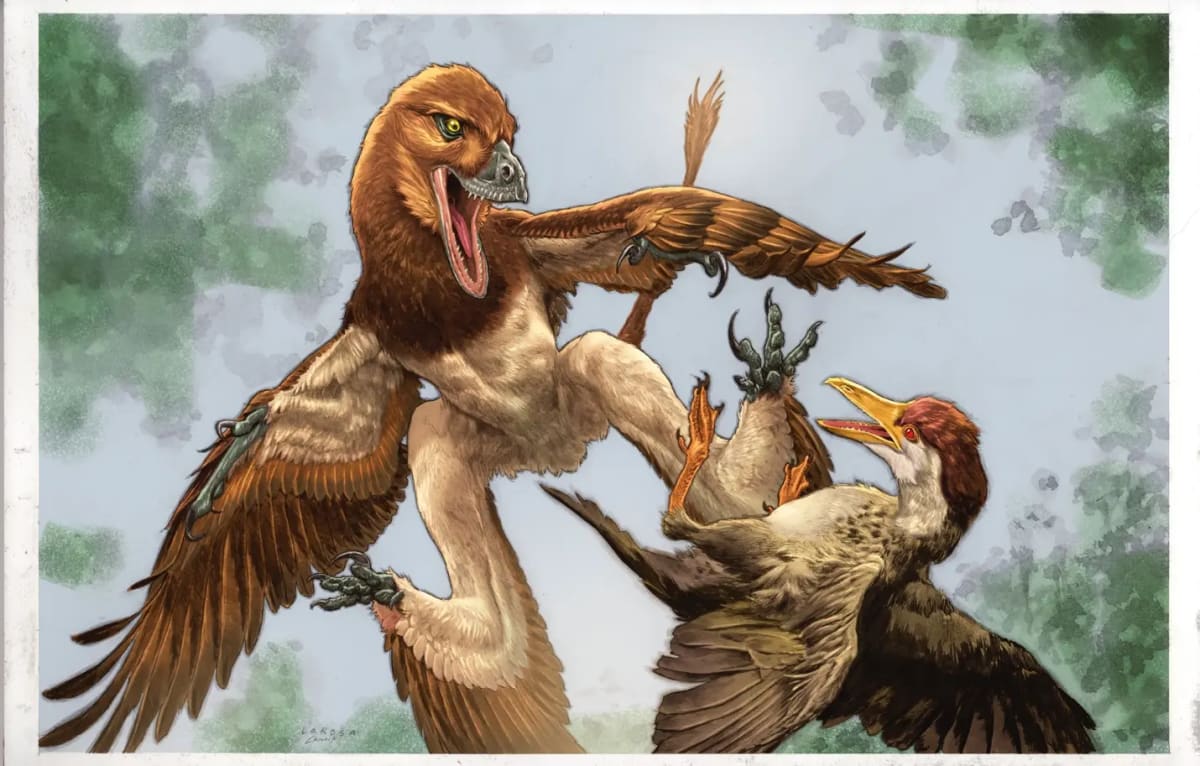
Scientists discovered a new four-winged dinosaur that likely hunted ancient birds 120 million years ago, solving a mystery about crushed bird bones found in northwestern China. The barn owl-sized predator could glide through the air like a flying squirrel. ##
A mysterious pile of broken bird bones in China just gave up its secret, and it's spectacular.
For years, scientists puzzled over hundreds of crushed prehistoric bird skeletons in northwestern China's Changma Basin. The bones were broken and compressed into pellets, like those modern owls cough up after eating. Something was hunting these ancient birds, but researchers could never find the predator.
Now they have. Meet Jian changmaensis, a newly discovered dinosaur cousin of Velociraptor with long feathers on all four limbs.
"This new microraptor dinosaur is our best guess for what made those weird, broken-up clusters of bird bones," says Jingmai O'Connor, associate curator of fossil reptiles at Chicago's Field Museum. "It's the only dinosaur found at this site that wasn't a bird, it was a carnivore, and it was much bigger than everything else we've found there."
The discovery, published in the Annals of Carnegie Museum, reveals a predator about the size of a barn owl with a four-foot wingspan. Scientists only recovered part of Jian's upper arm bone, but that four-inch fragment tells an incredible story.
Based on similar microraptor species, Jian likely sported long feathers on both its front and back limbs, creating the appearance of four wings. While it probably couldn't achieve true powered flight like modern birds, it could glide through prehistoric skies like a flying squirrel.
The dinosaur's name honors both its bird-like appearance and birthplace. Jian refers to a winged creature in Chinese mythology, while changmaensis points to the Changma Basin in China's Gansu province where the fossil was discovered.
This flying predator lived 120 million years ago, tens of millions of years before the meteorite that would wipe out all dinosaurs except birds. Back then, early birds and their feathered dinosaur relatives shared the skies in ways scientists are only beginning to understand.
The Bright Side
The discovery transforms our understanding of prehistoric ecosystems. Matt Lamanna, corresponding author and curator at Carnegie Museum of Natural History, notes that his team has recovered more than a hundred bird fossils at Changma, but only this single non-bird dinosaur specimen.
That rarity makes Jian incredibly valuable for understanding how early birds evolved alongside their predatory cousins. The fossil site has become a window into a complete ancient ecosystem, showing not just the prey but finally revealing the hunter.
"Birds are arguably the most successful group of land-dwelling vertebrate animals on Earth today," O'Connor explains. "Learning about early birds and their close non-bird dinosaur relatives gives us a better understanding of what made them so successful."
One fossil solved a years-long mystery and rewrote the story of an entire ancient landscape.
##
Based on reporting by Google: fossil discovery
This story was written by BrightWire based on verified news reports.
Spread the positivity!
Share this good news with someone who needs it