Chimps Choose Crystals Over Rocks, Revealing Ancient Mystery
Chimpanzees deliberately selected and studied crystals with intense curiosity, offering clues about why our ancestors collected these unusual stones 780,000 years ago. The discovery suggests our fascination with crystals has deep evolutionary roots.
Scientists may have finally solved a puzzle that's stumped archaeologists for decades: why did early humans collect crystals when they couldn't use them as tools or weapons?
The answer came from watching chimpanzees, our closest living relatives, interact with crystals for the first time. Researchers at Spain's Donostia International Physics Center gave two groups of chimps access to various stones, including crystals, and the results were striking.
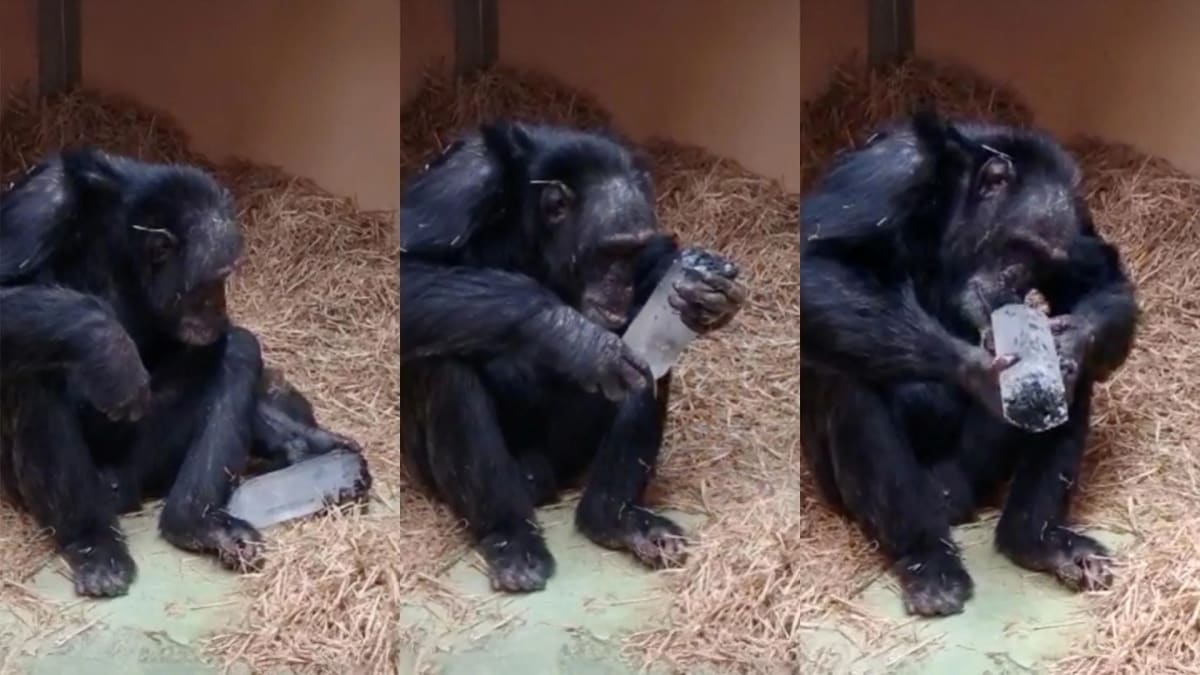
When presented with a large crystal next to an ordinary rock of similar size, the chimps immediately gravitated toward the crystal. They examined it intensely, rotating and tilting it to view from different angles, while largely ignoring the regular stone.
One chimp named Yvan became so captivated that he deliberately carried the crystal back to the dormitories. Caretakers eventually had to trade bananas and yogurt to get it back.
In a second experiment, researchers mixed smaller quartz crystals into a pile of 20 rounded pebbles. The chimps identified and selected the crystals within seconds, even when the team added different types like pyrite and calcite.
A chimp named Sandy displayed particularly fascinating behavior. She carried both pebbles and crystals in her mouth to a wooden platform, then sorted them into separate groups, distinguishing three different crystal types from all the ordinary stones.
"We were pleasantly surprised by how strong and seemingly natural the chimpanzees' attraction to crystals was," said lead author Professor Juan Manuel García-Ruiz. The chimps held the transparent crystals up to eye level, peering through them with extreme curiosity.
The chimps in this study live around humans and encounter objects that don't exist in the wild, but their immediate fascination suggests something deeper. Since humans and chimpanzees split from a common ancestor six to seven million years ago, this attraction may have ancient origins.
Why This Inspires
Crystals are the only naturally occurring objects with flat surfaces and straight edges. While trees, mountains, rivers, and clouds feature curved and branching forms, crystals stand out with their geometric perfection.
This uniqueness may have captured the attention of early humans trying to understand the world around them. Ancient humans at sites dating back 780,000 years collected crystals that served no practical purpose, keeping them simply because they were unusual and beautiful.
The research suggests that our ancestors, like the chimps, recognized something special in these transparent, geometric stones. Our capacity for wonder and aesthetic appreciation may be millions of years older than we thought, connecting us to both our ancient past and our primate cousins.
Understanding this deep-rooted fascination helps explain why humans still treasure crystals today.
Based on reporting by Science Daily
This story was written by BrightWire based on verified news reports.
Spread the positivity!
Share this good news with someone who needs it