China's Tianwen-2 Snaps First Photo of Earth's Mini Moon
A Chinese spacecraft just captured the first close-up image of a mysterious asteroid that follows Earth like a tiny companion. After traveling 621 million miles over 400 days, Tianwen-2 is now preparing to bring samples of this cosmic neighbor back home.
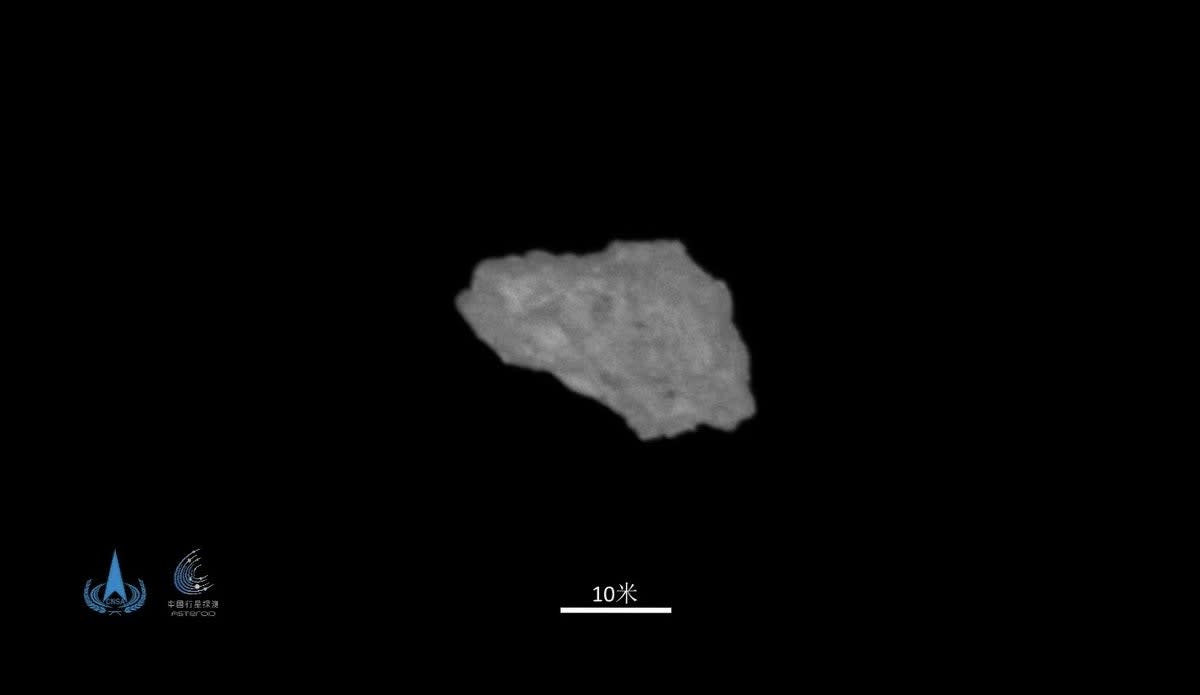
A small asteroid that quietly orbits alongside Earth just got its first close-up portrait, and the image marks a milestone in understanding our planet's cosmic companions.
China's Tianwen-2 spacecraft transmitted the first detailed photo of Kamo'oalewa, a space rock about the size of a school bus that loops near Earth. The asteroid comes as close as 9 million miles to our planet and as far as 25 million miles away, earning it the affectionate nickname "mini moon."
Scientists discovered Kamo'oalewa in 2016, and it's one of only eight quasi-satellites found following Earth's path around the sun. Some researchers believe it might actually be a chunk of our own moon, blasted into space by an ancient impact, though other evidence disputes this origin story.
The spacecraft launched on May 28, 2025, and has spent over a year traveling to reach its target. By late June, Tianwen-2 had closed to within 12 miles of the rotating asteroid, which spins on its axis every 28 minutes.
Now comes the exciting part. The spacecraft is equipped with three different methods to collect samples, depending on what works best when it arrives. It can use a quick touch-and-go approach, anchor itself directly to the surface, or deploy a robotic arm while hovering above to scoop up material.
The China National Space Administration says the probe will study the asteroid's shape, composition, and internal structure before attempting to gather samples. Those precious specimens are scheduled to parachute back to Earth in 2027, giving scientists their first chance to examine material from one of Earth's mysterious traveling companions.
Why This Inspires
This mission represents a giant leap in understanding the small celestial objects sharing our cosmic neighborhood. Every sample returned from space teaches us more about how our solar system formed and evolved. The fact that Kamo'oalewa might be a piece of our own moon makes the mission even more thrilling, offering a potential window into Earth's ancient history.
The spacecraft won't rest after delivering its payload either. Tianwen-2 will continue onward to study a comet, maximizing the scientific return from a single ambitious journey.
We're entering an era where multiple nations are reaching farther into space, bringing back pieces of our cosmic story to share with everyone on Earth.
More Images


Based on reporting by Scientific American
This story was written by BrightWire based on verified news reports.
Spread the positivity!
Share this good news with someone who needs it