Hubble Spots 210-Light-Year 'Superbubble' in Neighbor Galaxy
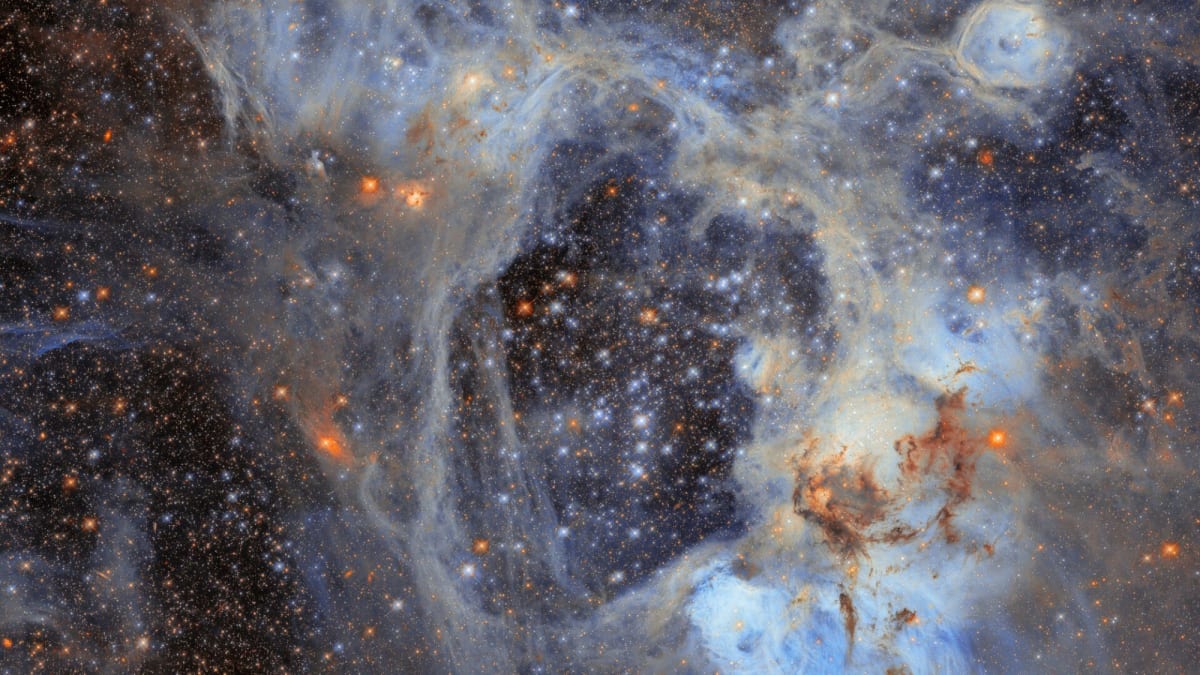
The Hubble Space Telescope captured a stunning nebula with a giant glowing void at its center, where stellar explosions may have carved out a bubble hundreds of light-years wide. Scientists surveyed nearly 500,000 stars in the region, revealing secrets about how stars are born and evolve.
A giant cosmic bubble hundreds of light-years across is glowing in our galactic neighbor, and the Hubble Space Telescope just gave us front-row seats to the spectacle.
The nebula, called N44, sits about 160,000 light-years away in the Large Magellanic Cloud, a small galaxy that orbits our Milky Way. What makes this star nursery extraordinary is the massive hollow center called a "superbubble" that measures roughly 210 by 140 light-years across.
To put that in perspective, the distance from our sun to Pluto isn't even one light-year. This bubble is incomprehensibly vast, yet scientists think they know what created it.
The leading theory suggests that stars at the bubble's center exploded as supernovas or released powerful stellar winds that swept away surrounding gas. This cosmic force essentially cleared out a void, leaving behind the glowing shell we see today.
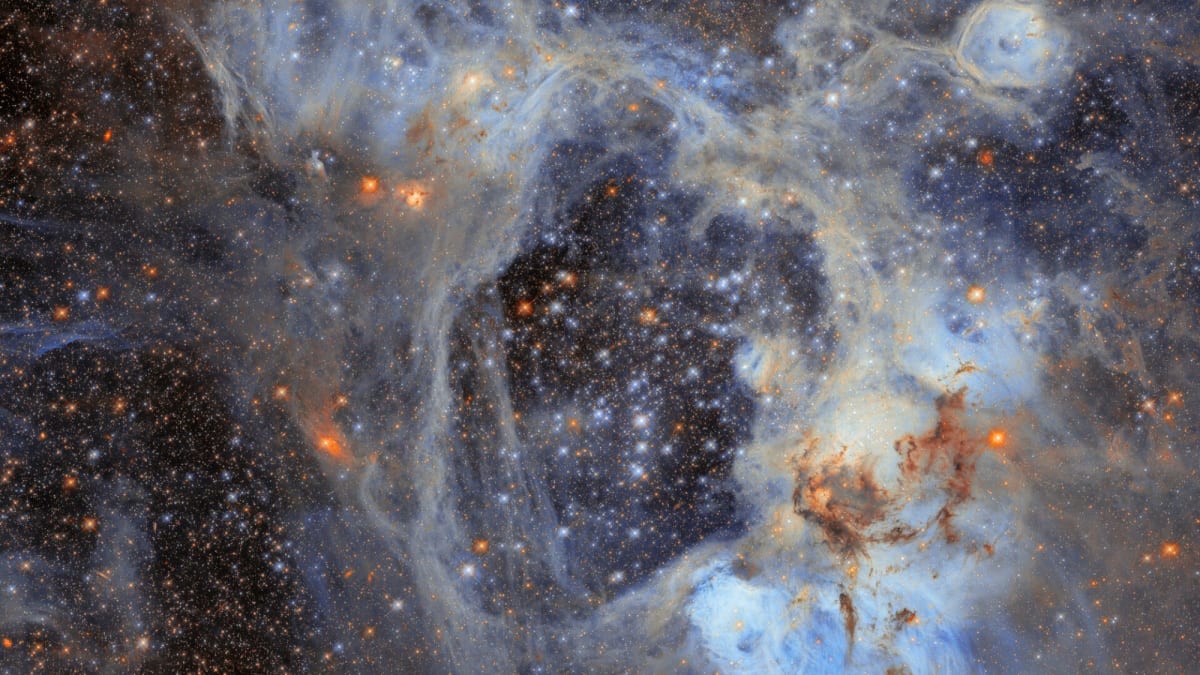
Around that shell, new stars continue forming at a rapid pace, appearing as brilliant points scattered across the watercolor-like landscape. Hubble's survey captured nearly half a million stars in and around N44, with 30,000 of them in the earliest stages of their lives.
N44 belongs to a special category called emission nebulas, where gas gets energized by nearby stars. When that energized gas cools down, it releases energy in the form of light, creating the nebula's luminescent glow.
The Bright Side
This cosmic phenomenon isn't just beautiful. N44 offers scientists ideal conditions to study how stars form and evolve, serving as a natural laboratory in space.
The nebula has been captivating astronomers for years, with major observations in 2012, 2021, and now 2026. Each time Hubble turns its eye toward N44, we learn more about the forces that shape our universe and create new generations of stars.
Understanding star formation helps us grasp our own origins, since every element in our bodies was forged inside ancient stars. When we look at N44, we're witnessing the same process that eventually led to planets, life, and us.
The Large Magellanic Cloud itself is a treasure trove for astronomers because it's close enough to study in detail yet far enough to see entire regions at once. It's like having a neighboring city where you can watch construction projects unfold from a perfect vantage point.
As Hubble continues its mission despite being over three decades old, it keeps delivering images that inspire wonder and advance our understanding of the cosmos. This latest portrait of N44 reminds us that even in the vast darkness of space, beauty and creation never stop.
Every glowing tendril in this nebula represents ongoing star formation, a process that will continue for millions of years, lighting up the cosmic neighborhood one star at a time.
More Images

Based on reporting by Space.com
This story was written by BrightWire based on verified news reports.
Spread the positivity!
Share this good news with someone who needs it