James Webb Finds Salt Clouds on Pink Planet
After a decade of trying, scientists finally captured the spectrum of a mysterious pink planet 57 light-years away and discovered something never seen before: clouds made of salt. The James Webb Space Telescope solved in hours what ground telescopes couldn't crack in ten years.
A faint pink dot floating around a distant star just revealed one of the strangest atmospheres astronomers have ever studied, and it only took humanity's most powerful telescope a few hours to crack a mystery that stumped scientists for over a decade.
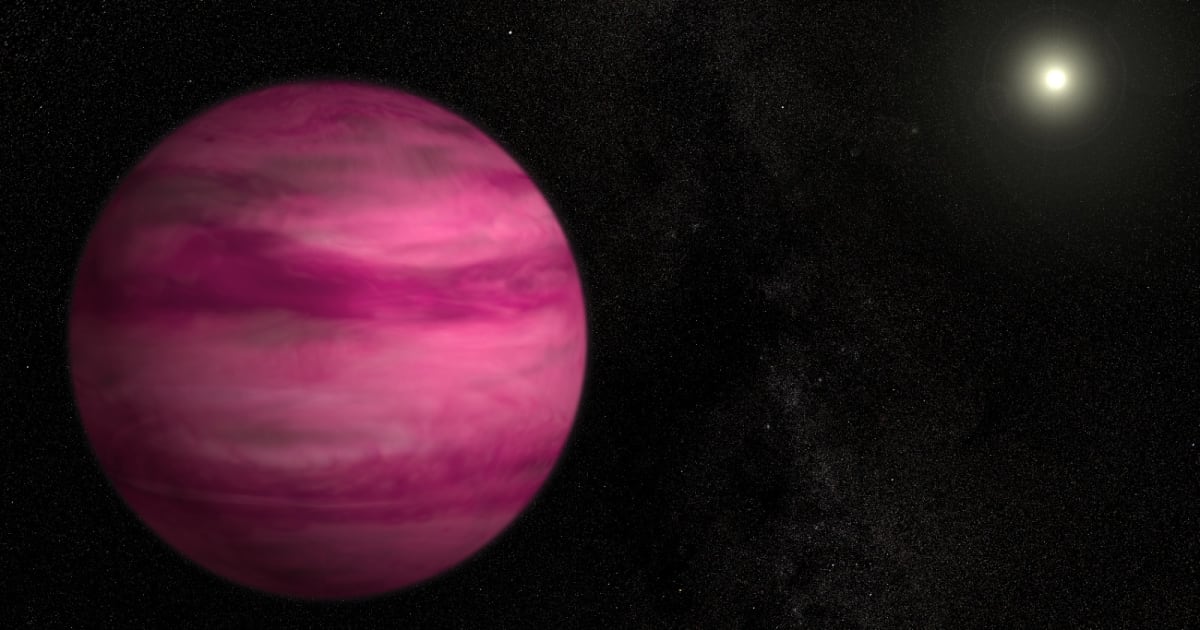
GJ 504 b, nicknamed the Pink Planet, was first photographed in 2013 orbiting a sun-like star about 57 light-years from Earth. It made history as the first planet-like object ever directly imaged around a star similar to our own, but it came with a puzzle.
The planet sits at roughly 290 degrees Celsius, about the temperature of a hot oven. That might sound scorching, but for planets formed around other stars, it's remarkably cool. Most directly imaged worlds glow at temperatures three times hotter, still radiating the heat from their birth.
That coolness made GJ 504 b incredibly dim. For more than ten years, every major ground-based telescope that pointed at it came up empty. Astronomers could see the pink dot in images, but they couldn't read its light signature, the detailed spectrum that reveals what an atmosphere is actually made of.
When the James Webb Space Telescope finally turned its gaze toward the Pink Planet, everything changed. Using its NIRSpec instrument, a team led by researcher Aneesh Baburaj captured the planet's spectrum across multiple wavelengths of infrared light.
The reading was rich with surprises. The team identified water vapor, carbon monoxide, methane, carbon dioxide, ammonia, and hydrogen sulfide swirling through the atmosphere. The chemical mix showed signs of violent churning, with molecules being dredged up from deeper, warmer layers faster than they could settle into balance.
But the real breakthrough came when the team tried to make sense of the overall pattern. The data refused to fit normal atmospheric models. The only way to match what Webb actually saw was to add clouds into the mix, and not just any clouds.
Salt clouds fit the data perfectly. A deck of salt haze sitting over the deeper atmosphere quiets the chemical signatures from below, reshaping the light in exactly the way the telescope recorded.
The Bright Side
Salt clouds might sound exotic, but they're actually a natural outcome of planetary chemistry. Just as water vapor condenses into clouds on Earth when temperatures drop, salts can condense out of gas in cooler planetary atmospheres. Scientists predicted this possibility over fifteen years ago, but until now, they'd never needed to invoke salt clouds to explain an actual observation.
GJ 504 b sits right on the fuzzy boundary between a giant planet and a small brown dwarf, those failed stars that never grew massive enough to ignite. At roughly 25 times Jupiter's mass, it occupies a realm astronomers are only beginning to understand.
The discovery marks the first time salt clouds have proven essential to explaining a real planetary spectrum. It's a reminder that the universe still has plenty of surprises waiting, even in atmospheres we thought we understood.
What took years of frustration for ground telescopes took Webb just a few hours to solve, and the answer floating in that faint pink light was stranger and more wonderful than anyone expected.
More Images



Based on reporting by Google: James Webb telescope
This story was written by BrightWire based on verified news reports.
Spread the positivity!
Share this good news with someone who needs it