James Webb Telescope Captures Stunning Lion Nebula Images
NASA's most powerful telescope just revealed a dying star that looks like a cosmic lion, complete with a glowing face and dusty mane 10,000 light-years from Earth. The new images show details never seen before in this celestial wonder.
A dying star 10,000 light-years away is putting on one of nature's most spectacular shows, and NASA's James Webb Space Telescope just captured its best portrait yet.
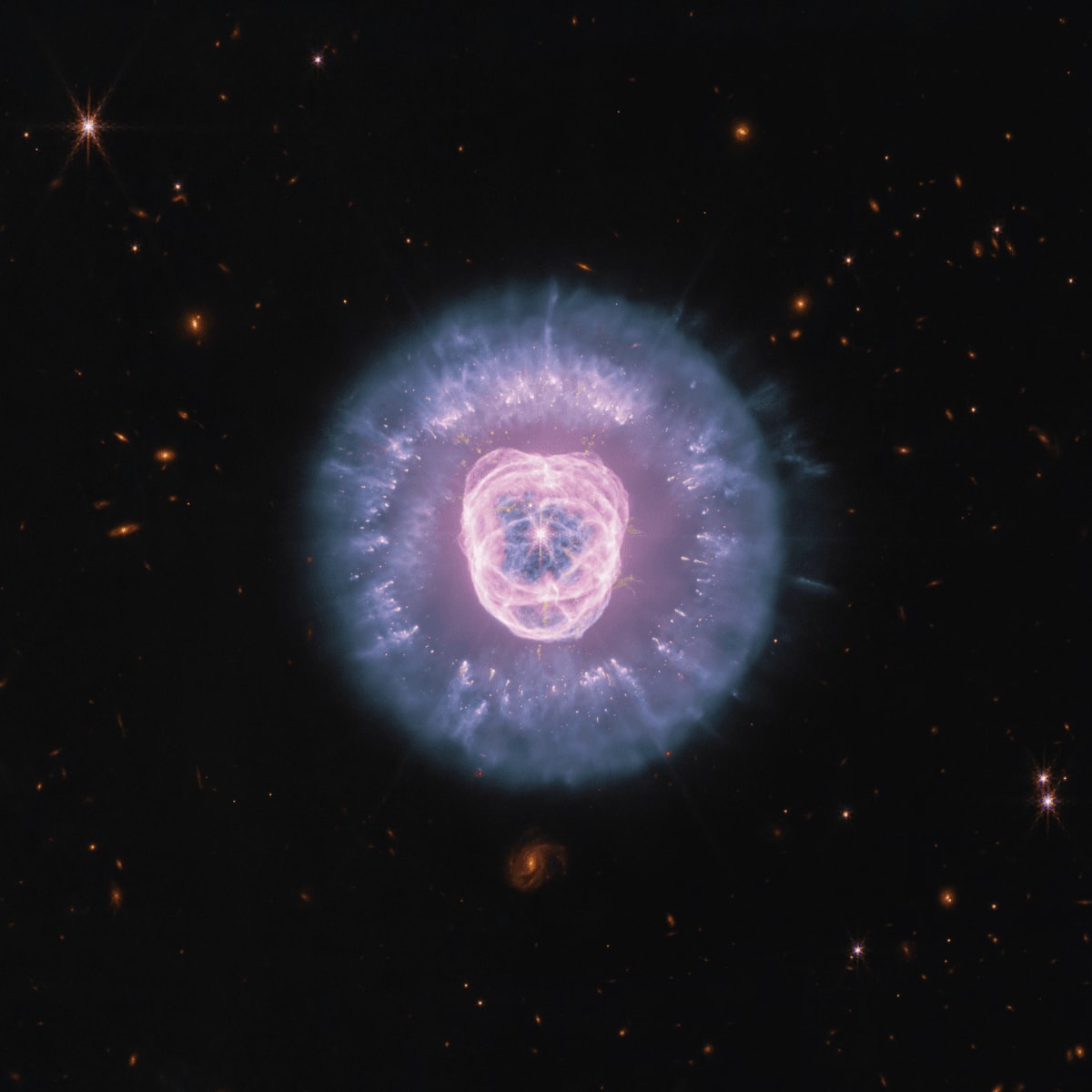
The Lion Nebula, officially named NGC 2392, earned its nickname for looking remarkably like the big cat floating in space. The Hubble Space Telescope first spotted it in 2000, but Webb's new infrared images reveal the cosmic lion in stunning detail.
At the center sits a white dwarf star nearing the end of its life. The star pumps out powerful radiation that creates a giant gas bubble around it, forming what looks like the lion's glowing face. Surrounding this brilliant core is a shell of space dust that forms the creature's flowing mane.
The new images show intricate rings and shells of gas and dust that astronomers are still working to fully understand. These complex structures, now visible in crisp detail, reveal how material flows and interacts around dying stars. Webb's infrared vision can peer through cosmic dust that blocked Hubble's view, showing clumps and patterns scientists have never seen before.
Planetary nebulae like this one give astronomers a preview of what will eventually happen to our own sun. When medium-sized stars exhaust their fuel, they shed their outer layers in beautiful displays that can last thousands of years.
Why This Inspires
The Lion Nebula reminds us that even endings can be beautiful. This star's final chapter is creating something magnificent that humans can observe and study from Earth.
The images also showcase how far our technology has come. What Hubble showed us in 2000 was amazing, but Webb's capabilities are revealing an entirely new level of cosmic detail. Each advancement helps scientists better understand how stars live, die, and contribute to the universe.
Astronomers estimate the star has about 10,000 years left before it completely disperses into interstellar space. That gas and dust won't disappear but will eventually help form new stars and planets, continuing the cosmic cycle of creation.
For now, this celestial lion stands as a stunning example of the universe's artistic side, proving that the cosmos can be both scientifically fascinating and simply beautiful to behold.
More Images
Based on reporting by Scientific American
This story was written by BrightWire based on verified news reports.
Spread the positivity!
Share this good news with someone who needs it