James Webb Telescope Spots Magnesium Clouds on Distant Planet
For the first time, scientists have mapped daily weather patterns on a planet 700 light-years away, revealing mornings filled with metallic clouds that vanish by evening. The James Webb Space Telescope's powerful eye is unlocking secrets about distant worlds we could never see before.
Scientists just discovered something remarkable on a planet far beyond our solar system: clouds made of magnesium that appear every morning and disappear by sunset.
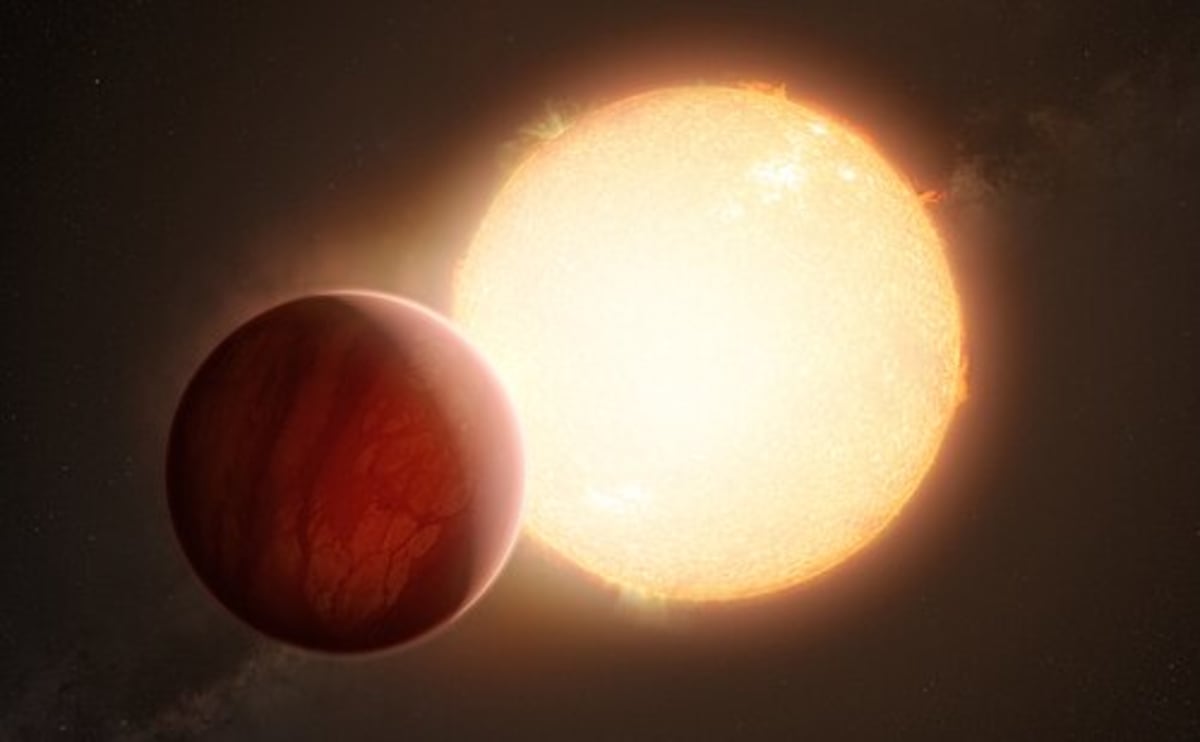
The planet, called WASP-94A b, sits 700 light-years from Earth and orbits so close to its star that it completes a full year in just days. Researchers from Johns Hopkins University used the James Webb Space Telescope to watch this gas giant as it passed in front of its star, capturing weather patterns with stunning detail.
What they found surprised everyone. The planet's morning side is hazy with clouds containing magnesium silicate, the same rocky mineral found in sand and volcanic rocks on Earth. But by evening, those clouds completely vanish, leaving clear skies.
This marks one of the first times scientists have identified daily cloud cycles on a planet outside our solar system. The achievement was possible because JWST can measure different parts of the planet separately, something the Hubble telescope couldn't do.
The telescope captured the planet's leading edge as it crossed the star first, where air flows from night to day creating morning conditions. Then it measured the trailing edge, where air moves from day to night producing evening weather.
Scientists think powerful winds might lift clouds high on the cooler morning side, then push them deep into the planet's interior on the scorching day side, burying them before sunset. Another possibility is that fog forms on the nightside and evaporates when it drifts into intensely hot regions.
"It was a huge surprise," said lead researcher Sing. "People have expected some differences, like its cooler in the morning than the evening. But what we saw was a real dichotomy between the weather on both sides of the planet."
Why This Inspires
The discovery isn't just about one planet. When researchers looked at eight other hot gas giants, they found the same cloud pattern on two more worlds. This suggests daily weather cycles might be common across distant planets, giving scientists a new tool to understand what these worlds are made of.
By isolating where clouds form and disappear, researchers can more accurately measure a planet's atmospheric composition and get a clearer picture of its makeup. The team is already planning a new JWST program to study cloud cycling across even more exoplanets, including planets in habitable zones where conditions might support life.
Every new detail we learn about distant worlds brings us closer to understanding our place in the universe and finding planets that might harbor life.
Based on reporting by Google: James Webb telescope
This story was written by BrightWire based on verified news reports.
Spread the positivity!
Share this good news with someone who needs it