Mystery Planet Holds 120-Million-Mile Cloud of Metal Vapor
Astronomers discovered a massive cloud of vaporized iron and calcium swirling around an unknown object 3,000 light-years away. The rare find reveals that even in mature planetary systems, dramatic cosmic collisions still reshape worlds.
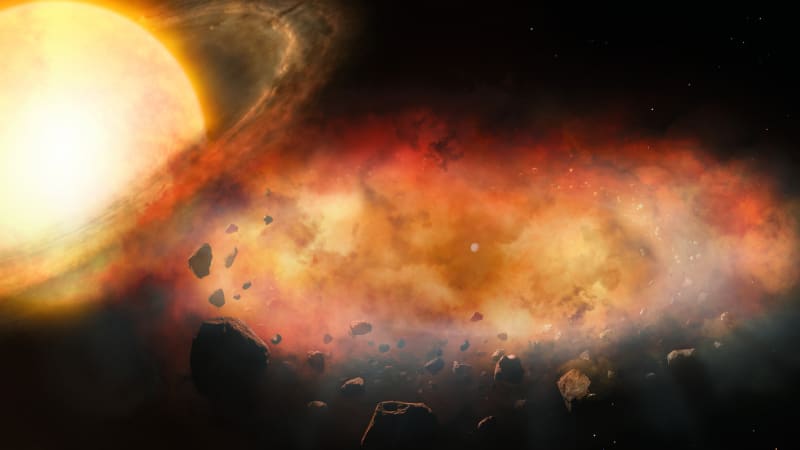
A cloud of swirling metal vapor wider than the distance from Earth to the sun has astronomers buzzing about what's holding it together.
The discovery started in September 2024 when a distant sun-like star suddenly became 40 times dimmer than usual. For nine months, something enormous blocked its light before the star finally brightened again in May 2025.
Johns Hopkins astronomer Nadia Zakamska jumped on the mystery. Stars like our sun don't just go dark for no reason, making this dimming event incredibly rare.
Using powerful telescopes in Chile and the United States, Zakamska's team discovered a vast cloud of gas and dust 120 million miles wide had passed in front of the star. The cloud sat about 1.2 billion miles from the star itself, roughly 13 times the distance between Earth and our sun.
Here's where it gets really interesting. The cloud isn't just drifting through space on its own.
Something massive is holding it together with gravity, something at least several times bigger than Jupiter. The question keeping astronomers up at night: is it a huge planet or a small star?
When the team analyzed the cloud's composition using specialized equipment, they found something unprecedented. The cloud contains winds of vaporized metals including iron and calcium, and for the first time ever, scientists mapped how these metallic gases move in three dimensions around a secondary object.
"The result exceeded all my expectations," Zakamska said after two hours of watching the cloud pass in front of the star.
The measurements revealed the cloud moves separately from its host star, confirming it's bound to another object lurking in the outer edges of this planetary system.
Why This Inspires
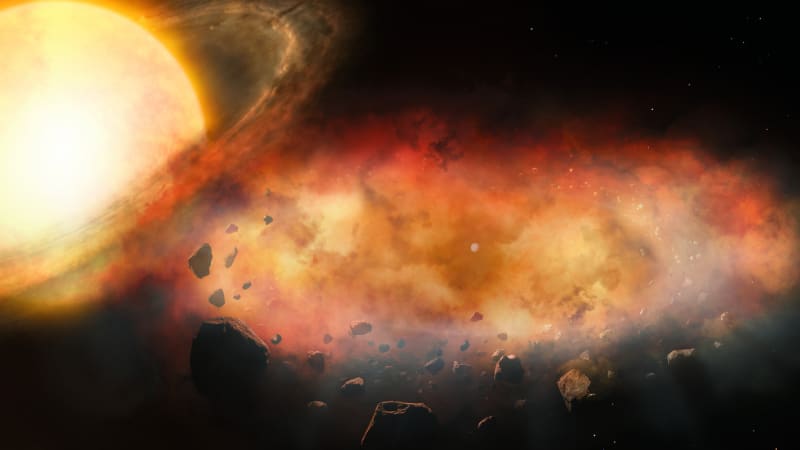
The most exciting part? This cloud likely formed when two planets smashed into each other, spraying debris across space.
That kind of catastrophic collision usually happens in young, chaotic planetary systems. But this star system is about 2 billion years old, proving that even mature cosmic neighborhoods can experience dramatic transformation.
"It's a vivid reminder that the universe is far from static," Zakamska explained. The cosmos continues its ongoing story of creation, destruction, and rebirth, reshaping worlds on timescales we're only beginning to understand.
This breakthrough gives scientists their first detailed look at how planets and their surrounding clouds behave in distant star systems, opening new windows into how worlds form and evolve across the universe.
More Images

Based on reporting by Space.com
This story was written by BrightWire based on verified news reports.
Spread the positivity!
Share this good news with someone who needs it