NASA Completes Telescope to Find 100,000 Alien Worlds
NASA just finished building its most powerful planet-hunting telescope yet, and it's launching ahead of schedule. The Roman Space Telescope could discover more worlds in five years than humanity has found in three decades.
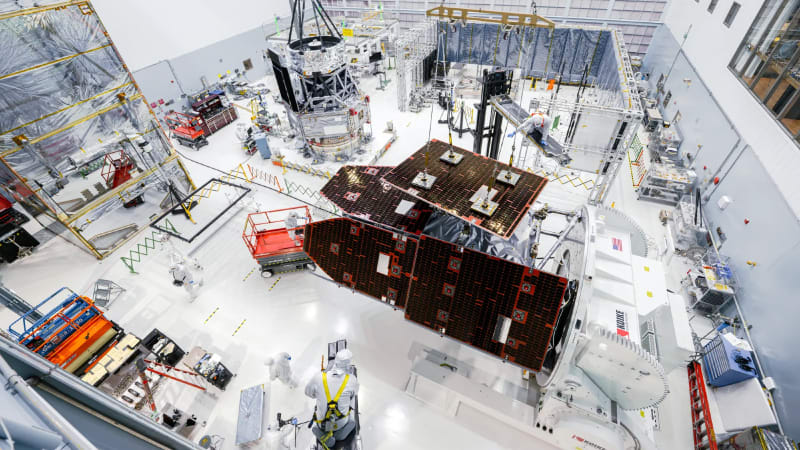
Scientists at NASA just unveiled the completed Nancy Grace Roman Space Telescope, a cosmic explorer ready to revolutionize our search for alien worlds. The telescope is launching later this year, possibly by late 2026, beating its original 2027 deadline.
Standing 42 feet tall in a Maryland clean room, Roman represents nearly a decade of careful construction that stayed within its $4.3 billion budget. It's named after Nancy Grace Roman, NASA's first chief astronomer, who blazed trails for space exploration in the 1960s.
Once launched, Roman will park itself a million miles from Earth alongside the James Webb Space Telescope. Six massive solar panels will power its mission to map stars, hunt planets, and solve cosmic mysteries like the nature of dark matter.
The telescope's secret weapon is a special instrument that blocks starlight, revealing planets that normally hide in the glare of their suns. This coronagraph technology could transform our ability to spot distant worlds that might harbor life.
Roman will spend at least 25% of its time creating the most detailed map ever made of the Milky Way's center. Its 288-megapixel camera can capture infrared light invisible to human eyes, photographing everything from our solar system's edge to the farthest galaxies.
Why This Inspires
Humanity has discovered roughly 6,000 exoplanets in 30 years of searching. Roman expects to find 100,000 more in just five years, along with hundreds of millions of new stars and billions of galaxies we've never seen before.
"The question of 'Are we alone?' is a big one," says Feng Zhao, who manages Roman's planet-finding instrument at NASA's Jet Propulsion Lab. This telescope brings us closer to answering it.
The mission will collect 20,000 terabytes of data, equivalent to 3,000 iPhones worth of cosmic information. Each photo will help scientists understand our universe and our place in it.
Roman won't replace existing telescopes like Hubble or Webb; it will work alongside them, giving humanity three powerful eyes watching the cosmos. Together, they'll reveal wonders we haven't yet imagined.
More Images


Based on reporting by Live Science
This story was written by BrightWire based on verified news reports.
Spread the positivity! 🌟
Share this good news with someone who needs it