NASA Discovers Rare Atmospheric Effect on Mars
NASA's MAVEN spacecraft detected a never-before-seen phenomenon inside Mars's atmosphere that could explain how the Red Planet lost its air. The Zwan-Wolf effect was caught squeezing Mars's atmosphere during a powerful solar storm in December 2023.
Scientists just watched Mars's atmosphere get squeezed by a force they've never seen working inside any planet's atmosphere before.
NASA's MAVEN spacecraft spotted something extraordinary during a solar storm in December 2023. The probe detected the Zwan-Wolf effect happening about 200 kilometers above Mars's surface, marking the first time this phenomenon has been observed inside a planetary atmosphere instead of just in surrounding space.
The discovery started when researchers noticed strange wiggles in their magnetic field measurements. After checking multiple instruments and ruling out other causes, they realized they were watching something new.
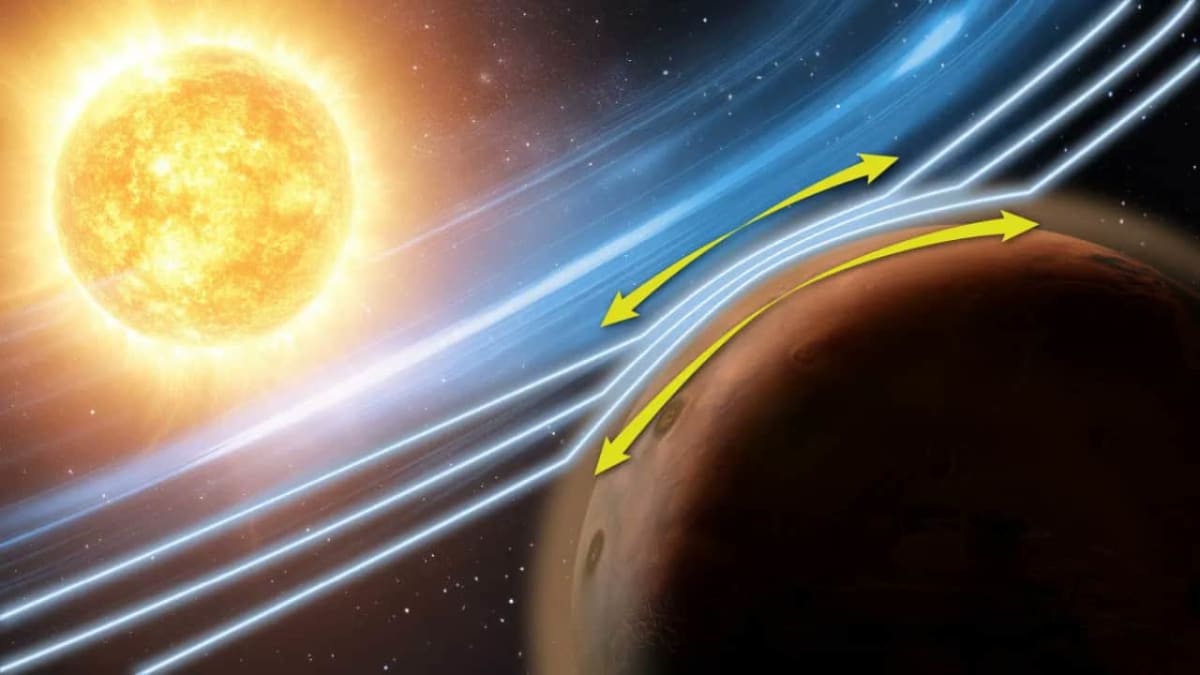
The Zwan-Wolf effect compresses charged particles along magnetic structures. On Earth, our global magnetic field uses this same effect to shield us from solar wind, but Mars lost its protective magnetic bubble long ago.
Without that shield, solar particles slam directly into Mars's thin atmosphere. During the December storm, scientists watched the effect squeeze and reshape the ionosphere in real time.
Why This Inspires
This discovery opens a window into Mars's past and future. Scientists believe the Zwan-Wolf effect might happen regularly on Mars but usually too subtly to detect.
Understanding how the Sun strips away Martian air helps answer one of the biggest questions about the Red Planet: where did all its atmosphere go? Mars likely had a thick atmosphere billions of years ago, possibly supporting liquid water on its surface.
The finding also matters for future Mars missions. Knowing how space weather reshapes the Martian atmosphere helps protect spacecraft and eventually astronauts who'll explore the planet.
MAVEN has orbited Mars since 2014, studying how the planet loses its atmosphere to space. This latest discovery shows that even well-studied worlds can still surprise us with new secrets.
Every puzzle piece brings us closer to understanding whether Mars once supported life and what happened to transform it into the cold desert world we see today.
Based on reporting by Google: NASA discovery
This story was written by BrightWire based on verified news reports.
Spread the positivity!
Share this good news with someone who needs it