NASA Shows Earth's True Gravity Shape: A Lumpy Potato
NASA released a stunning visualization showing what Earth would look like if shaped only by gravity and rotation. The result? Our planet resembles a lumpy potato with bumps and dips stretching across its surface.
Scientists have created the most detailed picture yet of Earth's gravitational personality, and it's delightfully imperfect.
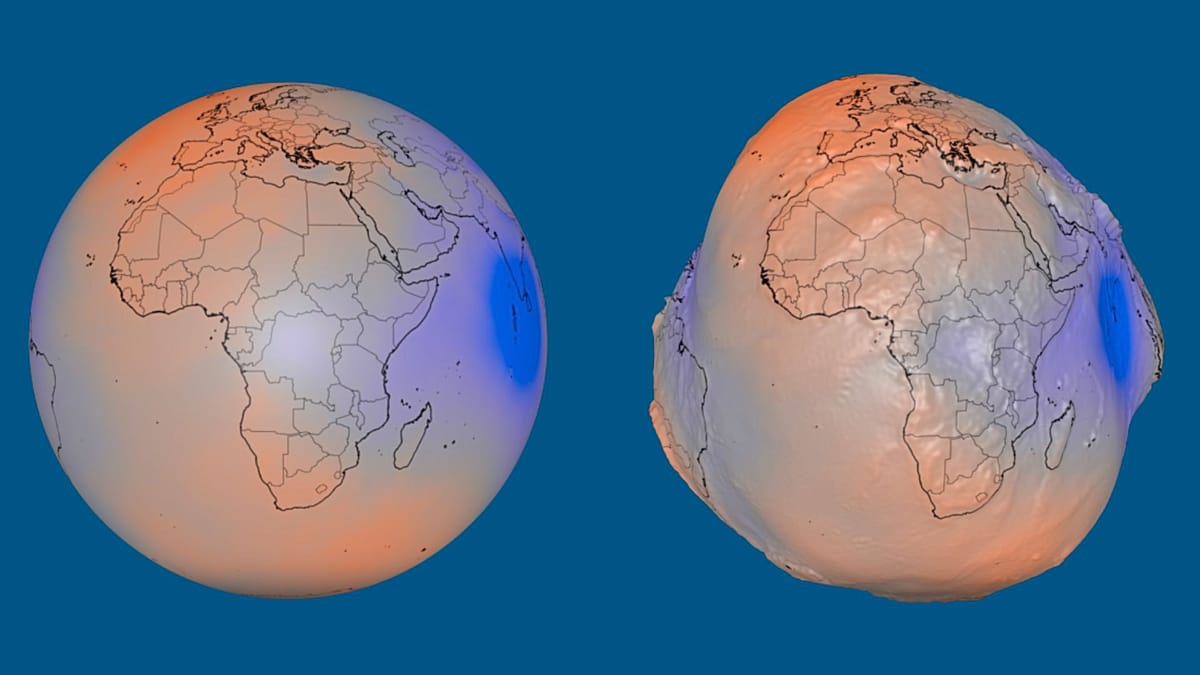
NASA released a mesmerizing visualization this summer showing the geoid, a model revealing how gravity actually shapes our planet. If you removed all ocean waves, winds, tides, and currents and let only gravity and Earth's rotation do their work, the water surface would form subtle bulges and valleys across the globe.
The visualization magnifies these differences by 10,000 times to make them visible, transforming our familiar blue marble into something resembling a cosmic potato. In reality, the variations are much gentler, with the highest point reaching 85 meters above the reference level near Iceland and the lowest dipping 106 meters below it south of India.
Why the lumps? Mass isn't distributed evenly throughout Earth. Mountains, ocean trenches, and differences in the density of materials inside our planet all tug on gravity differently, creating invisible peaks and valleys in the gravitational field.
This isn't just a pretty picture. Scientists spent 15 years gathering over one billion observations from 19 satellites, including NASA's Gravity Recovery and Climate Experiment and the European Space Agency's Gravity Field and Steady-State Ocean Circulation Explorer.
Why This Inspires
This visualization reminds us that imperfection makes things interesting. Just as no two snowflakes are identical, Earth has its own gravitational fingerprint shaped by billions of years of geological history.
Scientists use the geoid to track how water, ice, and other masses move around our planet as the climate changes. The data helps with everything from creating accurate maps to improving GPS navigation systems we use every day.
The fact that we can now measure Earth's gravitational bumps to within meters shows how far our technology has come. What once seemed impossible is now helping us understand and protect our home planet better than ever before.
Our wonderfully lumpy Earth continues revealing its secrets, one gravity measurement at a time.
More Images


Based on reporting by Euronews
This story was written by BrightWire based on verified news reports.
Spread the positivity!
Share this good news with someone who needs it