NASA Spacecraft Discovers New Physics Effect on Mars
Scientists using NASA's MAVEN spacecraft stumbled upon something never seen before: a physics phenomenon squeezing Mars' atmosphere like toothpaste from a tube. This discovery opens a whole new window into how space weather affects the Red Planet.
Scientists looking at Mars data in December 2023 discovered something completely unexpected: a physics effect that's never been observed in any planet's atmosphere before.
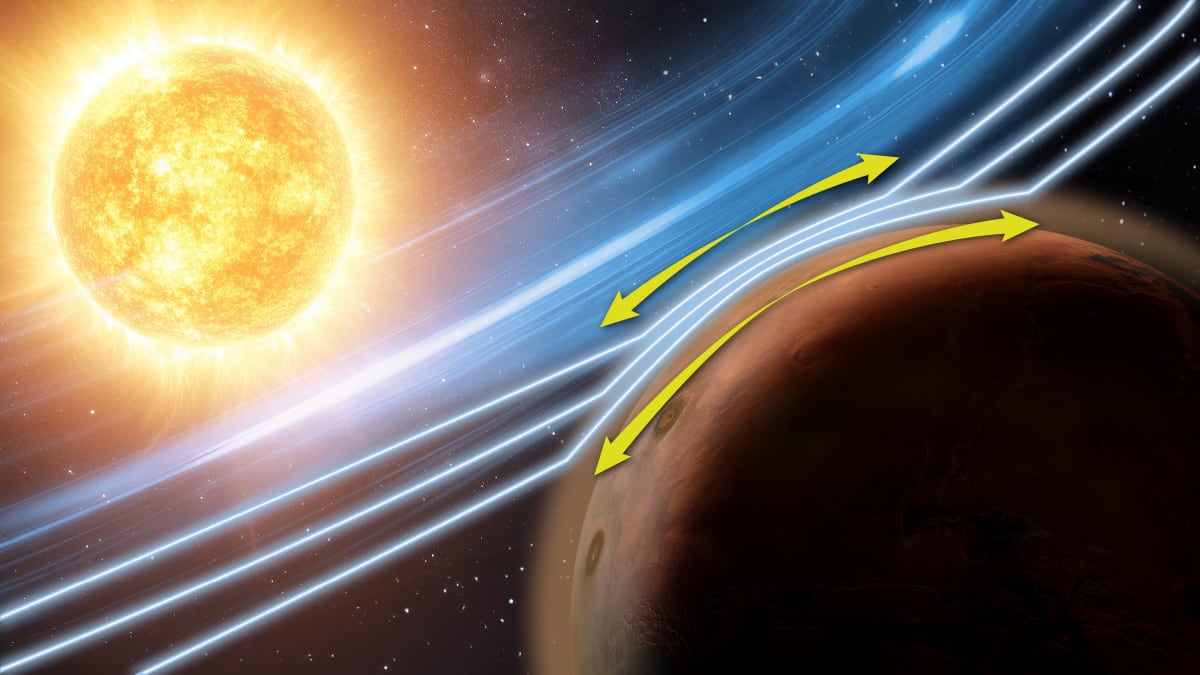
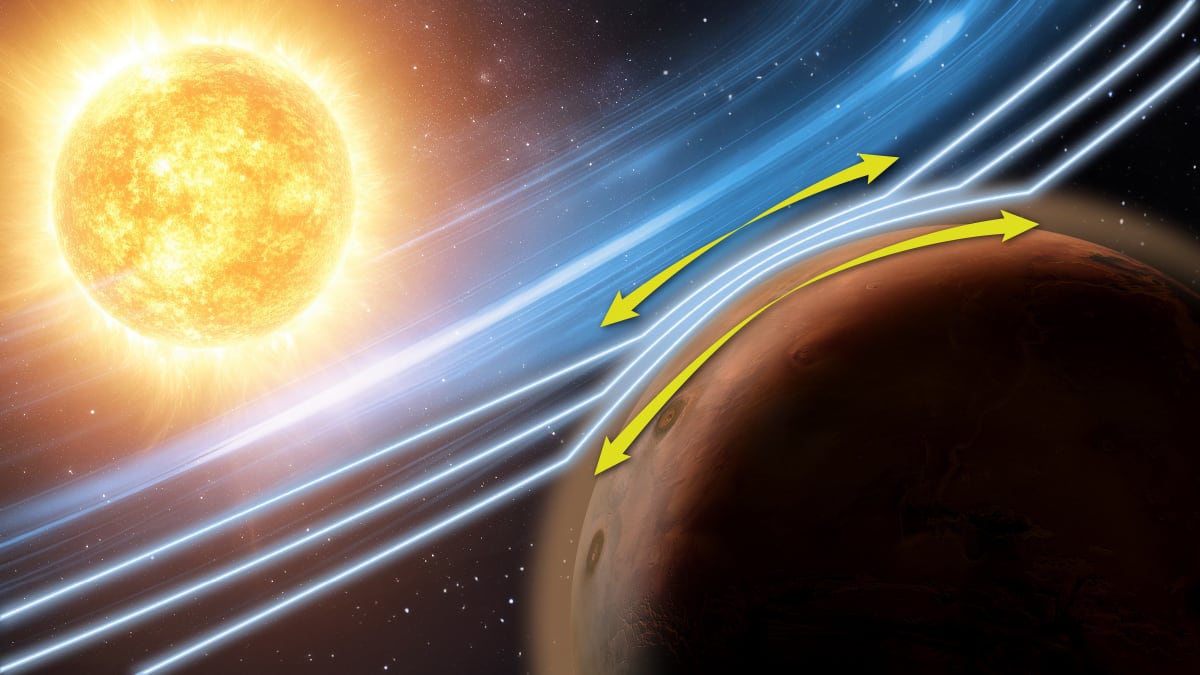
NASA's MAVEN spacecraft detected the Zwan-Wolf effect happening deep in Mars' atmosphere. This phenomenon squeezes charged particles along invisible magnetic structures, similar to how toothpaste gets pushed through a tube.
"When investigating the data, I all of a sudden noticed some very interesting wiggles," said Christopher Fowler, a research professor at West Virginia University who led the study. He never expected to find this effect in a planetary atmosphere.
The Zwan-Wolf effect was first discovered in 1976, but scientists had only seen it in protective magnetic bubbles around planets, never inside their actual atmospheres. Earth's magnetic field creates one of these bubbles, helping deflect dangerous solar wind away from our planet.
Mars doesn't have that same protection. Without a global magnetic field, the Red Planet interacts with space weather very differently than Earth does.
The discovery happened when a massive solar storm hit Mars. MAVEN's instruments picked up strange fluctuations in the magnetic field as the spacecraft flew through the atmosphere.
Fowler and his team dug through measurements from several instruments aboard MAVEN. After ruling out other possibilities, they identified the culprit: the Zwan-Wolf effect was squeezing and redistributing charged particles throughout Mars' ionosphere, deep within the atmosphere below 200 kilometers.
The solar storm appears to have amplified the effect enough for the instruments to detect it. Based on the findings published in Nature Communications, this squeezing effect might be happening constantly at Mars, just usually at levels too small to measure.
Why This Inspires
This discovery shows that even after studying Mars for decades, we're still finding surprises that challenge what we thought we knew. The MAVEN spacecraft has been orbiting Mars since 2014, quietly gathering data that continues revealing new secrets about our neighboring planet.
Understanding how space weather squeezes Mars' atmosphere helps scientists figure out why the planet lost most of its air over billions of years. That knowledge connects directly to the bigger question of whether Mars could have supported life in its watery past.
The discovery also matters for future Mars missions. Knowing how solar storms interact with the Martian atmosphere helps protect both robotic spacecraft and eventual human explorers from dangerous space weather events.
"The MAVEN team continues making new discoveries with our datasets and finding these links between our host star and the Red Planet," said Shannon Curry, MAVEN's principal investigator at the University of Colorado Boulder.
Scientists now have a completely new avenue to explore how the Sun shapes planetary atmospheres, not just at Mars but at similar unprotected worlds like Venus and Saturn's moon Titan.
Sometimes the most exciting discoveries come from noticing unexpected wiggles in the data.
More Images
Based on reporting by NASA
This story was written by BrightWire based on verified news reports.
Spread the positivity!
Share this good news with someone who needs it