New Dark Matter Map Reveals Hidden Cosmic Structures
Scientists created the most detailed map of dark matter ever made, using 250,000 galaxies to reveal mysterious structures never seen before. This breakthrough could finally help us understand what makes up 85% of the universe's matter.
Scientists just unveiled the most detailed portrait of the invisible universe, and it's showing us cosmic structures we never knew existed.
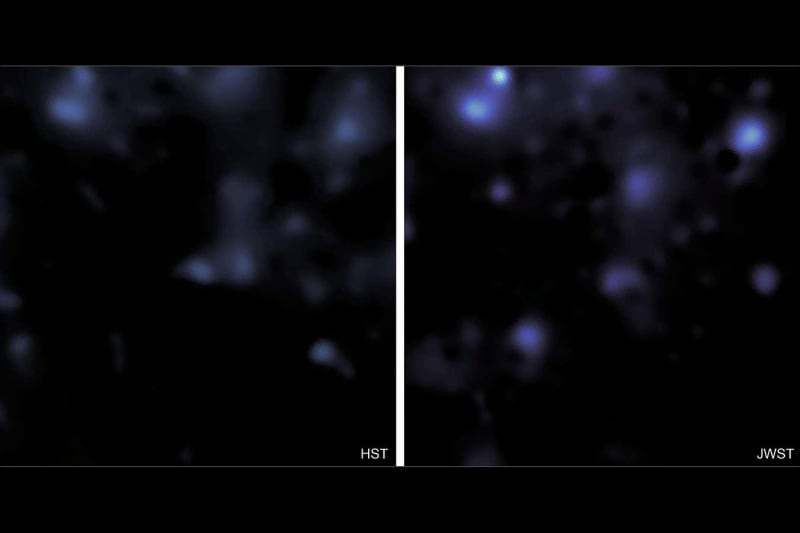
Researchers led by Jacqueline McCleary at Northeastern University used the James Webb Space Telescope to map dark matter across a patch of sky slightly larger than the full moon. The result is a high-resolution picture revealing the "scaffolding" of our universe with twice the clarity of previous attempts.
Dark matter earned its name honestly. It doesn't emit light we can detect, making it extraordinarily difficult to study despite making up 85% of all matter in the cosmos.
The team examined about 250,000 distant galaxies, but not for their beauty. They were looking at how gravity from dark matter warps and distorts the shapes of these galaxies as their light travels to us, a phenomenon called gravitational lensing.
Think of it like looking at a pebble through rippling water. The more distorted the galaxies appear from their natural circular shapes, the more dark matter sits between them and Earth.
The map revealed massive galaxy clusters connected by filaments forming a cosmic web. Some structures showed up in the dark matter map but had never been detected when scientists looked at regular, visible matter, proving these regions are dominated by the mysterious substance.
Why This Inspires
This breakthrough matters far beyond satisfying cosmic curiosity. Understanding how dark matter behaves and distributes itself across space is crucial to understanding how galaxies form, how they evolve, and how the universe itself expands.
The new map will help scientists test theories about dark energy, the mysterious force causing our universe to expand faster over time. It will reveal how galaxies grow within their dark matter "halos" and could finally answer fundamental questions about what dark matter actually is.
McCleary notes the map appears to match our current understanding of the universe, but deeper analysis is just beginning. "I'm withholding judgment until our analysis is finished," she says, hinting that surprises may still be waiting in the data.
Researchers outside the project are equally excited. Liliya Williams at the University of Minnesota calls gravitational lensing "definitely the best" technique for identifying these widespread structures across space.
We're finally getting a clear view of the invisible framework holding our universe together.
More Images



Based on reporting by New Scientist
This story was written by BrightWire based on verified news reports.
Spread the positivity!
Share this good news with someone who needs it